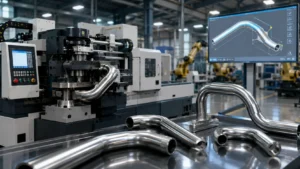
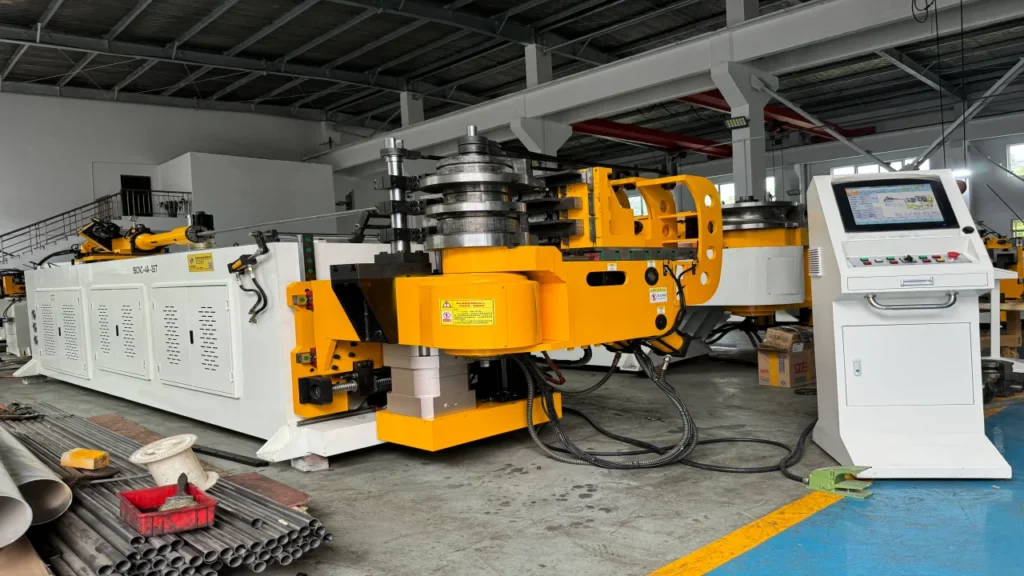
Large radius bending can refer to several different manufacturing processes. It may describe forming sheet metal with a broad inside radius, bending a tube or pipe to a long centerline radius, or rolling a structural profile into a continuous curve.
Because the term is broad, you should not choose a machine from the keyword or maximum diameter alone. Start with the finished part. Confirm the workpiece type, material, wall thickness, radius reference, bend angle, straight lengths, tolerance and production volume. Then compare step bending, roll bending, rotary draw bending and other suitable processes.
For tube and pipe projects, the most important question is usually not “How large is the radius?” but rather:
Which process can produce the required radius while maintaining the tube section, surface quality, repeatability and production output?
What Does “Large Radius Bending” Mean?
Large radius bending describes a bend or curve with a relatively large radius compared with the material thickness, tube diameter or profile size. However, there is no single radius value that defines every application.
| Workpiece | Important radius reference | Common process |
|---|---|---|
| Sheet or plate | Inside radius and material thickness | Step or bump bending, radius tooling |
| Round tube | Centerline radius, or CLR | Roll bending or rotary draw bending |
| Pipe | CLR, outside diameter and wall thickness | Roll, draw or induction bending |
| Square or rectangular tube | Inside radius, section orientation and corner radius | Profile rolling or dedicated tube tooling |
| Structural profile | Radius of the finished contour and section orientation | Profile rolling |
For sheet metal, large-radius bending is often associated with springback and multi-breakage during press-brake forming. For tubes and pipes, the result depends more directly on the relationship between outside diameter, wall thickness, material and centerline radius.
Therefore, your first step should be to define what the drawing means by “radius.” Is it the inside radius, outside radius, centerline radius or ring diameter?
Inside Radius, Outside Radius and CLR
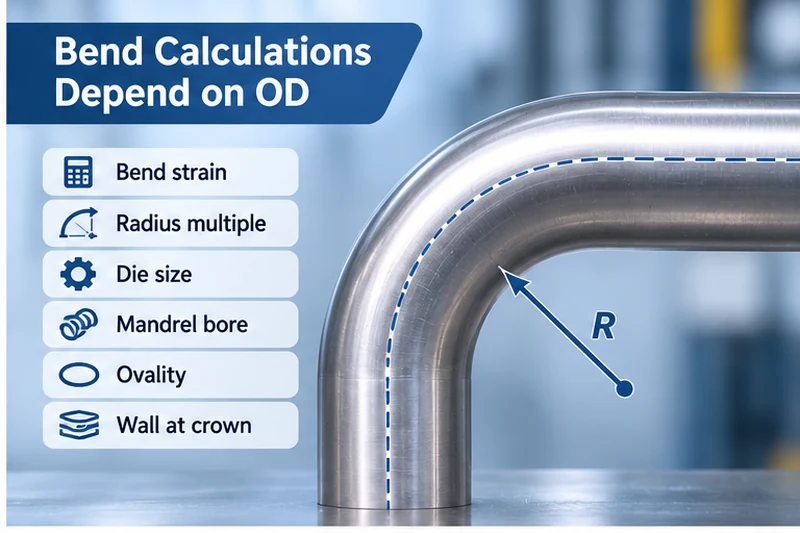
For round tubes, centerline radius is commonly used to define the bend geometry. CLR is measured from the bend center to the centerline of the tube.
For square and rectangular tubes, the drawing may use an inside radius or another profile reference. These references should not be treated as interchangeable.
Before you request a quotation, clarify:
- Inside radius;
- Outside radius;
- Centerline radius;
- Bend angle;
- Arc length;
- Straight-end length;
- Bend direction;
- Profile orientation.
If these values are unclear, different suppliers may interpret the same drawing differently.
Process Options for Large-Radius Forming
The correct forming process depends on the workpiece form and the required result. A process that works well for sheet metal may not be suitable for a thin-wall tube or a long structural profile.
Step or Bump Bending for Sheet and Plate
Step bending, also called bump bending, creates a large curve through a series of small bends. Instead of using one dedicated large-radius tool, the press brake forms the material at multiple positions.
The main variables include:
- Number of hits;
- Angle per hit;
- Pitch between hits;
- Material thickness;
- Punch and die geometry;
- Springback;
- Required surface smoothness.
More hits can produce a smoother curve, but they also increase cycle time. Fewer hits may be faster, but they can create visible faceting.
This method is mainly associated with sheet and plate forming. It should not be confused with tube roll bending.
Roll Bending for Tube, Pipe and Profiles
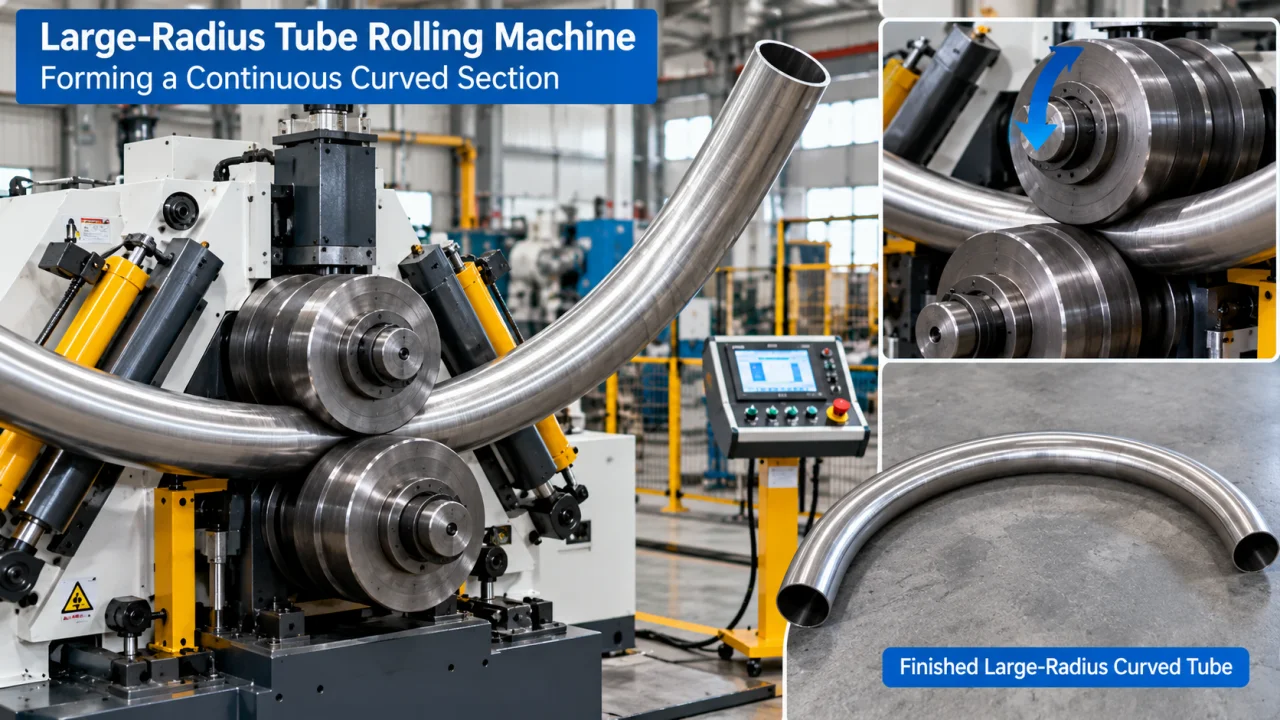
Roll bending progressively forms a tube or profile through rollers. It is commonly considered for:
- Long-radius tube curves;
- Arcs;
- Rings;
- Continuous sweeping sections;
- Round tube;
- Square and rectangular tube;
- Angle, flat and other structural profiles.
The roller arrangement and groove must match the workpiece. A round-tube roller is not automatically suitable for a rectangular tube or special profile.
Roll bending can be useful when a part has a long, gentle curve instead of several short, tightly controlled bends. However, the final result still depends on the material, wall thickness, profile shape, roller design and forming sequence.
You can review the broader selection factors in this tube rolling machine selection guide.
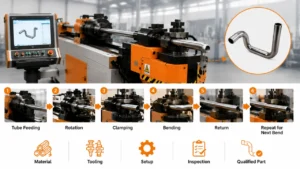
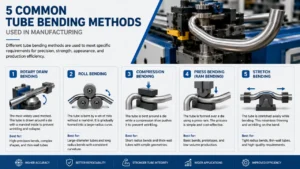
Rotary Draw Bending for Controlled Tube Geometry
Rotary draw bending is generally considered when the part requires:
- A defined centerline radius;
- Several bends in one tube;
- Different bend planes;
- Controlled bend positions;
- Repeatable production;
- Dedicated tooling for a specific tube size and radius.
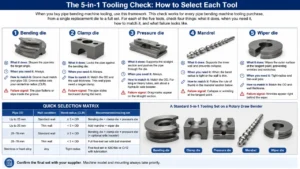
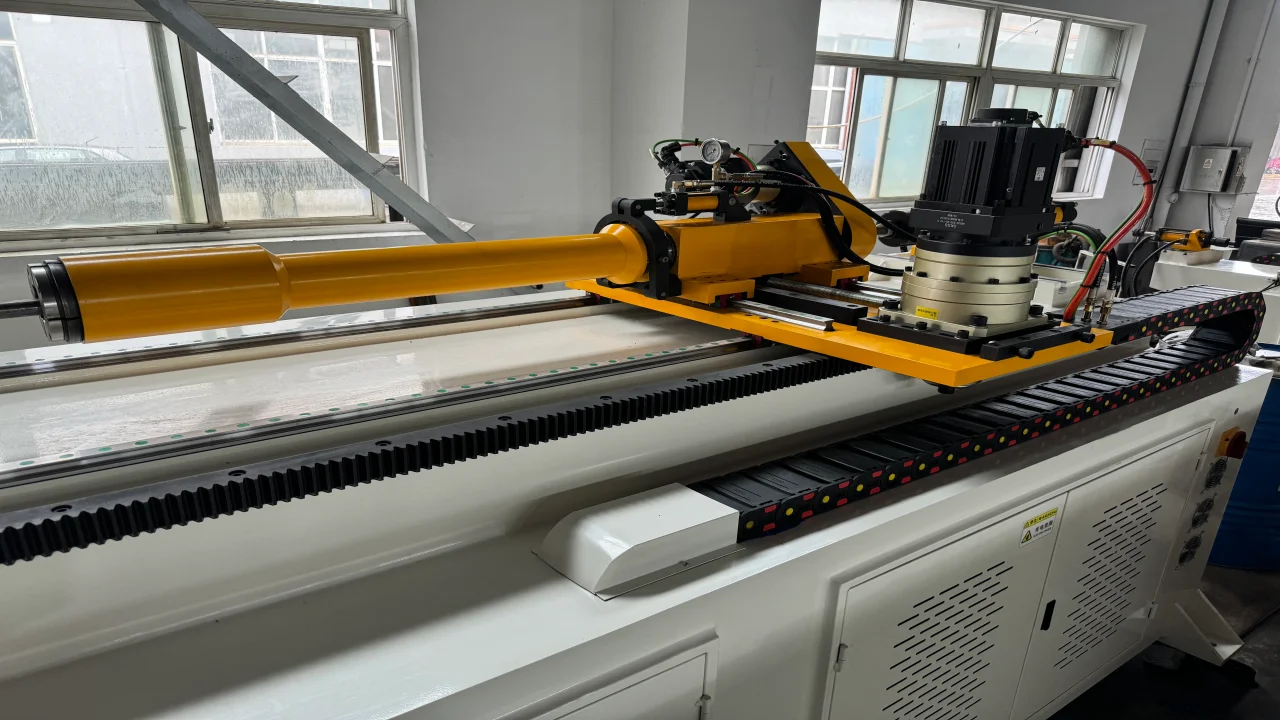
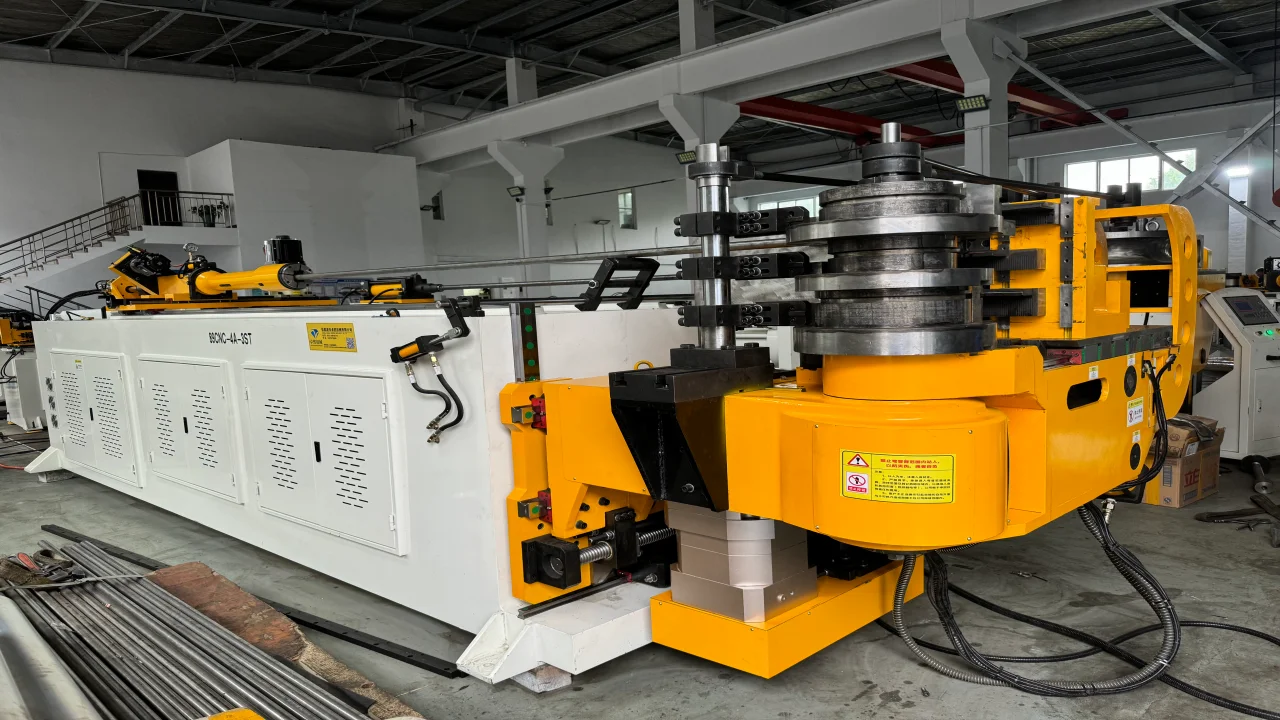
The tooling may include a bend die, clamp die, pressure die, mandrel and wiper die, depending on the tube geometry and quality requirements.
Rotary draw bending is not automatically the best option for every large-radius tube. If the radius is very large and the part is mainly one continuous arc, the tooling may become unnecessarily large or costly. In that case, roll bending may be a more practical starting point.
Other Processes for Special Applications
Some projects may require:
- Press bending;
- Induction bending;
- Push bending;
- Mandrel-assisted bending;
- Segmented bends and welding.
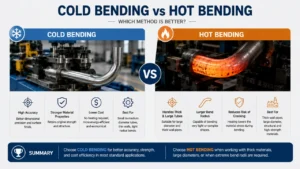
These methods are selected according to the pipe size, wall thickness, material, required radius, heat treatment, tolerances and production environment.
Do not select a process only because it is commonly used in your industry. Compare the complete part requirement with the actual process limits.
When Should You Choose Roll Bending Instead of Rotary Draw Bending?
Choose roll bending when the part requires a long, sweeping curve, ring or arc. Choose rotary draw bending when you need a controlled CLR, multiple bends, defined bend positions or different bend planes.
| Part requirement | Starting process to evaluate |
|---|---|
| Long, gentle tube curve | Roll bending |
| Ring or continuous arc | Roll bending |
| Square or rectangular profile | Profile-specific roll bending |
| Several fixed-radius bends | Rotary draw bending |
| Different bend planes | CNC rotary draw bending |
| Tight radius and thin wall | Mandrel-assisted rotary draw bending |
| Large-diameter or heavy-wall pipe | Project-specific evaluation |
| Sheet-metal broad curve | Step or bump bending |
This is a starting point, not a universal rule. A part with both a tight bend and a sweeping curve may require a combined process or special machine configuration.
For more information about defined-radius tube forming, see the rotary draw bending guide or compare it with rotary draw vs roll bending.
What Information Determines Whether a Large-Radius Tube Bend Is Feasible?
A supplier needs more than the tube diameter to assess a large-radius tube bending project.
Material and Material Condition
Provide the exact material grade whenever possible. Different materials respond differently to forming force, springback, surface contact and work hardening.
Common examples include:
- Carbon steel;
- Stainless steel;
- Aluminum alloy;
- Copper;
- Brass;
- Galvanized steel;
- Titanium alloy;
- High-strength alloy steel.
Also provide the material condition when it affects forming behavior. For example, heat-treated aluminum and high-strength alloys may require a different process window from annealed material.
Tube or Profile Dimensions
For a round tube, provide:
- Outside diameter;
- Wall thickness;
- Diameter tolerance;
- Tube length;
- Weld seam information, if relevant;
- Surface condition.
For square or rectangular tube, provide:
- Outside width;
- Outside height;
- Wall thickness;
- Corner radius;
- Bending direction;
- Profile orientation.
For a special profile, include a section drawing or 3D model. The roller groove must match the actual cross-section.
Radius and Bend Geometry
State the target:
- Centerline radius;
- Inside radius;
- Outside radius;
- Ring diameter;
- Bend angle;
- Arc length;
- Straight-end length;
- Distance between bends;
- Bend sequence;
- Bend plane or rotation angle.
For a three-dimensional tube part, also provide the tube-end orientation and the rotation angle between bends.
Tolerance and Surface Requirements
Define the required limits for:
- Radius;
- Bend angle;
- Bend position;
- Straight length;
- Tube-end position;
- Ovality;
- Flattening;
- Wall thinning;
- Wrinkles;
- Scratches;
- Dents;
- Surface finish.
A structural tube may tolerate more section deformation than a tube used for fluid flow or precision assembly. The acceptance criteria should therefore come from the product drawing and application.
How Do Material, Wall Thickness and CLR Affect the Result?
Material, wall thickness and radius work together. You should not evaluate any one of them in isolation.
Material Strength and Springback
Higher-strength materials may require more forming force and may show stronger springback. Stainless steel can also work-harden during forming. Aluminum may require additional attention to surface protection and handling.
The final compensation value should be established through representative trials whenever the part has strict dimensional requirements. Avoid using one universal over-bend value for every material and radius.
Wall Thickness and Section Stability
A thin-wall tube has less resistance to local deformation. Depending on the radius and material, it may be more sensitive to:
- Ovality;
- Flattening;
- Wall thinning;
- Wrinkles;
- Local buckling;
- Surface damage.
A thick-wall tube may maintain its section more easily, but it can require greater forming force and more robust equipment.
The useful comparison is not wall thickness alone. You should consider the relationship between outside diameter and wall thickness.
CLR/OD and Bend Severity
The ratio between CLR and tube OD helps describe how tight or gentle the bend is.
A smaller CLR/OD ratio generally represents a more severe bend. It may require more support, more specialized tooling and tighter process control.
A larger CLR/OD ratio often reduces local deformation, but it does not eliminate all risks. Long arcs, thin walls, unusual profiles and strict surface requirements still require engineering review.
For projects involving larger tube diameters, see Zhuoran’s guide to large diameter tube bending.
Tooling and Machine Configuration for Large Radius Bending
Rollers and Profile-Specific Tooling
For tube and profile rolling, the roller groove should match:
- Tube outside diameter;
- Profile width and height;
- Corner radius;
- Wall thickness;
- Material;
- Target radius;
- Surface requirement.
Incorrect roller geometry can cause:
- Slipping;
- Twisting;
- Pressure marks;
- Local flattening;
- Corner collapse;
- Uneven curvature.
For this reason, roller information should be included in the quotation rather than treated as an afterthought.
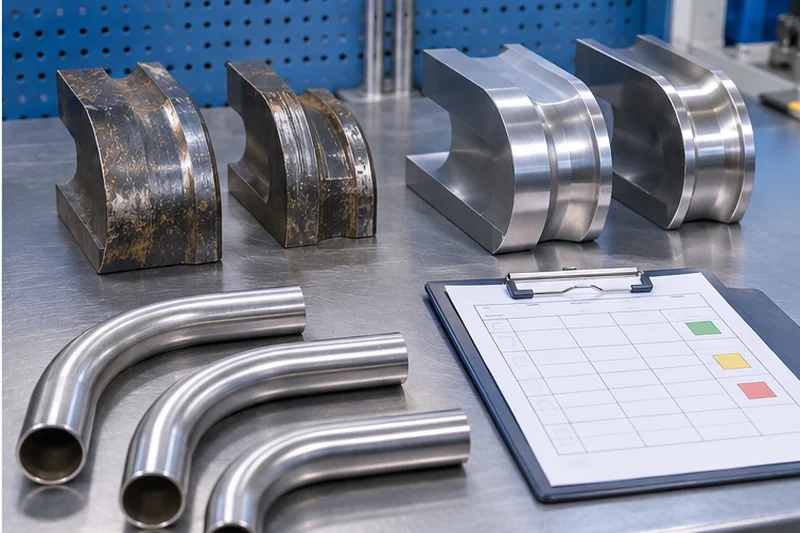
Bend Die, Pressure Die, Mandrel and Wiper Die
These tools are mainly associated with rotary draw bending and other supported tube-bending processes.
- The bend die establishes the radius.
- The clamp die holds the tube.
- The pressure die supports and pushes the tube.
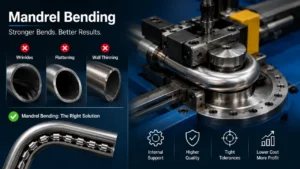
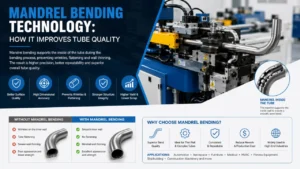
- The mandrel supports the inside of the tube.
- The wiper die helps control wrinkles near the tangent area.
A large-radius, thick-wall structural tube may not require the same internal support as a thin-wall tube with a tighter radius. Tooling should be selected from the actual geometry and acceptance criteria.
For a broader explanation of these components, see the pipe bending machine tooling guide.
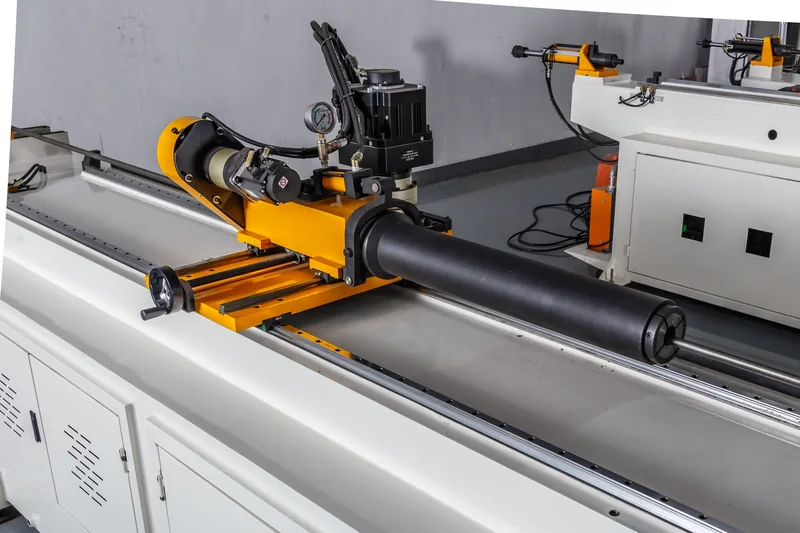
NC, Hydraulic and CNC Control
These terms describe different parts of a machine:
- Hydraulic usually refers to the forming drive or force system.
- NC refers to numerical control with programmed settings.
- CNC generally provides a higher level of programmable coordination and repeatability.
CNC can be more valuable when you need:
- Multiple programs;
- Repeating production;
- Multiple radii;
- Complex tube geometry;
- Automatic positioning;
- Data recording;
- Production-line integration.
The exact number of controlled axes and automation functions must be confirmed for the selected machine model.
Depending on the selected model and project requirements, automation functions may be configured individually or combined into a production line. Possible functions include:
- Automatic loading;
- Automatic feeding;
- Tube rotation;
- Cutting;
- Automatic unloading;
- Robotic handling;
- Inline inspection;
- NG sorting;
- PLC/HMI line control.
These functions should be listed separately as standard, optional or project-customized items.
How Can You Prevent Ovality, Wall Thinning, Wrinkles and Springback?
In large-radius forming the four defects behave differently from a tight draw: ovality comes from roller groove fit and local pressure, thinning from how much deformation is taken in one pass, wrinkles from a forming sequence that packs too much into a single pass, and springback from the material’s elastic recovery over a long arc. Measure the section before and after each pass rather than judging it by eye. The defect-by-defect causes and controls are in defect triage for bent tubes.
How Should You Evaluate Capacity and Finished-Part Quality?
Cycle Time Is Not the Same as Qualified Output
Machine movement speed does not equal finished-good output.
A realistic capacity calculation should include:
- Loading;
- Positioning;
- Forming;
- Unloading;
- Inspection;
- Sorting;
- Tooling changes;
- Planned stops;
- Unplanned stops;
- Rework and scrap.
For this reason, ask the supplier to provide a cycle-time estimate based on the complete part, not only the forming movement.
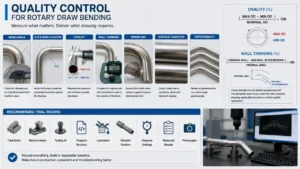
Define Measurable Acceptance Criteria
Your acceptance checklist may include:
- Final radius or contour;
- Bend angle;
- Bend position;
- Straight-end length;
- Tube-end position;
- Profile shape;
- Ovality;
- Wall thinning;
- Wrinkles;
- Cracks;
- Scratches and dents;
- Repeatability;
- Safety functions;
- Qualified output.
The inspection method should also be defined. Depending on the part, this may include calipers, dedicated gauges, angle measurement, CMM, laser scanning, ultrasonic thickness measurement or section inspection.
Use a Sample Trial Before Final Purchase
A sample trial is especially useful when the project involves:
- New material;
- Thin-wall tube;
- Special profile;
- Unusual radius;
- Strict surface requirements;
- Tight dimensional tolerances;
- High production volume;
- Complex automation.
Record the following:
- Material and grade;
- Tube or profile dimensions;
- Wall thickness;
- Target radius;
- Tooling configuration;
- Sample quantity;
- Qualified quantity;
- Cycle time;
- Defects;
- Inspection results;
- Final acceptance decision.
Large Radius Bending RFQ Checklist
A complete RFQ should include the following information:
| RFQ item | What to provide | Why it matters |
|---|---|---|
| Material | Grade and material condition | Affects forming force and springback |
| Tube or profile size | OD, width, height and wall thickness | Determines machine and tooling range |
| Radius | CLR, inside or outside radius | Defines the forming geometry |
| Bend angle | Degree or arc length | Defines forming travel |
| Straight lengths | Tangent and end lengths | Affects clamping and handling |
| Cross-section | Round, square, rectangular or special profile | Determines roller or die shape |
| Tolerance | Radius, angle, position and profile limits | Defines inspection requirements |
| Surface requirement | Marks, scratches and dents | Determines tooling and handling |
| Production quantity | Daily or monthly output | Affects control and automation |
| Sample requirement | Quantity and acceptance criteria | Defines pre-purchase validation |
| Installation conditions | Power, floor space and access | Affects machine installation |
| Commercial scope | Tooling, training, warranty and delivery | Prevents quotation disputes |
Do not send only:
Tube diameter + desired radius + quantity
That information is usually insufficient for a reliable machine and tooling recommendation.
What Should You Send to Zhuoran for a Machine Recommendation?
Send a 2D drawing or 3D STEP file together with:
- Material grade;
- Material condition;
- Tube OD or profile dimensions;
- Wall thickness;
- Target CLR or radius reference;
- Bend angle;
- Arc length;
- Straight lengths;
- Bend sequence;
- Profile orientation;
- Surface requirements;
- Dimensional tolerances;
- Production target;
- Sample quantity;
- Inspection and acceptance requirements.
For a tube bending project, Zhuoran can review the machine family, tooling arrangement, control configuration, automation requirements and sample-trial conditions based on the actual part.
For a profile rolling project, also provide:
- Profile width;
- Profile height;
- Corner radius;
- Bending direction;
- Target radius;
- Surface requirements;
- Cross-section drawing.
The final machine model, roller set, tooling package, automation scope and acceptance criteria should be confirmed through technical evaluation and, where necessary, a sample trial.
You can also review the CNC pipe bending machine product range when your project requires controlled tube positioning, repeat production or multi-bend geometry.
Common Questions About Large Radius Bending
What is the difference between large radius bending and large diameter tube bending?
Large radius bending describes the geometry of the curve. Large diameter tube bending describes the size of the tube cross-section. A tube can have a large diameter and a tight radius, or a small diameter and a large radius. Machine selection should consider both OD and radius, together with wall thickness, material and tooling.
Is roll bending better for large-radius tube curves?
Roll bending is often a practical starting point for long, sweeping curves, rings and continuous arcs. However, the final choice depends on the tube material, wall thickness, profile shape, surface requirement and tolerance. A sample trial may be needed when the section must remain highly accurate.
Does a large-radius tube bend always need a mandrel?
No. A thick-wall tube with a large radius may not require the same internal support as a thin-wall tube with a tighter radius. A mandrel becomes more important when the project has strict ovality, wall-thickness or surface requirements. The decision should be based on the actual drawing and sample result.
Can square and rectangular tubes be roll-bent?
Yes, when the machine, roller groove, profile orientation and target radius are suitable. Square and rectangular tubes require different tooling from round tubes. The supplier should evaluate twisting, corner deformation, flattening and surface marks before confirming the configuration.
What should I include in a large-radius bending RFQ?
Include the material grade, tube OD or profile dimensions, wall thickness, radius reference, bend angle, arc length, straight lengths, tolerance, surface requirements, production volume and sample requirements. A 2D drawing or 3D STEP file will make the evaluation more reliable.
Conclusion: Start with the Finished Part
Large radius bending is not one universal process. Sheet metal, round tube, pipe and structural profiles may require different forming methods, tooling and inspection procedures.
For tube and pipe projects, start with:
- Material and grade;
- OD or profile dimensions;
- Wall thickness;
- CLR or radius reference;
- Bend angle;
- Arc length;
- Straight lengths;
- Tolerance;
- Surface requirements;
- Production volume.
Then compare roll bending, rotary draw bending and other suitable processes. Confirm the roller or die configuration, control system, automation scope and sample-trial requirements before finalizing the machine.
If you are evaluating a large-radius tube, pipe or profile bending project, send Zhuoran your drawing, material information, target radius and production requirements for a machine and tooling review.