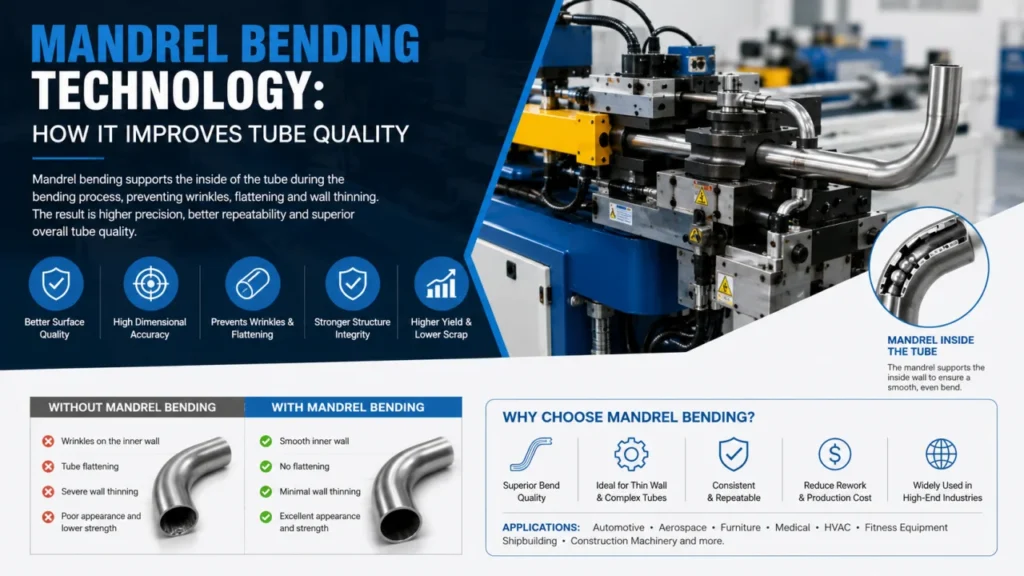
Thin-wall tubes and tight radius bends cause real problems in tube processing. You may have seen wrinkling on the inner radius, oval cross-sections, or wavy surfaces that ruin finished parts. These defects drive up scrap rates and stall production lines. Mandrel bending solves this by supporting the tube from the inside during the bend. In this guide, you will learn what mandrel bending is, how it protects tube quality, when you actually need it, and how to choose the right equipment for your shop.
What Is Mandrel Bending?
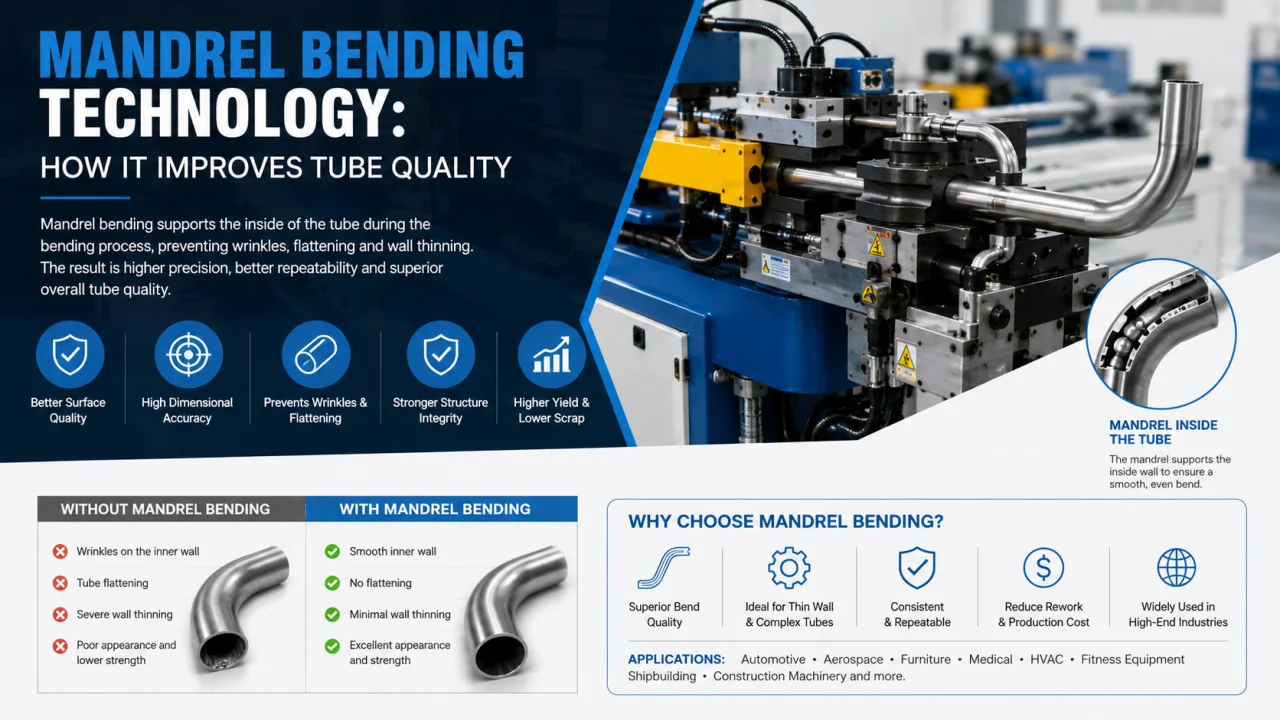
Mandrel bending is a tube forming method widely used in industrial manufacturing. A solid rod, called a mandrel, is inserted into the tube before bending. It stays inside the tube and supports the wall at the point of deformation. This internal support prevents the tube from collapsing or wrinkling when the bending force is applied. You will see this method everywhere, from furniture frames to aerospace lines.
How a Mandrel Supports the Tube From Inside
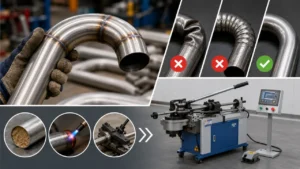
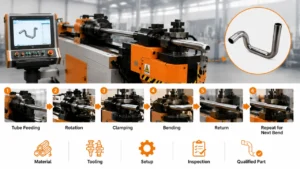
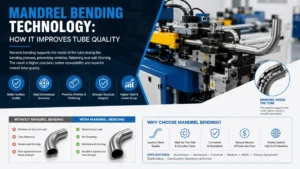
When a tube bends, the outer wall stretches and the inner wall compresses. Without support, the inner wall can wrinkle and the cross-section can flatten. A mandrel sits inside the tube and follows the bend curve. It holds the wall in place as the bending die rotates around the tube. The result is a smooth, round bend with a consistent cross-section. If you bend thin-wall tubes, you already know how easily quality can slip. That is why mandrel bending is the standard choice for demanding tube processing work.
Mandrel Balls, Wiper Die and Pressure Die: A Coordinated Tooling System
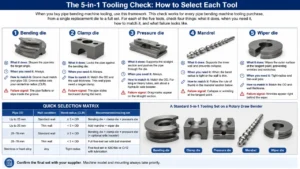
Mandrel bending is not a single tool. It is a coordinated system. The mandrel itself may carry several hinged balls that follow tight radii. A wiper die sits behind the bend point to prevent wrinkling on the inner radius. A pressure die holds the tube against the bend die and controls wall movement. These three elements work together during every cycle. When one part of the system is not matched, quality drops. This is why many manufacturers now source the complete tooling package from one supplier. For more detail, see The Fabricator’s guide to selecting the right mandrel and wiper.
How Mandrel Bending Improves Tube Quality
Mandrel bending improves tube quality in four measurable ways. Each one attacks a specific defect that empty bending cannot fully control.
Preventing Wrinkling on the Inner Radius
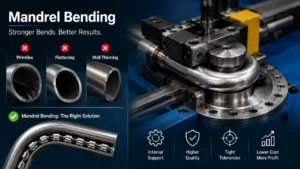
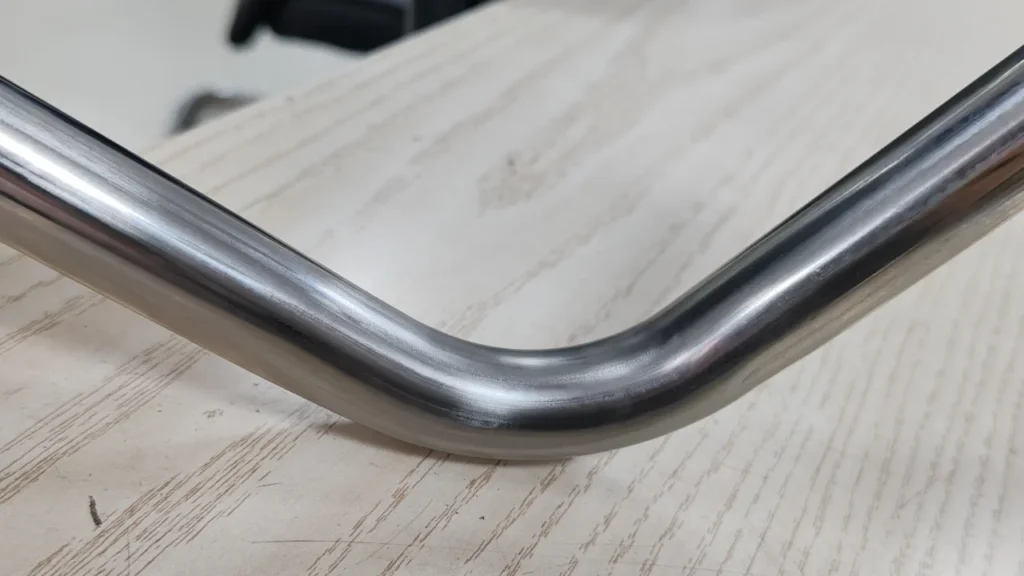
Wrinkling happens when the inner wall of the tube has no support during compression. The mandrel, together with the wiper die, keeps this wall stable. With mandrel bending, you can bend thin-wall tubes at much smaller radii without the telltale ripples. For furniture frames, handrails, and exhaust pipes, this visual quality matters as much as dimensional accuracy.
Controlling Collapse and Ovalization
When a tube flattens during a bend, you get an oval cross-section instead of a round one. Ovalization creates problems downstream. Fittings do not seal. Assemblies do not align. Pressure ratings drop. As a result, mandrel bending holds the tube open from the inside, so the cross-section stays close to its original shape. This is essential for hydraulic lines and structural applications where roundness is a requirement.
Reducing Wall Thinning and Cracking
The outer wall of a tube stretches during bending. With thin material, this stretch can thin the wall beyond tolerance or even crack it. In mandrel bending, a properly positioned mandrel redistributes the strain and limits thinning. You can bend high-strength and thin-wall materials with lower scrap rates. Aerospace and automotive suppliers rely on this control every day.
Improving Consistency and Surface Finish
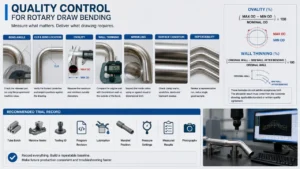
Repeatability is where mandrel bending shines. When the mandrel position, feed, and bending angle are CNC-controlled, every part comes out the same. Surface finish stays clean because the supported wall does not chatter or scrape. You can run long production batches with confidence. Consistency like this reduces inspection time and rework across your tube processing line.
Defect Map: Common Tube Bending Defects and How the Mandrel Solves Them
| Defect | Main Cause | How the Mandrel Helps | What to Check on Your Machine |
|---|---|---|---|
| Wrinkling | Inner wall compression without support | Mandrel plus wiper die stabilize the inner radius | Mandrel position, wiper die clearance |
| Collapse / Ovalization | Cross-section flattening under force | Mandrel holds the tube open from inside | Mandrel diameter, number of balls |
| Wall thinning / Cracking | Outer wall stretching beyond limits | Mandrel redistributes strain across the bend | Mandrel advance, bend speed |
| Waviness / Poor finish | Wall movement and vibration | Supported wall bends smoothly without chatter | Tooling alignment, lubrication |
When Do You Need Mandrel Bending?
Wall Thickness to Diameter Ratio (t/D)
A common industry guideline is the wall factor, or t/D ratio. It compares wall thickness to the outside diameter of the tube. Thick-wall tubes with a high t/D ratio bend well without a mandrel. Thin-wall tubes with a low t/D ratio need internal support. If your tube wall is thin relative to its diameter, you should plan for a mandrel. As a rule of thumb, when t/D drops below about 0.05, mandrel bending is usually recommended. The Fabricator’s tube bending guides describe this ratio in practical terms for shop floor use.
Bend Radius to Diameter Ratio (R/D)
The second factor is the centerline bend radius divided by the tube diameter, or R/D. Large radii put less stress on the tube wall. Tight radii put much more. You can check this ratio in minutes with a caliper and a drawing. In general, when the bend radius is less than about twice the tube diameter (R/D below 2), a mandrel is often required. When R/D is above 3, empty bending can often handle the job. Between these values, the wall thickness decides whether mandrel bending is necessary.
A Practical Decision Matrix
Use this simple matrix to judge your own parts. Check the t/D ratio of your tube first. Then check the R/D ratio of the bend. The combination tells you which bending method fits. In practice, these two numbers remove most of the guesswork from process planning.
| t/D Ratio | R/D ≥ 3 | 2 < R/D < 3 | R/D ≤ 2 |
|---|---|---|---|
| High (thick wall) | Empty bending | Empty or mandrel | Mandrel recommended |
| Medium | Empty or mandrel | Mandrel recommended | Mandrel required |
| Low (thin wall) | Mandrel recommended | Mandrel required | Mandrel required |
Note: these are practical guidelines, not fixed standards. Always verify with a sample bend. A reputable supplier will confirm tooling and process with a test piece before you commit.
Mandrel Bending vs. Empty Bending
Quality and Appearance
Empty bending pushes the tube around the die without internal support. It is fast and simple. However, the inner wall can wrinkle and the cross-section can flatten on thin material. Mandrel bending protects the inner radius and keeps the profile round. If your finished part is visible or must seal, mandrel bending gives you the cleaner, more reliable result.
Cost and Efficiency
However, mandrel bending costs more per setup. You need the mandrel itself, matching wiper and pressure dies, and more careful adjustment. In comparison, empty bending saves this cost when conditions allow. But compare the real numbers. If empty bending raises your scrap rate by a few percent, the tooling cost pays for itself quickly. Run the math for your batch size and material value before you decide.
When Empty Bending Is Good Enough
Empty bending still has a place. Thick-wall tubes, large bend radii, and simple profiles bend fine without a mandrel. If your parts tolerate minor ovalization and your scrap rate stays low, you may not need mandrel bending at all. Many shops use both methods side by side. The key is knowing when each one is appropriate. A decision matrix like the one above removes the guesswork.
Mandrel Tooling: The System Behind the Quality
Plug Mandrels vs. Ball Mandrels
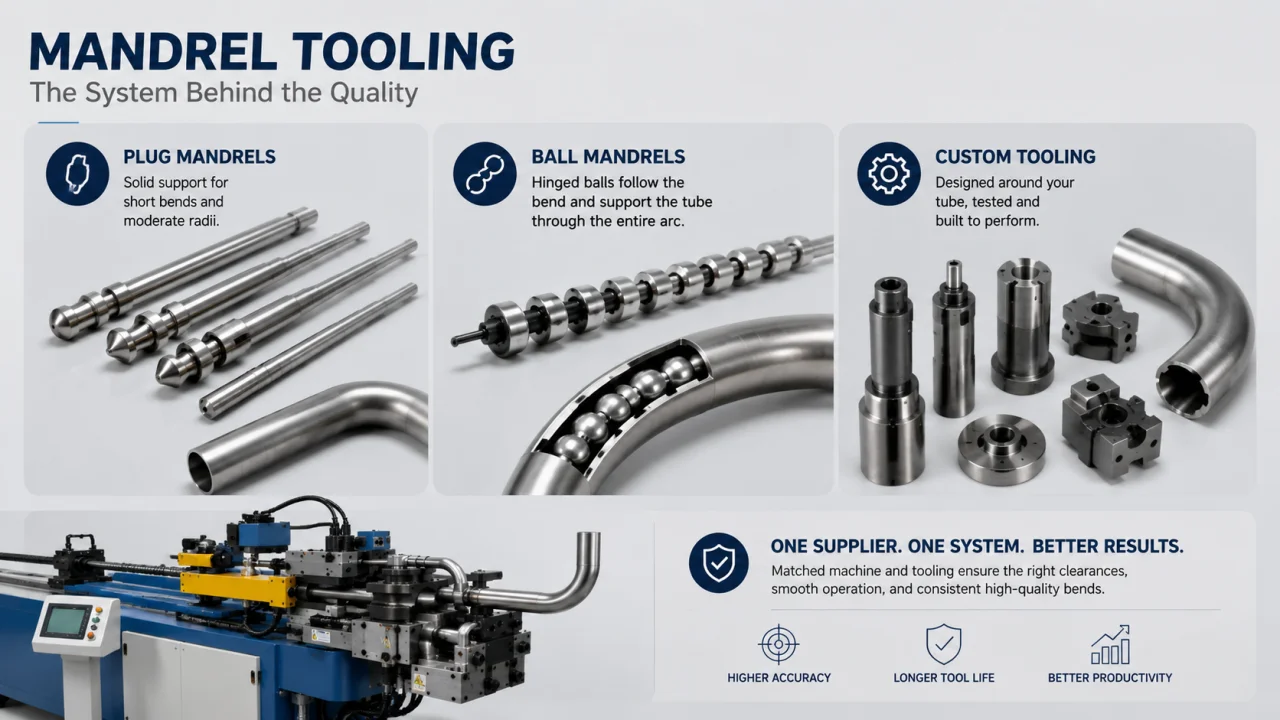
Plug mandrels are solid rods with a shaped nose. They suit short bends and moderate radii. Ball mandrels carry a chain of hinged balls behind the nose. They follow the bend curve and support the wall all the way through the arc. For tight radii and thin walls, ball mandrels deliver the support you need. Your tube diameter, wall thickness, and bend angle decide which one fits your parts. See mandrel tooling reference material for typical tooling configurations.
Why Tooling and Machine Should Come From One Supplier
Tooling quality determines bend quality. When the mandrel, wiper die, and pressure die come from the same manufacturer as the machine, the whole system is matched. Dimensions, clearances, and materials are designed to work together. In short, you get a verified package instead of mixing parts from different sources. Zhangjiagang Zhuoran Machinery manufactures its own mandrel tooling and supplies it with every CNC pipe bending machine.
Custom Tooling for Special Profiles
Standard tooling covers most round tubes. Special profiles need custom mandrels and dies. A good supplier designs tooling around your tube OD, wall thickness, and bend radius. They machine the tooling, test it, and adjust it until the sample passes. This is where a complete in-house tooling capability saves weeks of trial and error.
How to Choose a Mandrel Bending Machine
CNC Axes and Multi-Stack Tooling
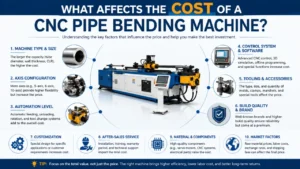
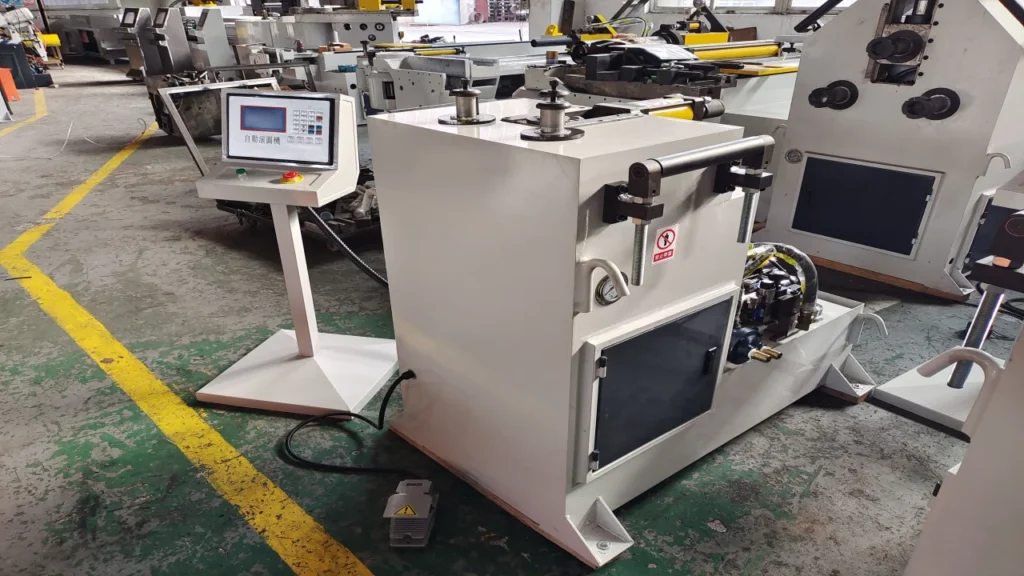
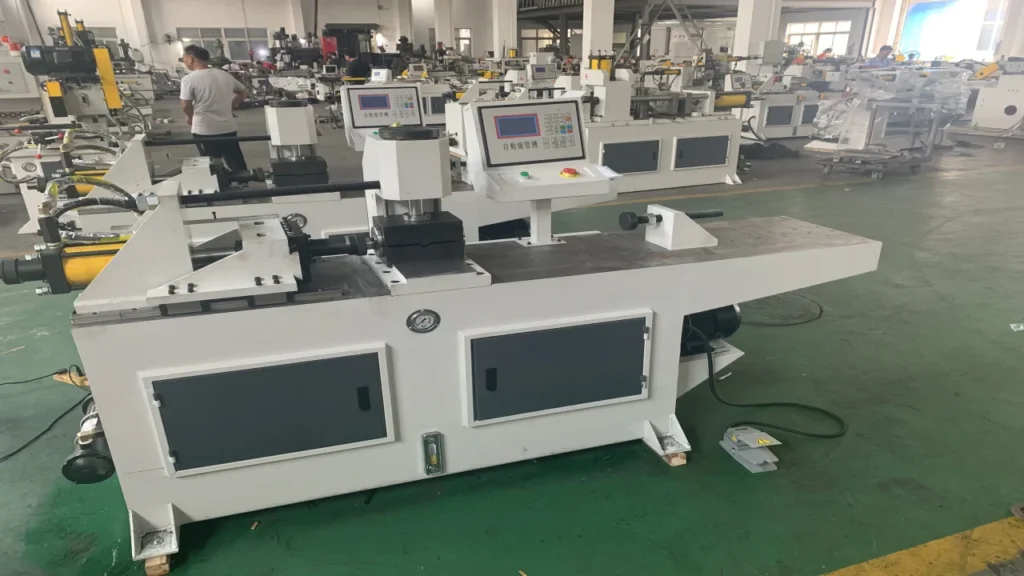
CNC mandrel bending machines range from simple 2-axis models to 6-axis systems. More axes mean more control. Feed, rotation, bend angle, and mandrel positioning all become programmable. Multi-stack tooling lets you run several bend radii on one machine without changing dies between operations. For your mixed production runs, look for a machine that combines axis count with multi-layer tooling capacity. Browse the CNC pipe bending machine collection to compare configurations.
Control System and Programming
The control system decides how easy the machine is to use. A good PLC system stores hundreds of programs, so you can recall any part in seconds. It converts XYZ coordinates into bend data and calculates total tube length automatically. An industrial control system adds 3D simulation, interference detection, and remote editing. These features shorten setup time and prevent crashes before they happen. Zhuoran’s machines, such as the DW18CNC / DW38CNC / DW50CNC series, include these controls as standard.
From Sampling to Production: Verifying Quality Before You Buy
You should never buy a bending machine on paper specs alone. A serious supplier follows a clear process. Confirm your parameters. Build the tooling. Produce a sample. Accept it. Then ship. Zhuoran works this way: parameter confirmation, tooling production, sample bending, acceptance and delivery, followed by after-sales support. Our sample service lets you verify quality with your own tube before you commit.
Frequently Asked Questions About Mandrel Bending
What is mandrel bending?
Mandrel bending is a tube bending method that supports the tube wall from the inside with a rod called a mandrel. The mandrel prevents wrinkling, collapse, and ovalization during the bend. It is widely used for thin-wall tubes and tight radius bends in tube processing industries.
When do you need a mandrel in tube bending?
You need a mandrel when the tube wall is thin relative to its diameter, or when the bend radius is tight. As a guideline, thin-wall tubes with a low t/D ratio and bends with an R/D ratio below 2 usually require mandrel bending.
What is the difference between mandrel bending and empty bending?
Empty bending bends the tube without internal support. It is faster and cheaper but can wrinkle or flatten thin-wall tubes. Mandrel bending adds an internal mandrel that keeps the cross-section round and the inner radius smooth. Quality is higher. Setup cost is higher too.
How does a mandrel prevent wrinkling and collapse?
The mandrel sits inside the tube and holds the wall in place during bending. Its hinged balls follow the bend curve and support the inner radius. A wiper die works with it to stop wrinkling. Together they keep the tube round and smooth.
What is the difference between a plug mandrel and a ball mandrel?
A plug mandrel is a solid rod with a shaped nose for short, moderate bends. A ball mandrel has hinged balls behind the nose that follow tight radii. For thin walls and small radius bends, a ball mandrel provides more support.
What industries use mandrel bending?
Mandrel bending serves automotive exhaust systems, aerospace tubing, furniture frames, fitness equipment, HVAC lines, and hydraulic applications. Anywhere a tube must keep its round shape through a bend, mandrel bending is the standard. See our application overview for the industries we equip.
How do I choose the right mandrel bending machine?
Check the axis count, control system, and tooling support. Choose a machine with CNC control for repeatability and multi-stack tooling for flexibility. Verify the supplier can produce samples with your own tube before purchase. You can also review our general FAQ for more buying guidance.
Conclusion
Mandrel bending is the answer when tube quality matters. It prevents wrinkling, collapse, and wall thinning. It keeps your cross-sections round and your production consistent. You now know the two ratios that decide your method: t/D and R/D. You also know what to look for in a machine, from CNC axes to tooling support.
At Zhangjiagang Zhuoran Machinery, mandrel is standard on our CNC pipe bending machines. We build our own mandrel tooling. Our machines are built to ISO 9001 quality standards and CE compliance requirements. We verify every machine with a sample before delivery. Our equipment is exported to more than 80 countries across Europe, North America, the Middle East, and Southeast Asia. We also provide after-sales service worldwide.
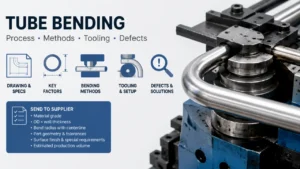
Ready to check your parts? Send us your tube OD, wall thickness, and bend radius. Our engineers will recommend the right tooling and bending solution for your application.