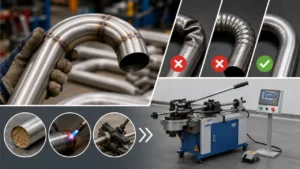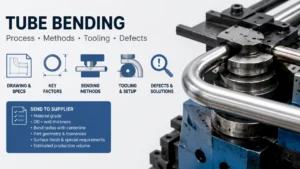
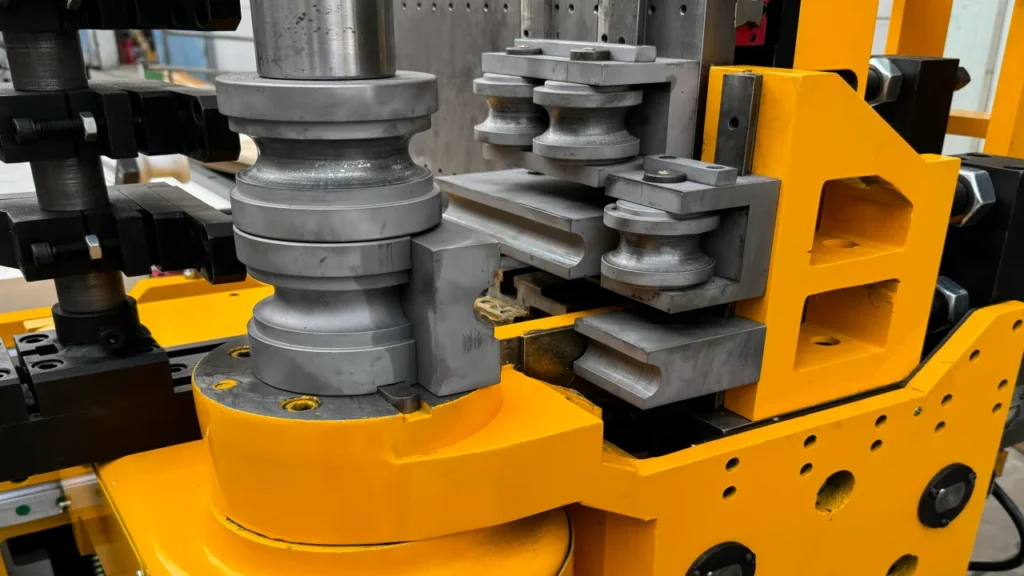
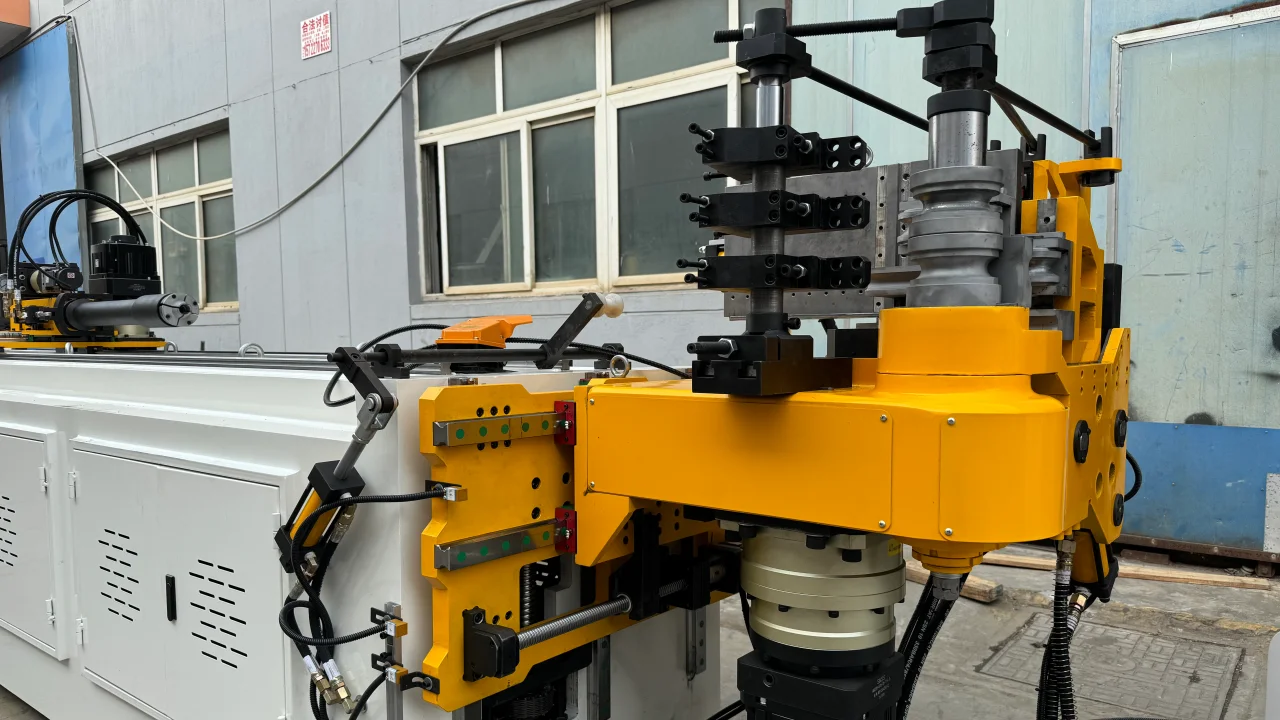
Large diameter tube bending is not determined by outside diameter alone. Material grade, wall thickness, centerline radius, bend angle, tooling, and quality requirements all affect whether a tube can be formed consistently.
If you are selecting a machine, start with the finished part rather than the largest diameter listed in a brochure. This guide explains how to compare bending processes, select tooling, control common defects and prepare an RFQ for a large diameter tube bending project.
In industrial equipment content, “tube” and “pipe” are sometimes used interchangeably. However, the machine recommendation should be based on the actual outside diameter, wall thickness, material, bend radius, and part geometry rather than on the name used in a search query.
What Makes Large Diameter Tube Bending Different?
Large diameter tube bending becomes more demanding as tube size, wall thickness or material strength increases. The machine must handle higher forming loads while keeping the tube stable throughout the bend.
Compared with smaller tube applications, large diameter work may require:
- Higher bending torque
- Greater pushing and clamping force
- A more rigid machine frame
- Stronger tooling support
- More controlled feeding and tube rotation
- Additional attention to springback and section deformation
However, a larger tube is not automatically more difficult than a smaller one. A large, thick-wall tube with a generous radius may be easier to process than a smaller, thin-wall tube with a tight CLR.
Diameter Is Only One Part of the Bending Problem
You should evaluate the complete bending condition:
- Outside diameter, or OD
- Wall thickness, or WT
- Material grade and condition
- Centerline radius, or CLR
- CLR-to-OD ratio
- Bend angle
- Number of bends
- Straight length between bends
- Surface quality requirements
- Required production volume
The ratio between diameter and wall thickness is especially important. A large-diameter, thin-wall tube has less structural support during bending, so it is more likely to flatten, ovalize or wrinkle.
Large-diameter and high-strength applications also place additional loads on the machine frame, bending head and tooling. BLM Group explains how thrust force, bending torque and machine rigidity affect large-diameter tube bending.
What Part Data Defines Process Feasibility?
Before you compare large tube bending machines, prepare the data that defines the actual part. A product photograph is useful for explaining the application, but it does not replace a controlled drawing.
Tube and Material Information
Provide:
- Material grade, such as carbon steel, stainless steel or aluminum
- Material condition or temper, when relevant
- Outside diameter
- Wall thickness and permitted variation
- Tube shape, including round, square, rectangular or special profiles
- Original tube length
- Surface finish and protected areas
Different materials respond differently during bending. Stainless steel, aluminum, carbon steel and high-strength alloys may require different bending force, tooling contact conditions and springback compensation.
Bend Geometry and Production Data
Your drawing or RFQ should also show:
- Centerline radius for each bend
- Bend angle for each bend
- Bend sequence
- Rotation angle between bend planes
- Straight lengths
- Tube-end orientation
- Number of bends per part
- Required output per hour or per shift
- Batch size and expected changeover frequency
For a three-dimensional part, a 3D STEP file can help the supplier review spatial interference. The 2D drawing should still define the dimensions, tolerances and acceptance criteria.
Quality and Acceptance Requirements
Define the quality requirements before asking for a final quotation. Typical inspection items include:
- Bend angle
- Bend position
- Straight length
- Ovality
- Minimum wall thickness
- Wrinkles
- Cracks
- Scratches and dents
- 3D profile accuracy
CYM’s tube bending specification guide also emphasizes the combined effect of diameter, radius, wall thickness and material.
A machine may be technically capable of bending a tube while still failing your actual quality requirements. That is why the finished drawing and acceptance limits matter as much as the nominal machine capacity.
Which Bending Process Fits Your Large Diameter Tube?
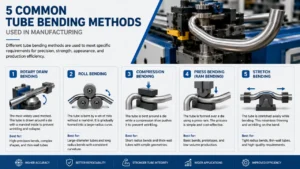
There is no single bending process for every large diameter tube. The correct method depends on the radius, geometry, material, production volume and required section quality.
| Process | Common fit | Main advantage | Main limitation |
|---|---|---|---|
| Rotary draw bending | Defined radii and multiple bends | Good control of radius, angle and position | Requires matched tooling |
| Roll bending | Large-radius curves, arches and rings | Practical for sweeping curves | Less suitable for tight multi-bend parts |
| Press bending | Simple, robust parts | Straightforward forming concept | Section control may be more limited |
| Induction bending | Selected large or heavy pipe applications | Can support special large-scale forming | Requires dedicated process planning |
When Rotary Draw Bending Is the Better Fit
Rotary draw bending is often considered when your part requires:
- A defined centerline radius
- Several bends in one part
- Different bend planes
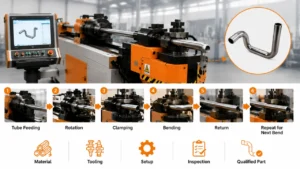
- Controlled feeding and rotation
- Repeatable angle and position
- Better control of the tube cross-section
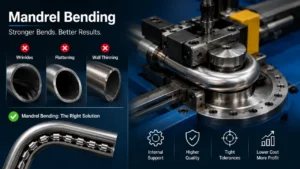
For thin-wall tubes or tight radii, the process may require a mandrel, wiper die and pressure die. The exact tooling combination depends on the material and acceptance requirements.
When Roll or Press Bending May Be More Practical
Roll bending may be more suitable when the part contains:
- A large sweeping radius
- A continuous arc
- A ring or arch shape
- A structural curve
- Relatively simple geometry
Press bending may be suitable for some thick-wall, low-volume or structurally robust parts. However, it should not be selected only because the machine appears simpler or less expensive. You still need to review cross-section deformation, repeatability and the final fit of the part.
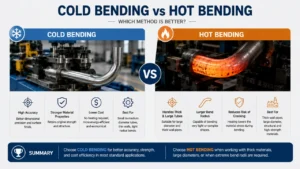
For some large or special pipe applications, induction bending may also be evaluated. This is a dedicated process decision, not a default replacement for cold bending.
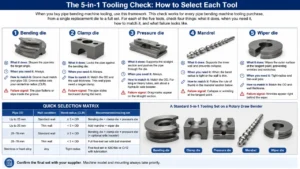
When Do You Need a Mandrel, Wiper Die and Pressure Die?
No. A mandrel is not automatically required for every large diameter tube bending project. The tooling decision depends on the tube geometry, material behavior and allowable deformation.
What Each Tool Does
- Bend die: Establishes the bending radius.
- Clamp die: Holds the tube during forming.
- Pressure die: Supports and pushes the tube as the bend develops.
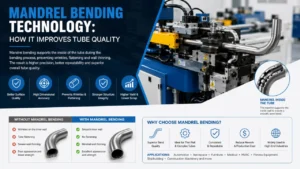
- Mandrel: Supports the inside of the tube and helps reduce collapse and ovality.
- Wiper die: Helps control compression and reduce wrinkles near the tangent area.
The tools must work as a matched system. Changing the tube diameter, wall thickness or CLR may require a different tool set.
How Tube Geometry Determines Tooling
Additional support should be evaluated when you have:
- Thin-wall tubing
- A tight CLR
- High-strength material
- Low ovality requirements
- Strict minimum wall-thickness limits
- Sensitive surface requirements
- Visible or functional areas near the bend
- Several bends in different planes
A structural tube may tolerate more ovality than a tube used for fluid flow or precision assembly. Therefore, tooling should be selected against the customer’s drawing, not against a general statement such as “all large tubes need a mandrel.”
You can review the functions of the main tools in Zhuoran’s pipe bending machine tooling guide.
Why Tooling Should Be Confirmed by a Sample
A tooling package should be checked using representative material and a real part drawing. The sample should confirm:
- Tube support
- Final radius
- Bend angle
- Cross-section shape
- Surface condition
- Wall thickness
- Repeatability
This is also the correct time to confirm whether the quotation includes the bend die, clamp die, pressure die, mandrel, wiper die and any special supports.
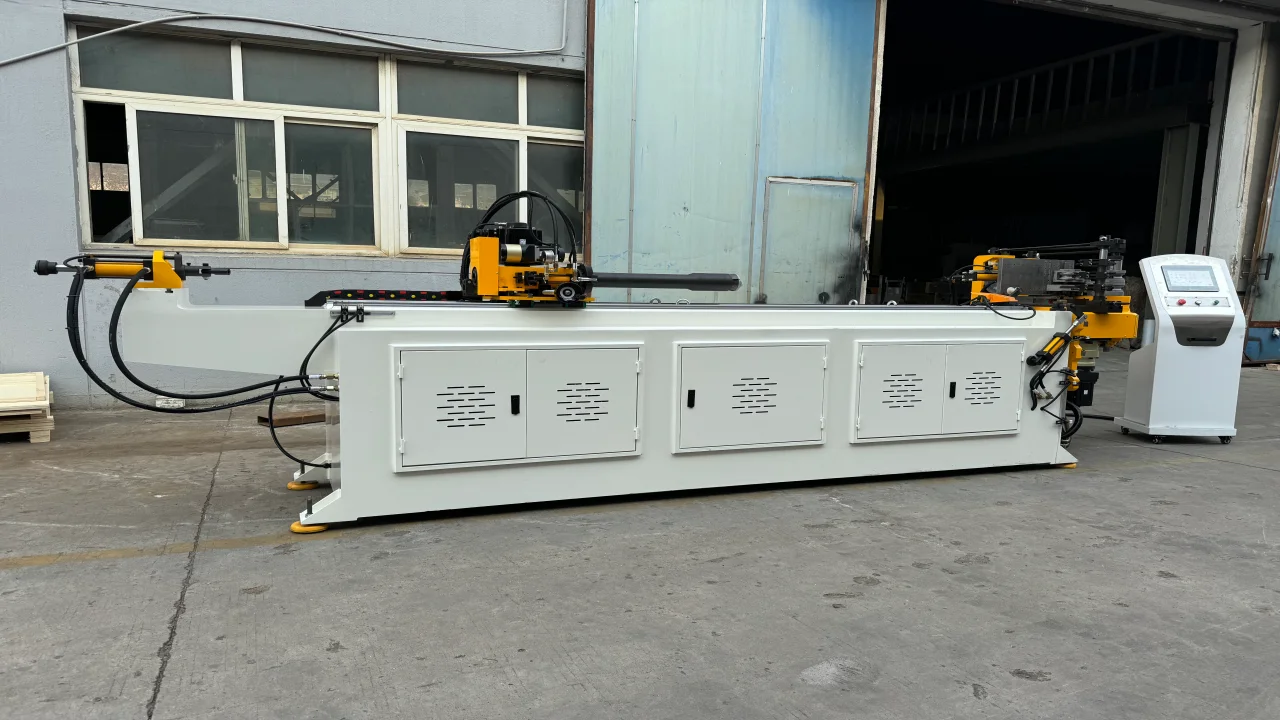
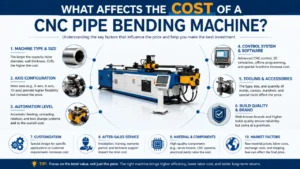
How Should You Select a Large Diameter Tube Bending Machine?
A suitable large diameter tube bending machine must do more than complete one bend. It must hold the tube securely, control deformation and repeat the result during production.
Machine Structure and Load Capacity
Review:
- Frame rigidity
- Bending torque
- Hydraulic pressure
- Clamping force
- Feeding thrust
- Tooling support
- Tube handling
- Foundation and floor space
- Maximum workpiece length
The supplier should explain the conditions behind the rated capacity. For example, the maximum tube diameter may apply only to a specific material, wall thickness, radius and tooling configuration.
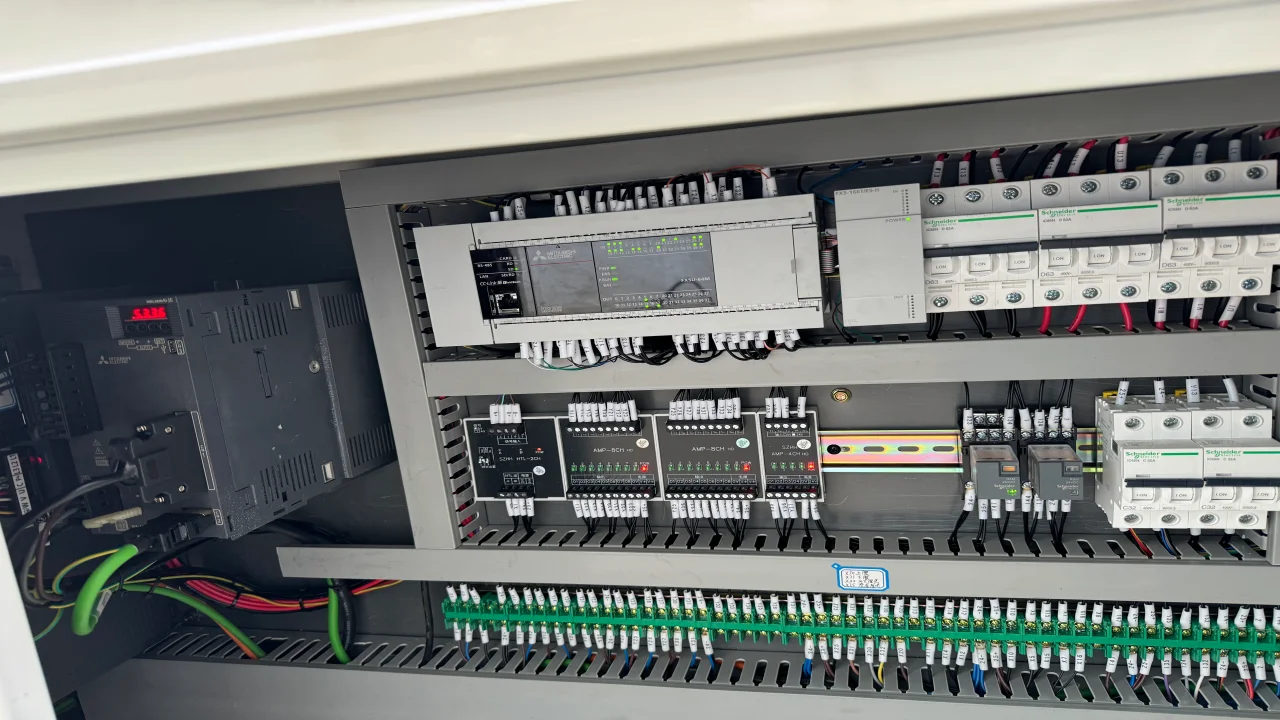
CNC, NC and Hydraulic Configurations
CNC and NC machines can both be suitable, but their control methods serve different production needs.
A CNC tube bender may be appropriate when you need:
- Programmed feeding
- Automatic tube rotation
- Multiple bends
- Different bend planes
- Stored programs
- Repeat production
- Reduced manual positioning
An NC or hydraulic machine may be practical when:
- The geometry is relatively simple;
- Most bends are in one plane;
- Operator involvement is acceptable;
- The production volume is moderate;
- Flexibility is more important than full automation.
The control label alone does not establish whether a machine is suitable. The correct decision depends on the part family, output target, labor model and required repeatability.
Zhuoran Equipment Examples
Zhuoran’s published equipment range provides different directions for large-diameter applications.
| Equipment example | Published model direction | Application consideration |
|---|---|---|
| DW75CNC | Φ75 × 6 mm, radius example around R330 | CNC feeding, rotation and programmed bending |
| DW89CNC | Φ89 × 6 mm, radius example around R400 | Medium-to-large tube applications |
| DW130CNC | Φ130 × 12 mm, radius example around R550 | Larger CNC tube bending applications |
| DW130NC | Φ130 × 10 mm, radius example around R520 | Heavy-duty NC bending |
| DW168NC | Φ168 × 14 mm, radius example around R650 | Larger and thicker-wall applications |
These are published model examples, not universal guarantees for every material or tube geometry. Final machine selection should be based on the actual drawing, tube data, tooling and acceptance requirements.
You can review the DW75CNC–DW130CNC CNC pipe bender range and the DW130NC–DW168NC heavy-duty pipe bending machines.
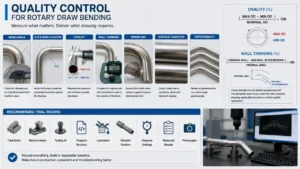
How Can You Control Ovality, Wall Thinning, Wrinkles and Springback?
The best way to control defects is to connect each defect to its cause, tooling condition and inspection method. A larger machine does not automatically solve every forming problem.
| Defect | Possible causes | Control direction |
|---|---|---|
| Ovality | Insufficient support, thin wall or tight CLR | Review mandrel, tooling and section tolerance |
| Wall thinning | Excessive tensile strain on the outside radius | Review CLR, material and forming parameters |
| Wrinkles | Compression on the inside radius | Review wiper die, pressure die and setup |
| Springback | Material strength and elastic recovery | Use controlled compensation and sample testing |
| Cracking | Excessive strain or low material ductility | Review material condition, CLR and process |
| Surface marks | Slippage, contact pressure or tool finish | Check clamping, lubrication and tool surface |
Why Defect Limits Must Come from the Drawing
There is no single ovality or wall-thinning value that applies to every large diameter tube.
For example:
- A structural frame may permit more section deformation;
- A fluid-carrying tube may need tighter section control;
- A tube inserted into another component may have strict end and profile limits;
- A visible decorative tube may have a lower surface-mark tolerance.
Therefore, the customer drawing, technical agreement and inspection method should define the acceptance limits.
How Quality Should Be Measured
A practical inspection plan may include:
- Bend angle measurement;
- Bend position measurement;
- Straight-length measurement;
- Cross-section measurement;
- Minimum wall-thickness measurement;
- Visual inspection for wrinkles and cracks;
- Surface comparison against the approved sample;
- 3D profile inspection for complex parts.
The same inspection method should be used during sample approval and final acceptance. Otherwise, the supplier and buyer may obtain different results from the same part.
How Should You Verify Capacity and Sample Results?
Production capacity should be measured using acceptable parts per hour, not bending speed alone.
Calculate the Full Cycle
A practical cycle may include:
Loading
+ Feeding
+ Clamping
+ Rotation
+ Bending
+ Unloading
+ Inspection
+ Changeover
A machine may have a high bending speed but still produce fewer acceptable parts if loading, unloading, inspection or tool adjustment takes significant time.
You should ask the supplier to state the assumptions behind any cycle-time estimate:
- Is loading manual or automatic?
- Is unloading included?
- Is inspection included?
- Is the cycle based on one bend or a complete part?
- Is tool change included?
- Are rejected parts included in the calculation?
- Is the estimate based on the actual material and drawing?
What a Sample Trial Should Confirm
A sample trial should use:
- The intended material;
- The intended tube diameter and wall thickness;
- The proposed tooling;
- The actual CLR;
- The actual bend sequence;
- The agreed measurement method.
The trial should record:
- Sample quantity;
- Good quantity;
- NG quantity;
- Bend angle;
- Bend position;
- Ovality;
- Wall thickness;
- Surface condition;
- Cycle time;
- Repeatability.
For higher-risk parts, repeatability should be checked across more than one setup or production run.
Zhuoran provides a tube bending sample service for projects that require application review before final equipment selection.
What Should Be Included in a Large Diameter Tube Bending RFQ?
A complete RFQ should help the supplier evaluate the part, machine, tooling, automation and acceptance requirements together.
Technical Information to Send
- 2D drawing;
- 3D STEP file, when available;
- Material grade;
- Material condition;
- Outside diameter;
- Wall thickness;
- Tube length;
- CLR for each bend;
- Bend angles;
- Bend sequence;
- Rotation angles;
- Straight lengths;
- Surface requirements;
- Dimensional tolerances;
- Required output.
If a value is not yet confirmed, mark it as TBC rather than allowing each supplier to make a different assumption.
Configuration Items to Confirm
Ask the supplier to separate the quotation into:
- Main machine;
- Control system;
- Bend die;
- Clamp die;
- Pressure die;
- Mandrel;
- Wiper die;
- Multi-stack tooling;
- Automatic feeding;
- Cutting;
- Automatic unloading;
- Inspection;
- Installation and commissioning;
- Operator training;
- Sample trial;
- Transportation and packaging.
Not every item is standard on every machine. The quotation should clearly show what is included, what is optional and what requires project customization.
Acceptance and Commercial Items
Also confirm:
- Sample quantity;
- Inspection tools;
- Measurement method;
- Good-part criteria;
- Cycle-time assumptions;
- Repeatability requirement;
- Warranty scope;
- Delivery terms;
- Excluded items;
- Required site conditions.
This prevents a common procurement problem: comparing two machine prices that include completely different scopes.
Zhuoran Equipment Paths for Large Diameter Applications
Zhuoran’s large-diameter tube bending solutions should be selected according to the actual application rather than by diameter alone.
CNC Equipment for Programmed Feeding and Rotation
CNC equipment may be considered for:
- Multi-bend tube parts;
- Multi-plane geometry;
- Programmed feeding;
- Automatic tube rotation;
- Repeat production;
- Reduced manual positioning.
The CNC pipe bending machine range includes different model groups. The final recommendation still depends on material, OD, WT, CLR, bend sequence, tooling and required output.
Heavy-Duty NC Equipment for Large and Thick-Wall Tubes
Heavy-duty NC equipment may be evaluated for:
- Larger tube diameters;
- Thick-wall tubes;
- Heavy structural parts;
- Applications requiring substantial hydraulic force;
- Simpler geometries with operator involvement.
The DW130NC and DW168NC pages provide published examples of heavy-duty configurations, but the final machine choice should be confirmed against the customer’s actual workpiece.
Why Application Review Comes Before Final Model Selection
The correct model cannot be selected from tube diameter alone. A proper technical review should answer:
- What material will be bent?
- What is the wall thickness?
- What is the tightest CLR?
- How many bends are required?
- What quality limits apply?
- What output is needed?
- What automation is required?
- Which tools are included?
A Practical Checklist Before You Request a Quote
- Finished-part drawing is available
- 3D file is available for complex parts
- Material grade is confirmed
- OD and WT are confirmed
- Minimum CLR is confirmed
- Bend angles and sequence are defined
- Tube-end orientation is defined
- Surface requirements are documented
- Ovality and wall-thinning limits are defined
- Required output is stated
- Automation requirements are listed
- Tooling scope is listed
- Sample trial is requested
- Inspection method is agreed
- Acceptance criteria are written into the technical agreement
If you are unsure which model or tooling configuration fits your part, send the drawing and tube data to Zhuoran for a technical review.
Frequently Asked Questions About Large Diameter Tube Bending
What is considered a large diameter tube?
There is no single diameter limit that applies to every industry. A tube may be considered large diameter because of its OD, wall thickness, material strength, weight or the machine structure required to bend it. The correct definition should be based on the complete forming condition, not OD alone.
Can thin-wall large diameter tubes be bent?
Yes, but thin-wall large diameter tubes usually require more careful process planning. The main risks include ovality, wall thinning, wrinkles and surface damage. Mandrel, wiper die and pressure die requirements should be reviewed against the CLR, material and quality limits.
Is a mandrel always required?
No. A mandrel may be unnecessary for a large-radius, thick-wall structural bend. It becomes more important when the tube has a thin wall, tight radius, strict ovality requirement or sensitive cross-section. A sample bend is more reliable than a universal rule.
Can CNC and NC machines both process large diameter tubes?
Both may be suitable. CNC machines are generally useful when the part requires programmed feeding, rotation and multiple bends. NC machines may be practical for simpler parts or production methods with more operator involvement. The control type does not replace application testing.
How can I verify a machine before purchase?
Provide the actual drawing and material, then request a sample-bending test. Agree in advance on the tooling, measurement method, acceptance limits, cycle-time assumptions and repeatability requirements. The result should be evaluated using the same criteria that will apply during production acceptance.
What information should I send to Zhuoran?
Send the part drawing or 3D file, material grade, OD, wall thickness, CLR, bend angles, bend sequence, tube length, quality requirements and target output. If automation is needed, also describe loading, unloading, inspection and downstream process requirements.
Conclusion: Select the Process Around the Part
Large diameter tube bending is a process-matching decision. The right solution depends on the relationship between OD, wall thickness, material, CLR, bend geometry, tooling, machine rigidity, quality requirements and production volume.
Do not select a machine only because its maximum diameter appears large enough. Instead, ask the supplier to evaluate your most demanding part, confirm the tooling, run representative samples and define the acceptance criteria before the final order.
For a machine and tooling recommendation, send your tube drawing, material grade, OD, wall thickness, CLR and production target to Zhuoran’s design and engineering team.
References and Technical Sources
Industry Technical References
- BLMA — How to Bend Large Diameter Tubes Accurately. Technical discussion of forming force, machine rigidity, tooling, springback and large-diameter tube bending accuracy.
- BLM Group — Right- and Left-Hand Bending for Tubes with Large Diameter, Thick or High Rigidity. Discussion of bending torque, thrust force, frame rigidity and high-strength or thick-wall tube applications.
- CYM Materiales — How to Choose and Specify a Tube Bending Machine. Reference for diameter, wall thickness, material, CLR, mandrel support, ovality and wrinkling.
- Raysun Equipment — How to Choose the Right Tube Bending Machine for Your Production. Reference for machine selection, production flow, cycle-time evaluation, tooling review and RFQ preparation.
- Suzhou Jiuqiang Machinery — How to Choose the Right Tube Bending Machine. Reference for CNC, NC, rotary draw, roll bending, tooling and sample-bending evaluation.
Zhuoran Product and Service Sources
- Zhuoran CNC Pipe Bending Machines
- DW75CNC–DW130CNC CNC Pipe Bending Machine
- DW130NC–DW168NC Heavy-Duty Pipe Bending Machine
- Pipe Bending Machine Tooling
- Tube Bending Sample Service
Reference note: Industry references are provided for general process and selection guidance. Zhuoran product specifications apply to the listed models and should not be interpreted as universal performance guarantees for every material, wall thickness, bend radius or part geometry. Final machine, tooling and acceptance requirements should be confirmed through technical evaluation and sample testing.