
Double Head Tube Bender Supplier
Zhuoran’s double-head pipe bending machine is specifically designed for pipe components requiring symmetrical left-and-right forming, stable center-to-center distances, and repeatable bending conditions.
Our dual-head configuration enables the machining of two sides of an asymmetric component in a single, coordinated setup, thereby reducing repositioning steps and improving consistency between paired parts.
Production Challenges
When Should You Consider a Double Head Tube Bender?
Matched Left and Right Parts
A double-head layout is useful when both sides of a component must maintain a controlled relationship between bend angle, endpoint and center distance.
Repeated Symmetrical Components
The configuration can be evaluated for chair frames, furniture structures, fitness equipment, motorcycle parts and other paired tube components.
Less Repositioning
Processing two sides in a coordinated setup may reduce manual repositioning and simplify the production sequence.
Stable Batch Conditions
Shared setup parameters help maintain consistent bending conditions across repeated parts, subject to the actual material, tooling and inspection requirements.
Model Selection
Double Head Tube Bender Models
The final model should be selected according to tube outside diameter, wall thickness, bend radius, center distance, material, product geometry and required operating mode.
SW38NC
A hydraulic double-head tube bender for tube sizes up to approximately Ø38 × 2 mm, with a maximum bend radius of R200 and a maximum bend angle of 190°. Microcomputer control and manual center adjustment are used for project-specific production setups.
SW38CNC
A CNC-oriented option for projects that require automatic servo center adjustment, repeatable positioning and multiple product lengths or models.
SW50NC
A larger hydraulic double-head model for tube sizes up to approximately Ø50 × 2 mm, with a maximum bend radius of R250 and a maximum bend angle of 190°.
Operating Configuration
Flexible Forming Modes for Different Production Needs
Double-head tube bending should be configured around the actual component geometry and production rhythm, not only around the tube diameter.
- Full-cycle operation for repeatable production sequences
- Semi-cycle operation for operator-assisted production
- Manual adjustment for setup and changeover work
- Single-tube or paired-tube processing, depending on the component
- Hydraulic clamping and bending control
- Independent adjustment of the two bending heads
- Quick die-change and center-distance adjustment for product variation
- Angle detection and safety interlock requirements to be confirmed by configuration
DISCUSS YOUR CONFIGURATION
Technical Reference
Double Head Tube Bender Technical Reference
The following values are reference capabilities for the listed model family. The final machine specification depends on the ordered configuration, tooling and confirmed workpiece requirements.
| Parameter | SW38NC | SW38CNC | SW50NC |
|---|---|---|---|
| Maximum tube size | Approx. Ø38 × 2 mm | Approx. Ø38 × 2 mm | Approx. Ø50 × 2 mm |
| Maximum bend radius | R200 | R200 | R250 |
| Minimum bend radius | R ≥ 1.5D | R ≥ 1.5D | R ≥ 1.5D |
| Maximum bend angle | 190° | 190° | 190° |
| Control approach | Microcomputer control | PLC and servo center adjustment | Microcomputer control |
| Maximum system pressure | 12 MPa | 12 MPa | 14 MPa |
Application Scenarios
Applications for Double Head Tube Bending
Furniture and Chair Frames
Suitable for symmetrical armrests, chair structures and furniture frames where paired tube geometry must remain consistent.
Fitness Equipment
Can be evaluated for handrails, support frames and other fitness components requiring repeatable left and right forming.
Motorcycle Components
Suitable for selected pedals, guards, supports and tubular structures after confirming material, radius and assembly requirements.
Display and Industrial Frames
Useful for paired tube frames, display structures and industrial components that benefit from a coordinated two-side setup.
VIEW TUBE PROCESSING APPLICATIONS
Equipment Selection
Double Head Tube Bender or Single Head Tube Bender?
A double-head machine is not automatically the right solution for every tube part. The decision should be based on symmetry, bend sequence, production volume, changeover needs and inspection requirements.
| Decision factor | Double head | Single head |
|---|---|---|
| Symmetrical parts | Strong fit for paired or matched geometry | May require additional repositioning |
| Two-side forming | Can coordinate both sides in one setup | Usually processed sequentially |
| Product variation | Requires suitable center adjustment and tooling | May offer simpler single-part setup |
| Complex multi-plane geometry | Confirm machine movement and tooling suitability | Consider CNC tube bending equipment |
Need multi-axis CNC bending? View CNC machines →
Inspection and Acceptance
How Double Head Tube Bending Results Are Verified
Geometry
- Bend angle
- Bend-to-bend distance
- Center distance
- Tube end position
- Plane-of-bend rotation
Section Quality
- Tube ovality
- Wall-thickness condition
- Wrinkles and deformation
- Surface marks
- Cracks or tearing
Assembly Fit
- Fixture fit
- Left and right matching
- Welding or connection position
- First-article inspection
- Production repeatability
Inspection criteria should be agreed from the part drawing and application requirements. Measurement may involve gauges, fixtures, calipers, digital measurement equipment or other agreed methods.
Review Tube Bending Tolerances →Sample Validation
Validate the Double Head Tube Bender Before Production
Sample testing helps confirm whether the proposed machine, tooling arrangement and operating sequence are suitable for the actual part.
- Tube material and material condition
- Tube outside diameter and wall thickness
- Bend radius and bend angle
- Left and right part symmetry
- Center-distance stability
- Tooling and clamping arrangement
- Surface condition and deformation
- Inspection method and acceptance criteria
Send These Details for a Faster Recommendation
- Part drawing or 3D model
- Tube OD and wall thickness
- Material grade
- Required bend radius
- Required bend angle and center distance
- Expected production quantity
- Current quality or deformation concerns
- Preferred automation and operator workflow
Start Your Project
Build the Right Double Head Tube Bending Solution
Share your tube drawing, material, dimensions and production requirements. Zhuoran can help evaluate the machine model, tooling arrangement, center adjustment and sample validation route.
GET A QUOTATIONRelated Tube Processing Resources
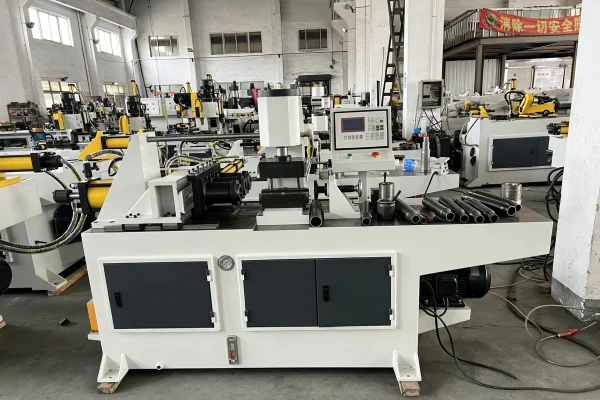
Double Head Tube Bending
Get Your Custom Machine Quotation Now
Want to confirm which symmetrical pipe fittings are right for you? Send us your tube drawing, material information and production requirements. We can review the bending process and recommend a suitable double head tube bending solution.
LET’S GET STARTEDDouble Head Tube Bender FAQ
What is a double head tube bender?
A double-head tube bender uses two coordinated bending heads to form two sides of a tube component or two matched tube sections.
What is the difference between a double head and twin head tube bender?
The terms often describe similar equipment concepts. The key difference depends on the head arrangement, adjustment method and control configuration.
Can the machine bend both ends of one tube?
This depends on the component geometry, clamping arrangement, tooling and machine configuration. Send the drawing for a project-specific review.
Can a double head bender process different product models?
It may be possible when the machine has suitable center adjustment, tooling and operating procedures for the required product range.
Should I choose a double head machine or a CNC pipe bender?
Choose a double-head configuration when matched two-side forming is the main requirement. Choose a CNC pipe bender for multi-axis feeding, tube rotation or complex multi-plane geometry.
How do I confirm whether the selected model is suitable?
Provide the tube drawing, material, tube OD, wall thickness, bend radius, bend angle, center distance, production volume and inspection requirements.