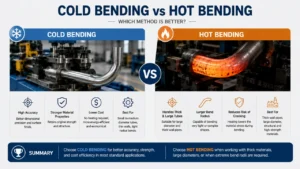
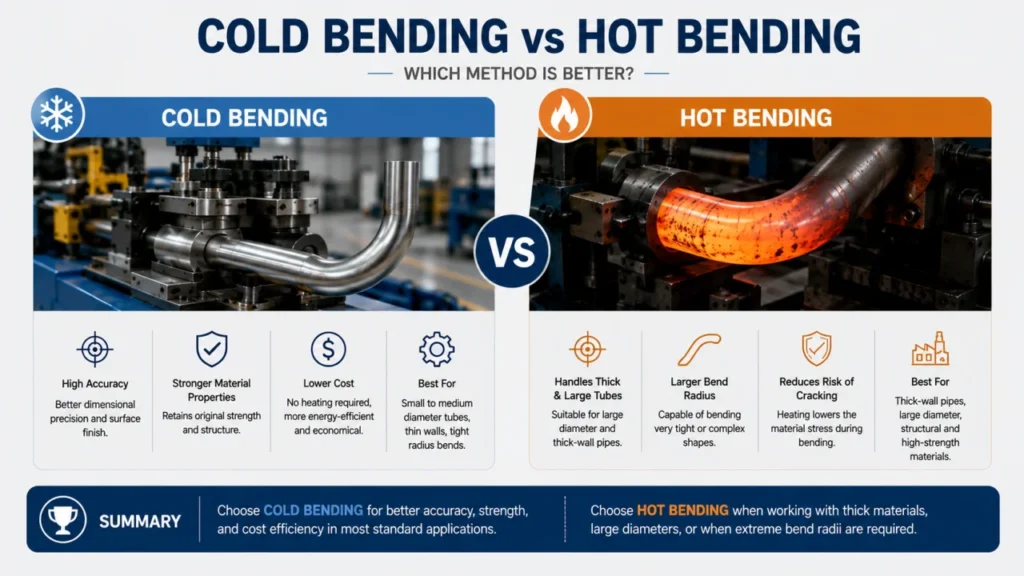
Choosing between cold bending vs hot bending is a decision every pipe and tube fabricator faces. Pick the wrong process, and you get wall thinning, ovality, or damaged material properties. You may have compared quotes, read forums, and still felt unsure. The truth is simple: neither method is universally better.
The right choice depends on your pipe size, wall thickness, material, and quality requirements. This guide compares cold bending vs hot bending across every key factor, so you can decide with confidence. By the end, you will know exactly how to evaluate your own parts. Whether you are new to tube processing or a seasoned buyer, this cold bending vs hot bending overview will help you think clearly about the trade-offs. Use the comparison table as your quick reference at every stage.
What Is Cold Bending?
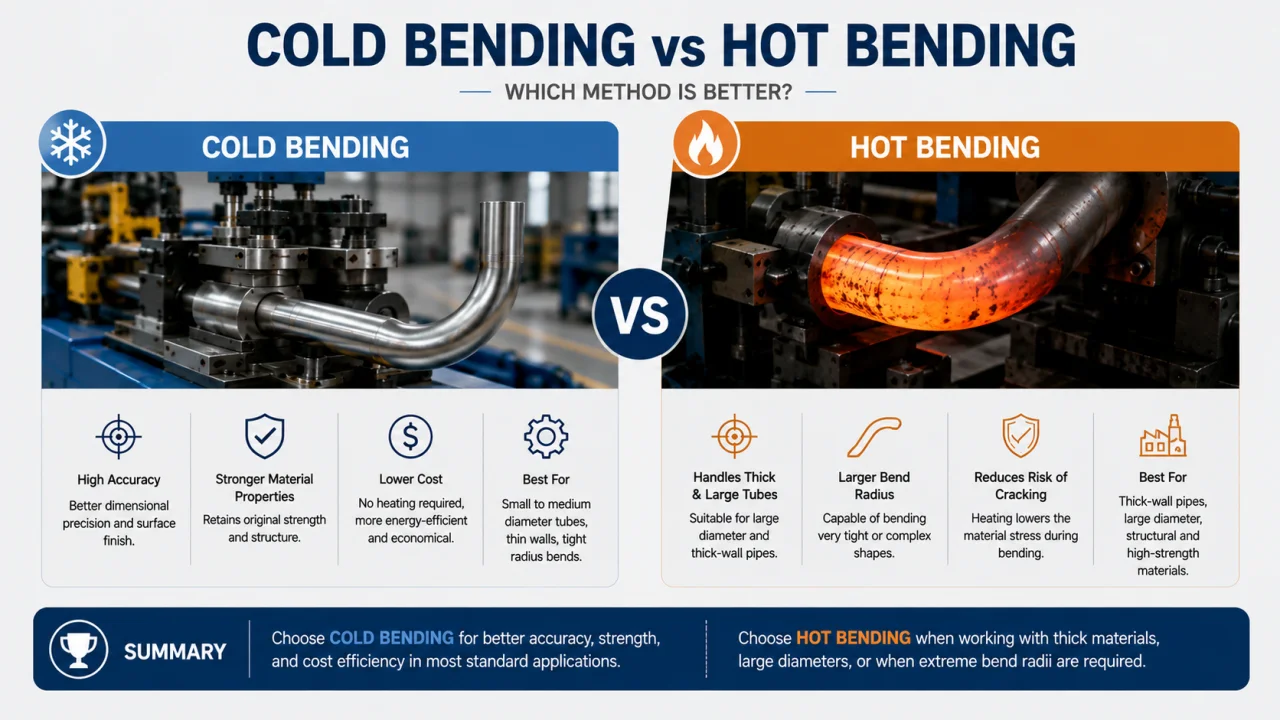
Cold bending forms metal tubes at room temperature. No heat is applied, so the material keeps its original structure throughout the process. In tube processing, this is the most common way to produce bends for structural frames, furniture, automotive parts, and many other components. When you compare cold bending vs hot bending, you are really comparing two different approaches to the same goal: shaping metal without breaking it. Most everyday bends in industrial manufacturing start with cold bending because it is fast, clean, and precise.
How Cold Bending Works at Room Temperature
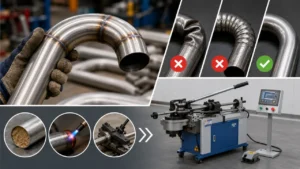
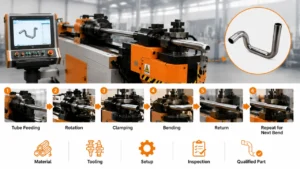
Cold bending uses mechanical force to shape the tube. The tube passes through or around tooling that pushes it into the desired angle. Because the metal is cold, it resists deformation and tends to spring back slightly after bending. Skilled operators and CNC controls compensate for this springback automatically. The result is a clean bend with predictable dimensions and no heat-affected zone. For most tube processing shops, cold bending is the everyday workhorse. When buyers compare cold bending vs hot bending for speed and cleanliness, cold bending usually wins.
Common Cold Bending Methods
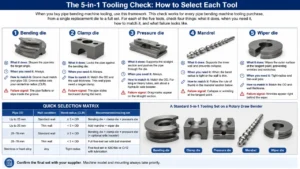
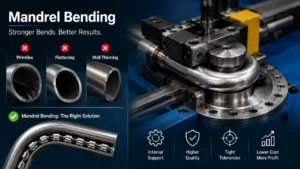
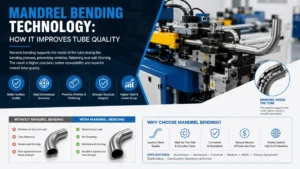
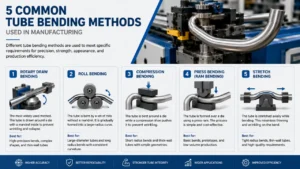
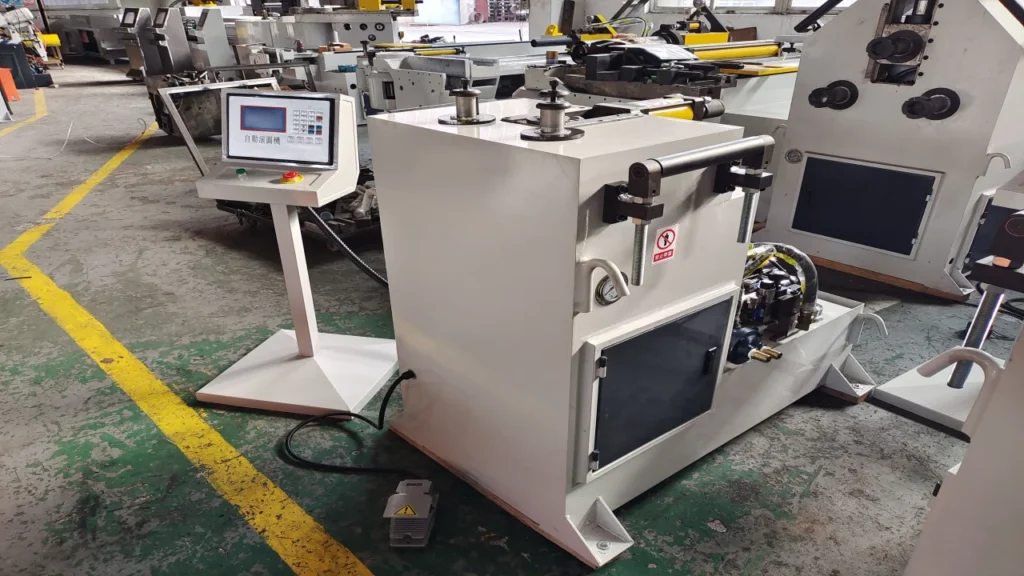
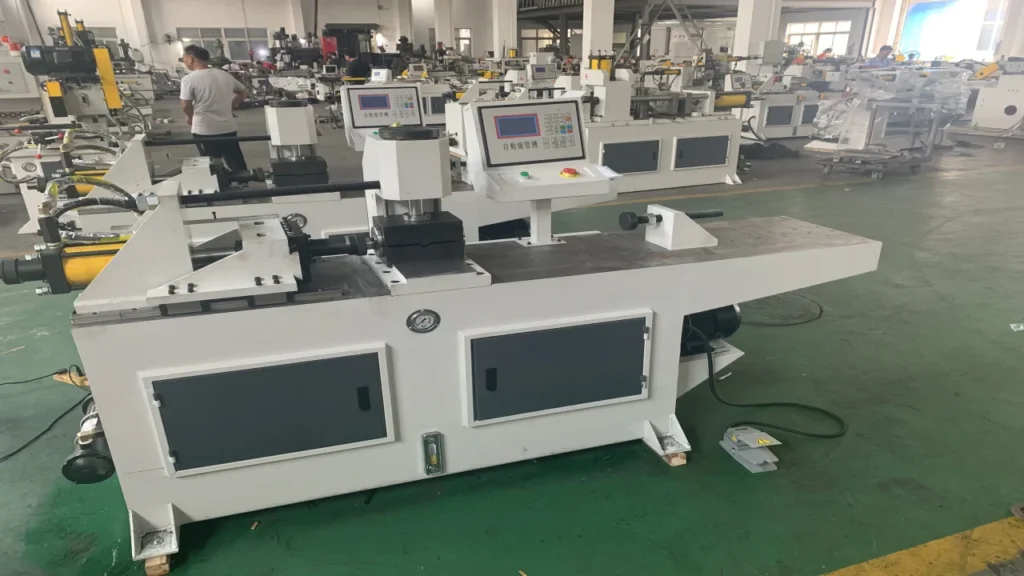
Several methods fall under cold bending. Rotary draw bending clamps the tube to a rotating die and draws it around the bend. This is the most accurate method, especially when a mandrel supports the inner wall for thin-wall tubes. Roll bending passes the tube through three rollers to form large-radius curves. Press bending uses a ram to push the tube against a fixed die for simple parts. Double-head tube benders bend both ends of a tube in one setup. Each method suits different part geometries, and many shops use several of them. See the CNC pipe bending machine collection and the tube rolling machine collection for equipment options.
What Is Hot Bending?
Hot bending uses heat to soften the metal before shaping. This lowers the material’s yield strength, so the tube bends with much less force. Hot bending handles geometries that cold bending cannot manage, especially large-diameter and thick-wall pipes. When you weigh cold bending vs hot bending, remember that heat changes both the process and the material. That trade-off sits at the heart of every comparison.
How Heat Changes the Bending Process
When metal is heated, its yield strength drops and its ductility increases. The tube becomes easier to shape, and the bend can follow tighter profiles without cracking. However, heat also changes the material’s microstructure. Grain growth and surface oxidation can occur, so hot bending requires careful temperature control. This is one reason why the cold bending vs hot bending decision is not always obvious. For thick-wall pipes, though, hot bending often has no practical alternative. Learn more about induction bending from industry sources.
Induction Bending and Furnace Bending
Induction bending is the most common hot bending method. An induction coil heats a narrow band of the pipe, and the machine bends the heated zone around a die. Furnace bending heats the whole pipe section in an oven before shaping. Both methods are used for large-diameter pipelines, boiler tubes, and structural steel where cold bending is not practical.
Cold Bending vs Hot Bending: Key Differences
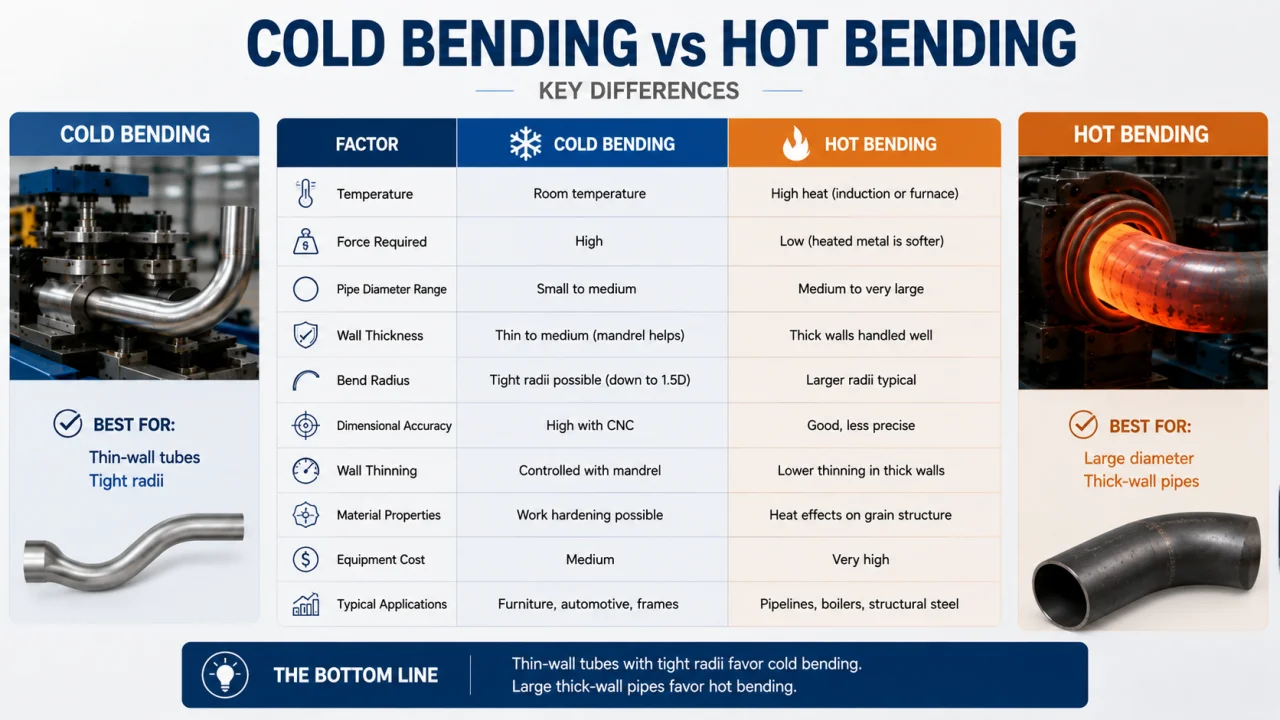
Here is a side-by-side comparison of cold bending vs hot bending. The table uses relative levels, because exact values depend on your pipe material and size. Use it as a quick reference whenever you compare the two processes.
| Factor | Cold Bending | Hot Bending |
|---|---|---|
| Temperature | Room temperature | High heat (induction or furnace) |
| Force Required | High | Low (heated metal is softer) |
| Pipe Diameter Range | Small to medium | Medium to very large |
| Wall Thickness | Thin to medium (mandrel helps) | Thick walls handled well |
| Bend Radius | Tight radii possible (down to 1.5D) | Larger radii typical |
| Dimensional Accuracy | High with CNC | Good, less precise |
| Wall Thinning | Controlled with mandrel | Lower thinning in thick walls |
| Material Properties | Work hardening possible | Heat effects on grain structure |
| Equipment Cost | Medium | Very high |
| Typical Applications | Furniture, automotive, frames | Pipelines, boilers, structural steel |
This cold bending vs hot bending comparison shows why the choice depends on your part. Thin-wall tubes with tight radii favor cold bending. Large thick-wall pipes favor hot bending. In short, the table gives you the full picture at a glance. Read the rows that match your specs, and the right process starts to stand out. See engineering discussions on hot vs cold bends for real-world perspectives.
How Each Method Affects Production Quality
Production quality depends on how each process handles the tube wall and the material itself. Let’s compare the key quality factors. These differences often decide the cold bending vs hot bending question for quality-critical parts. Work through each factor with your own parts in mind, and the right process will reveal itself.
Wall Thinning and Ovality
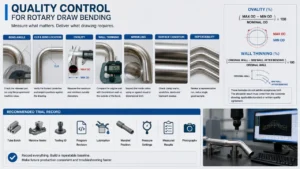
Every bending process thins the outer wall and flattens the cross-section to some degree. Cold bending controls ovality well, especially with a mandrel inside the tube. The mandrel holds the wall in place, so the cross-section stays round. Hot bending naturally reduces wall thinning on thick pipes, because the heated metal flows instead of stretching. For thin-wall tubes, cold bending with a mandrel gives better control. You should check both factors on your own samples.
Material Properties: Work Hardening vs. Heat Effects
Cold bending work-hardens the metal in the bend zone. This can increase strength but reduce ductility. Hot bending avoids work hardening, but the heat can affect the grain structure and surface condition. Neither effect is automatically bad. It depends on your application and material specification. For pressure applications, engineers check both the bend quality and the material properties before acceptance. Your material grade often points toward one process in the cold bending vs hot bending decision.
Springback and Dimensional Control
Cold bending produces springback, where the tube tries to return to its original shape. CNC controls compensate for this, so repeatability stays high. Hot bending holds its shape better because the metal is formed while soft. However, hot parts can distort during cooling. For tight tolerances and high repeatability, cold bending with CNC control is usually the stronger choice. If your parts must match every time, this factor matters a lot.
Surface Finish and Appearance
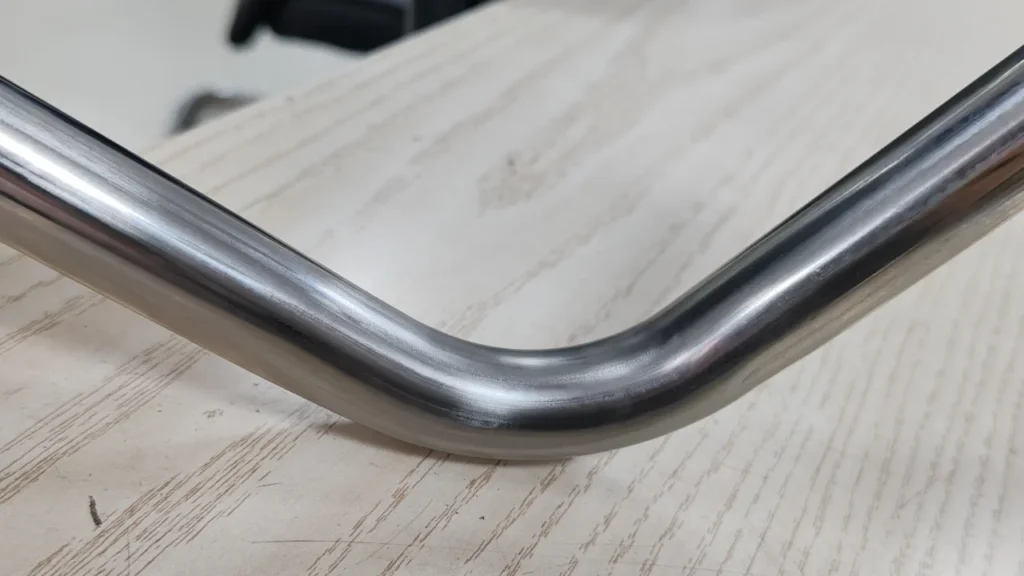
Cold bending keeps a clean surface with no scale or oxidation. This matters for visible parts like furniture frames and handrails. Hot bending can leave scale and discoloration that requires cleaning or finishing. If appearance is critical, cold bending gives you the better surface from the start. You can compare the two finishes side by side on sample parts. For many buyers, this visual difference settles the cold bending vs hot bending question on its own.
Which Method Should You Choose?
Match the process to your part, not to habit. Work through your pipe specs one step at a time, and the answer becomes clear. The cold bending vs hot bending decision becomes easy once you know your numbers. For most small and medium parts, the choice lands on cold bending. For heavy pipes, hot bending takes over.
Match the Method to Pipe Diameter and Wall Thickness
Pipe diameter and wall thickness narrow the field quickly. Large-diameter thick-wall pipes usually need hot bending. Small and medium tubes with thin or medium walls bend well cold. A good benchmark for cold bending is a minimum bend radius of 1.5D, where D is the outside diameter. If your part stays within the machine’s capacity, cold bending delivers speed and precision. If the pipe is too large or thick, hot bending is the practical route. Measure your pipe before you decide.
Consider Your Material and Quality Requirements
Material behavior matters as much as geometry. Carbon steel, stainless steel, aluminum, and copper all respond differently to bending. If your material hardens quickly, cold bending needs more power and careful tooling. If your application demands specific material properties after bending, verify how each process affects them. Quality requirements like tolerance, surface finish, and consistency also point toward one method over the other. Write your requirements down before comparing processes.
A Practical Selection Guide
Follow this six-step guide when you evaluate a pipe bending job:
- Measure the pipe diameter and wall thickness.
- Confirm the bend radius relative to the diameter.
- Identify the material grade and its ductility.
- Define the accuracy and surface finish required.
- Check the batch size and production speed needs.
- Compare the costs of each process for your volume.
Cold bending wins on speed, precision, and cost for most small and medium parts. Hot bending wins on size and thickness limits. Use the table above to match your specs to the right process. This six-step approach removes the guesswork from the cold bending vs hot bending decision. When in doubt, test both processes with a sample and compare the results yourself. Most shops find that the cold bending vs hot bending answer becomes obvious once they hold two samples side by side. Review the CNC pipe bending machine collection if you plan to bring cold bending in-house.
Code Requirements and Compliance
Some industries require more than a good-looking bend. Pressure piping and boiler work follow codes that define acceptable bending practice.
Why Codes Matter in Pipe Bending
Power plant and chemical plant piping often reference codes such as ASME B31.1 and ASME B31.3. These codes set requirements for bend quality, wall thinning limits, and material handling. They may restrict which process you can use for certain materials and thicknesses. Engineers select the process with the code requirements in mind, not just cost or convenience. When codes apply, verify that your chosen process meets them.
How to Verify Your Supplier’s Process
When you outsource bending, verify the supplier’s process against your requirements. Ask for a sample bend with your own pipe. Check wall thickness, ovality, and surface quality. Request material documentation and inspection records. A serious supplier confirms your parameters, builds the tooling, produces a sample, and only ships after acceptance. This verification protects your production quality from day one. Our sample service lets you test your parts before purchase.
Frequently Asked Questions About Cold and Hot Bending
What is the difference between cold bending and hot bending?
Cold bending shapes metal at room temperature with mechanical force. Hot bending heats the metal first to soften it. Cold bending suits small and medium tubes with tight tolerances. Hot bending handles large-diameter and thick-wall pipes that cold processes cannot manage. This is the core of the cold bending vs hot bending difference.
Which is better: cold bending or hot bending?
Neither is universally better. Cold bending wins on speed, precision, and cost for most small and medium parts. Hot bending wins on size and thickness limits. The best choice depends on your pipe diameter, wall thickness, material, and quality requirements. Run the cold bending vs hot bending comparison with your own specs, and the answer becomes clear.
Does hot bending weaken steel?
Hot bending can affect the grain structure of steel because heat changes the microstructure. The impact depends on temperature, material grade, and cooling. For critical applications, engineers verify material properties after bending to confirm the part meets specification.
What is the minimum bend radius for cold bending?
A practical minimum bend radius for cold bending is often about 1.5 times the tube outside diameter, written as 1.5D. Below this ratio, wrinkling and wall thinning increase quickly. A mandrel-supported rotary draw bender handles tight radii best.
Can cold bending handle thick-wall pipes?
Cold bending works well for thin and medium walls, especially with a mandrel. Very thick walls need high force and can crack or thin excessively. For large-diameter thick-wall pipes, hot bending is usually the practical choice.
What is induction bending used for?
Induction bending is a hot bending method for large-diameter and thick-wall pipes. An induction coil heats a narrow band of the pipe, and the machine bends the heated zone around a die. Pipelines, boiler tubes, and structural steel are typical applications. In the cold bending vs hot bending comparison, induction bending covers the heavy end of the size range.
How do I choose between cold bending and hot bending?
Check your pipe diameter, wall thickness, bend radius, material, and quality needs. Small and medium tubes with tight tolerances favor cold bending. Large thick-wall pipes favor hot bending. Verify with a sample before you commit to a supplier. In the cold bending vs hot bending decision, your numbers decide the answer. You can also review our general FAQ for more guidance.
Conclusion
Cold bending vs hot bending is not a contest with one winner. It is a selection based on your part. You now know the key differences: temperature, capacity, accuracy, cost, and quality effects. You also know the six-step selection guide and the code considerations for critical applications. Match the process to your pipe diameter, wall thickness, material, and quality requirements, and you will choose correctly. Keep this cold bending vs hot bending guide next to your desk for the next project. The comparison itself is the tool that makes the decision easy.
At Zhangjiagang Zhuoran Machinery, we build cold bending equipment: CNC and NC pipe bending machines with mandrel as standard, rolling machines, and double-head tube benders. Our machines achieve bend radii down to 1.5D, with CNC accuracy around ±0.1 mm. We manufacture our own mandrel tooling, and our machines are built to ISO 9001 quality standards and CE compliance requirements. Our equipment is exported to more than 80 countries across Europe, North America, the Middle East, and Southeast Asia. Explore how our equipment serves different applications.
Ready to find out which method fits your parts? Send us your tube OD, wall thickness, bend radius, and material. Our engineers will recommend the right process and machine for your application. Whatever your tube processing challenge, we can match the right cold bending solution to your parts.