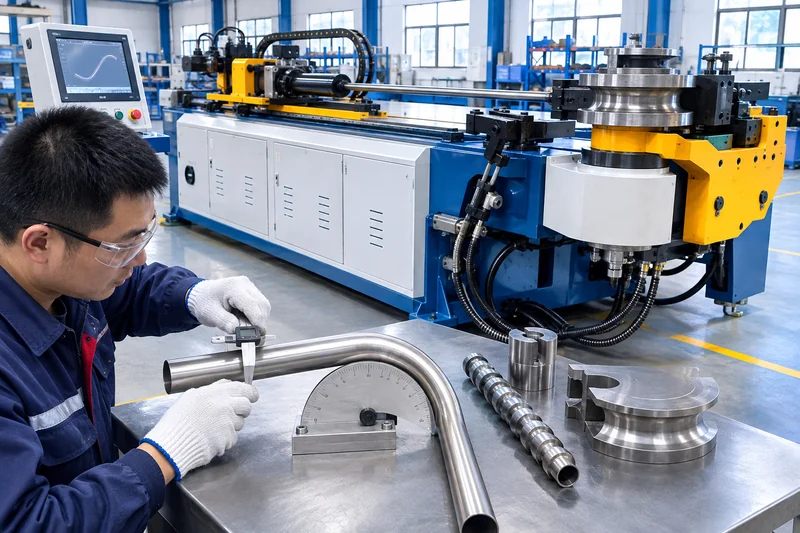

Aerospace tubing projects require more than a machine-size check. Material grade, heat-treatment condition, wall thickness, centerline radius, bend sequence, tooling, inspection criteria, and production volume should be reviewed together. This article focuses on aerospace tube bending, tube forming, tooling, and equipment evaluation. It does not represent Zhuoran as an aerospace raw-material supplier or as an aviation certification body. Final machine and tooling recommendations should be confirmed through drawing review and sample trials.
Aerospace tubing is used in fluid lines, hydraulic systems, fuel systems, ventilation assemblies, structural tube fittings, and other aircraft-related applications. However, choosing equipment for aerospace tube forming is not simply a matter of matching the tube outside diameter to a machine model.
This guide explains the main aerospace tubing materials, common bending risks, tooling considerations, inspection requirements, and the information you should prepare before requesting an equipment recommendation.
What Does Aerospace Tubing Include?
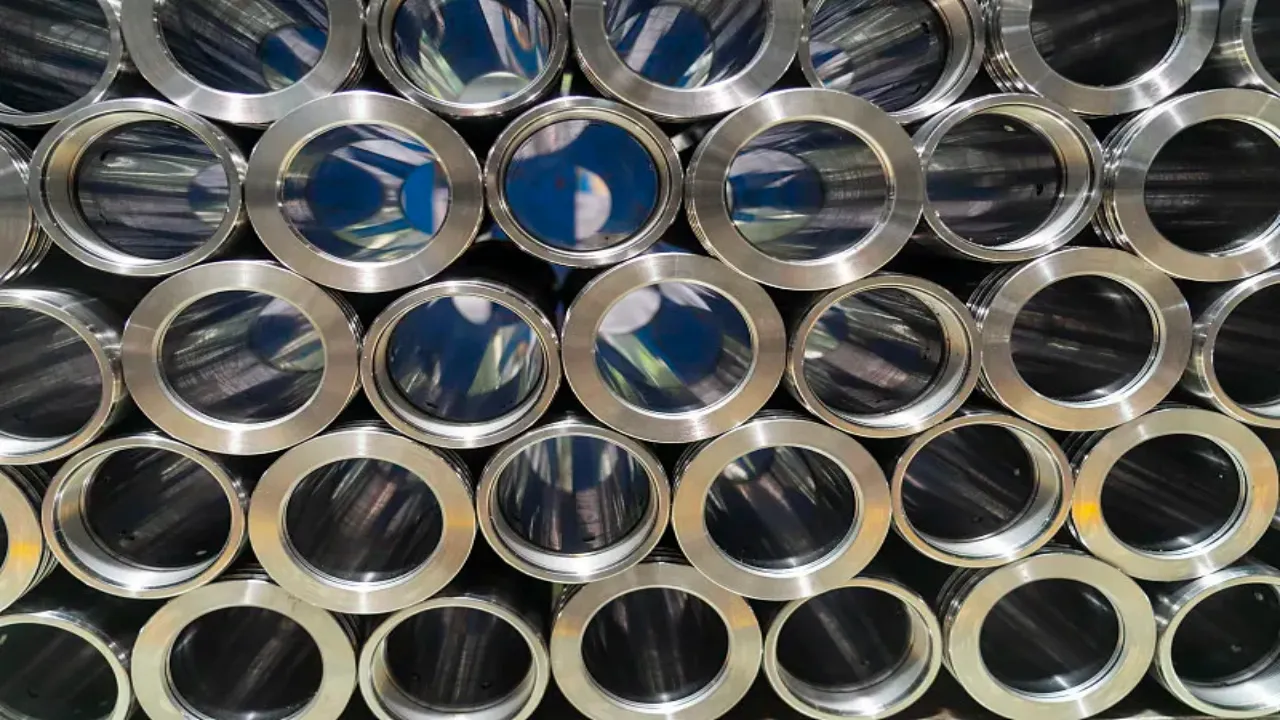
Aerospace tubing can refer to more than one type of tube or application. Depending on the aircraft system and part design, it may include:
- Hydraulic and fuel lines
- Fluid and pressure lines
- Ventilation and auxiliary system tubing
- Engine-related high-temperature tubing
- Structural tube fittings
- Lightweight aluminum tube assemblies
- Tube components with formed or finished ends
The manufacturing route may include cutting, bending, end forming, inspection, and sometimes additional operations such as flaring, swaging, welding, brazing, or heat treatment.
For equipment buyers, the important distinction is between the material itself and the formed tube component. A tube supplier may provide raw tubing, while a tube-processing equipment supplier provides the machines, tooling, automation, and process support needed to turn that tubing into a finished part.
For this reason, your equipment inquiry should include both the raw tube specification and the finished component requirements. You can also review Zhuoran’s aerospace tube-bending application page for the company’s equipment and project-review scope.
Material Selection Sets the Forming Window
Material grade and condition influence the force required, the amount of springback, the risk of cracking, and the tooling needed to control the tube.
Based on the material information supplied for Zhuoran’s project evaluations, the following material groups may be considered for aerospace tube-forming projects.
| Material group | Common grades | Typical applications | Main forming concerns |
|---|---|---|---|
| Titanium and titanium alloys | Grade 2, Grade 5 / Ti-6Al-4V | Aerospace tubing and structural tube fittings | Springback, cracking, wall thinning |
| Nickel-based alloys | Inconel 625, Inconel 718 | High-temperature tubing and engine-related components | High forming force and work hardening |
| Austenitic stainless steel | 304, 304L, 316, 316L, 321 | Fluid lines and structural parts | Springback, wrinkles, and ovality |
| Precipitation-hardening stainless steel | 17-4PH, 15-5PH | Special structural and connection components | Heat-treatment condition affects formability |
| Aluminum alloys | 6061, 6063, 5052, 3003 | Lightweight tubing and auxiliary systems | T6 condition may require special processing |
| High-strength alloy steel | 4130, 4340 | Aerospace structural tubing | Strength, heat treatment, and cracking risk |
| Copper and copper alloys | C12200 and selected copper-nickel alloys | Heat-exchanger and fluid systems | Wall support, dents, and deformation |
Titanium and Titanium Alloys
Titanium is valued in aerospace applications for its strength-to-weight ratio and corrosion resistance. However, titanium tube bending requires careful process control.
Grade 5 titanium, also known as Ti-6Al-4V, can be more difficult to cold-bend than softer tube materials. Springback can make it difficult to hold the target angle. At the same time, excessive forming force or unsuitable tooling can increase the risk of cracking and wall thinning.
The process review should therefore consider:
- Tube OD and wall thickness
- Material condition
- Bend radius
- Bend angle
- Required dimensional tolerance
- Need for internal support
- Surface protection
- Sample inspection method
A machine recommendation based only on nominal tube diameter is not sufficient for Grade 5 titanium.
Nickel-Based Alloys
Inconel 625 and Inconel 718 are used in applications where high-temperature performance and corrosion resistance are important. These alloys can require higher forming force and may work-harden during processing.
This affects the equipment review in several ways:
- Machine capacity must be evaluated against the actual tube and bend geometry.
- Tooling must be strong enough for the forming load.
- The process may need to limit repeated deformation, depending on the material condition and required dimensional tolerance.
- Lubrication and surface protection may require specific consideration.
- Sample trials should check both dimensional repeatability and surface condition.
The forming window may be narrower than it is for ordinary carbon steel or aluminum tubing. Therefore, material grade and condition should be included in the initial RFQ.
Stainless Steel and Precipitation-Hardening Stainless Steel
304, 304L, 316, 316L, and 321 stainless steels are commonly considered for fluid lines and structural parts. They can show springback, ovality, and wrinkle risks depending on wall thickness, bend radius, and tooling design.
The condition of 17-4PH and 15-5PH stainless steel is particularly important. Heat treatment can significantly affect formability. Two tubes with the same nominal grade may behave differently if their material conditions are different.
For these materials, you should provide the material grade, heat-treatment condition, outside diameter, wall thickness, bend radius, surface requirements, maximum allowable ovality, and inspection method.
Aluminum, Alloy Steel, and Copper Alloys
6061, 6063, 5052, and 3003 aluminum alloys may be used for lightweight tubing, ventilation systems, and auxiliary assemblies. The temper condition matters. For example, a T6 condition may require a different process approach from a softer condition.
4130 and 4340 alloy steels may be used for higher-strength structural tubing. Their strength and heat-treatment condition can increase forming force and cracking risk.
Copper and copper-nickel alloys, such as C12200, may require careful wall support because dents and local deformation can affect the finished part. For heat-exchanger and fluid-system components, surface condition and wall integrity may be as important as the final bend angle.
Why Aerospace Tubing Requires Tighter Process Control
Many aerospace tube-forming projects involve a narrow tolerance window. A part may have the correct bend angle but still fail because of excessive wall thinning, an incorrect tube-end position, a surface defect, or unacceptable ovality.
The main risks include:
- Springback
- Cracking
- Wall thinning
- Ovality
- Wrinkles
- Scratches
- Dents
- Bend-position error
- Tube-end-position error
- Variation between production batches
These risks are connected. For example, reducing the bend radius may improve part compactness but increase the need for internal support. Increasing forming force may help control the shape but can also increase surface damage or material stress.
The same machine concept may behave differently when material grade, wall thickness, heat-treatment condition, or bend radius changes. That is why aerospace tube bending should be treated as a process-validation task rather than a simple machine-purchase decision.
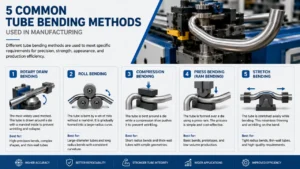
How Should You Match Tube Geometry to the Bending Process?
Before selecting a tube bending machine, prepare the full part geometry rather than only the tube diameter.
Tube Diameter and Wall Thickness
Tube OD and wall thickness affect the required machine size, forming force, mandrel selection, pressure-die loading, ovality risk, wall-thinning risk, and surface contact pressure.
Thin-wall tubes often require more careful internal support. A larger wall thickness may increase forming force. Neither condition can be judged correctly without considering the material and bend radius together.
Bend Radius and Bend Sequence
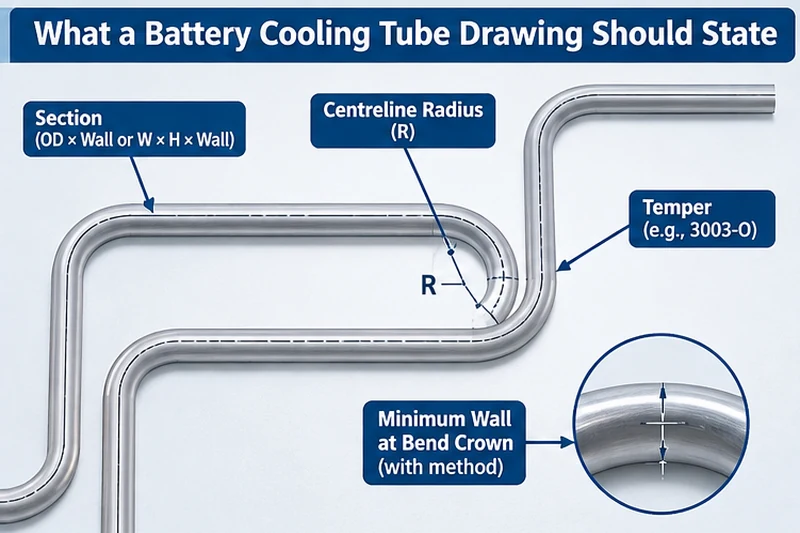
The centerline radius, or CLR, is one of the most important variables in tube bending.
A smaller CLR may require:
- A bending mandrel
- A wiper die
- A pressure die
- More accurate tube positioning
- More careful lubrication
- A more detailed sample trial
For multi-bend parts, bend sequence also matters. The sequence determines whether the machine can access the part, whether the tube will interfere with the tooling, and whether the part can be rotated and repositioned accurately.
You should provide the bend number, bend angle, bend direction, rotation angle, distance between bends, straight lengths, tube-end orientation, and reference datum.
Straight Lengths and End Features
Short straight sections can make clamping and positioning more difficult. End features such as flares, reductions, expansions, or swaged sections can also change the recommended process sequence.
A project may require cutting, bending, end forming, and inspection. In other cases, end forming may need to occur before bending. The correct sequence depends on the part geometry and the required dimensional control.
Tube bending and tube end forming should be evaluated as related but separate processes. A bending mandrel is not the same as an end-forming punch or internal support tool. For end-forming requirements, see Zhuoran’s tube end-forming machine range.
Machine and Tooling Configuration Should Follow the Part
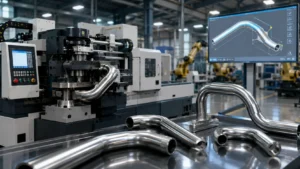
Aerospace tube-forming equipment may include CNC or NC control, but the control system is only one part of the solution.
The complete equipment review may include:
- CNC tube bending machine
- NC tube bending machine
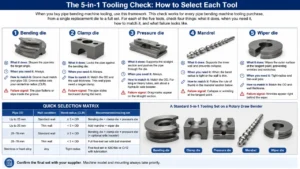
- Bending die
- Clamp die
- Pressure die
- Bending mandrel
- Wiper die
- Multi-stack tooling
- CNC feeding axis
- Tube rotation axis
- Automatic loading
- Automatic unloading
- Inline inspection
- NG sorting
- Line PLC/HMI integration
When Is a Mandrel Needed?
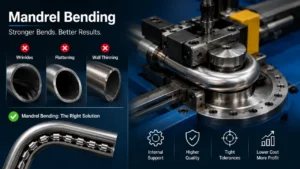
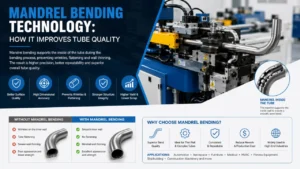
A bending mandrel may be required when the tube is thin-walled, the bend radius is small, or the part has strict ovality and wall-thinning requirements.
Mandrel selection should consider tube OD, wall thickness, material, CLR, bend angle, surface requirements, and internal deformation limits. The purpose of the mandrel is to support the tube during bending. The correct design and setting depend on the actual part.
When Is a Wiper Die Needed?
A wiper die may be considered when the material and bend geometry create a higher risk of wrinkles near the inside of the bend. Its use depends on material behavior, wall thickness, bend radius, bend angle, surface requirements, and acceptable wrinkle level.
A wiper die is not automatically required for every aerospace tube. It should be evaluated through process review and sample testing.
What Does the Pressure Die Do?
The pressure die supports the tube and assists the bending process as the tube moves around the bend die. Its configuration may affect material flow, surface contact, wrinkle control, forming force, and repeatability.
The pressure die, clamp die, mandrel, and wiper die should be considered as a tooling system rather than as isolated components.
When Are Automation and Inspection Added?
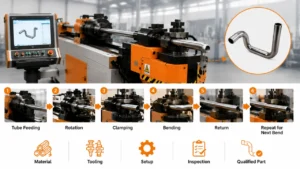
Automation can be configured individually or combined into a complete line. Possible functions include raw tube loading, automatic feeding, tube rotation, automatic cutting, automatic unloading, robotic handling, inline inspection, NG sorting, and integrated line control.
These functions are project-based options. They should be selected according to tube specifications, part geometry, production volume, quality requirements, and plant layout.
Automatic feeding is not the same as automatic raw-material loading. A CNC feeding axis may move the tube through the bending cycle, while a separate loading system may be required to pick and orient raw tubes. You can compare the control-system differences on Zhuoran’s CNC pipe bending machine page and NC pipe bending machine page.
How Should Aerospace Tube Quality Be Verified?
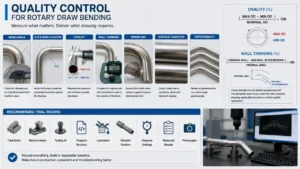
A sample trial should verify both product quality and process stability.
Dimensional Inspection
Typical inspection items may include bend angle, bend position, straight length, tube-end position, end-form dimensions, 3D centerline profile, ovality, wall thickness, and surface condition.
Possible inspection tools include angle measuring equipment, dedicated gauges, calipers and micrometers, coordinate measuring machines, laser or profile measurement, ultrasonic thickness measurement, visual inspection, and approved comparison samples.
The appropriate method depends on the customer drawing and acceptance criteria.
Material and Wall-Thickness Inspection
If wall thinning is important, the measurement method should be agreed before the sample trial. Possible methods include ultrasonic thickness measurement, sectioning when permitted, thickness gauges, and dedicated inspection fixtures.
The result should be connected to the original wall thickness, minimum measured wall thickness, measurement location, measurement method, and acceptance limit.
Surface Inspection
The sample should be checked for cracks, visible wrinkles, scratches, dents, tool marks, surface contamination, and local deformation.
The acceptable level should be based on the approved drawing, customer specification, or approved sample. It should not be invented by the machine supplier.
Sample Trial and Acceptance
Before purchasing equipment, define the sample quantity, tube material and condition, approved drawing, tooling configuration, inspection method, dimensional tolerances, surface requirements, cycle-time measurement method, acceptance criteria, documentation format, and retest procedure.
A sample trial can show whether the proposed equipment and tooling are suitable for the stated part. It does not automatically establish compliance with every aerospace standard or customer-specific requirement.
Customer specifications, applicable industry standards, and regulatory requirements must be confirmed for each project. This article does not define airworthiness or certification requirements.
What Should an Aerospace Tubing RFQ Include?
A complete RFQ helps the supplier recommend the correct machine and tooling package.
Tube and Material Information
- Material grade
- Heat-treatment condition
- Tube OD
- Wall thickness
- Tube length
- Material certificate requirements
- Surface condition
- Batch or lot requirements
Part Geometry
- Bend radius
- Bend angle
- Bend sequence
- Bend direction
- Rotation angle
- Straight lengths
- Tube-end orientation
- 2D drawing or 3D model
- Datum and reference points
- End-forming requirements
Quality Requirements
- Dimensional tolerances
- Ovality limit
- Wall-thinning limit
- Crack requirements
- Wrinkle requirements
- Surface requirements
- Inspection method
- Required inspection records
- Sample approval method
Production and Automation Requirements
- Expected quantity
- Daily or monthly output
- Number of shifts
- Target cycle time
- Automatic feeding requirements
- Automatic unloading requirements
- Tube rotation requirements
- Inline inspection requirements
- NG sorting requirements
- PLC/HMI or MES requirements
Commercial and Acceptance Requirements
- Installation requirements
- Operator training
- Tooling scope
- Sample trial requirements
- FAT or SAT requirements
- Packaging and shipping requirements
- Warranty requirements
- Spare parts
- Technical documentation
The more complete the RFQ is, the less likely you are to receive a machine quotation that excludes important tooling, inspection, automation, or acceptance items.

How Can Zhuoran Support an Aerospace Tube-Forming Project?
Zhuoran is a tube-bending and tube-processing equipment manufacturer. Its project-based support can include CNC tube bending equipment, NC tube bending equipment, tube-processing equipment, tooling evaluation, custom machine development, automation assessment, sample-trial planning, and tube-forming process review.
The company’s supplied material capability information includes titanium alloys, nickel-based alloys, stainless steels, aluminum alloys, high-strength alloy steels, copper, and selected copper-nickel alloys.
However, the final recommendation must be based on the actual project inputs. These include material grade, heat-treatment condition, tube size, wall thickness, bend radius, bend sequence, surface requirements, inspection criteria, production volume, and automation needs.
Zhuoran should not make a final machine or tooling recommendation without reviewing the drawing, tube data, and required acceptance criteria.
For an aerospace tubing project, you can send the following information for an initial review:
- Tube drawing or 3D model
- Material grade and condition
- Tube OD and wall thickness
- Bend radius and bend angles
- Straight lengths
- End-forming requirements
- Dimensional tolerances
- Surface requirements
- Inspection standards
- Expected production volume
- Automation requirements
The final machine model, tooling package, process parameters, sample-trial results, and acceptance criteria should be confirmed in the technical agreement.
Send your aerospace tube project to Zhuoran for a project-based equipment and tooling review.
Frequently Asked Questions
What materials are commonly used for aerospace tubing?
Common aerospace tubing materials include titanium alloys, nickel-based alloys, stainless steels, aluminum alloys, high-strength alloy steels, copper, and selected copper-nickel alloys. The suitable material depends on the system, temperature, pressure, corrosion environment, weight target, and customer specification.
Is Grade 5 titanium difficult to bend?
Grade 5 titanium can be more difficult to cold-bend than softer tube materials. Springback, cracking, and wall thinning may require more detailed tooling and process evaluation. The actual difficulty depends on tube dimensions, material condition, bend radius, and required tolerance.
Does aerospace tubing always require a mandrel?
No. Mandrel requirements depend on wall thickness, material, bend radius, ovality limits, wall-thinning limits, and part geometry. Thin-wall tubes and small-radius bends are more likely to require internal support.
What is the difference between a wiper die and a mandrel?
A mandrel supports the inside of the tube during bending. A wiper die helps control material flow near the inside of the bend and may reduce wrinkle risk. They perform different functions and may be used together when the part geometry requires both.
Can CNC equipment process titanium and Inconel tubing?
CNC equipment may be configured for projects involving titanium or nickel-based alloys, but suitability must be evaluated against tube dimensions, forming force, tooling, material condition, and required quality. Sample trials should be used before final acceptance.
What should be tested before purchasing an aerospace tube bending machine?
You should test dimensional accuracy, bend repeatability, wall thinning, ovality, wrinkles, cracks, surface condition, tube-end position, cycle time, and inspection records. Acceptance criteria should be agreed before the trial.
Can Zhuoran provide a complete aerospace tube-processing line?
Zhuoran can evaluate project-based combinations of tube bending, tube processing, tooling, feeding, unloading, inspection, and line-control functions. The exact configuration depends on the part, production volume, quality requirements, and plant conditions. Final scope must be confirmed through technical evaluation.