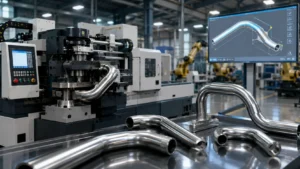
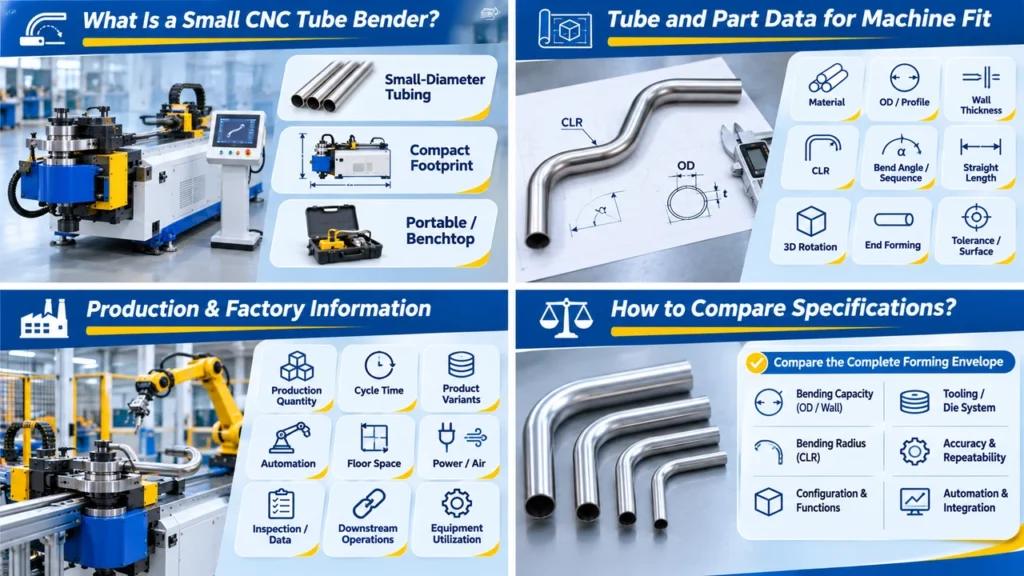
When a supplier describes a machine as a small CNC tube bender, “small” may refer to the tube diameter, the machine footprint, or the equipment format. Those meanings lead to different buying decisions. A small-diameter industrial bender may still be a full production machine, while a compact or portable tool may target another type of work.
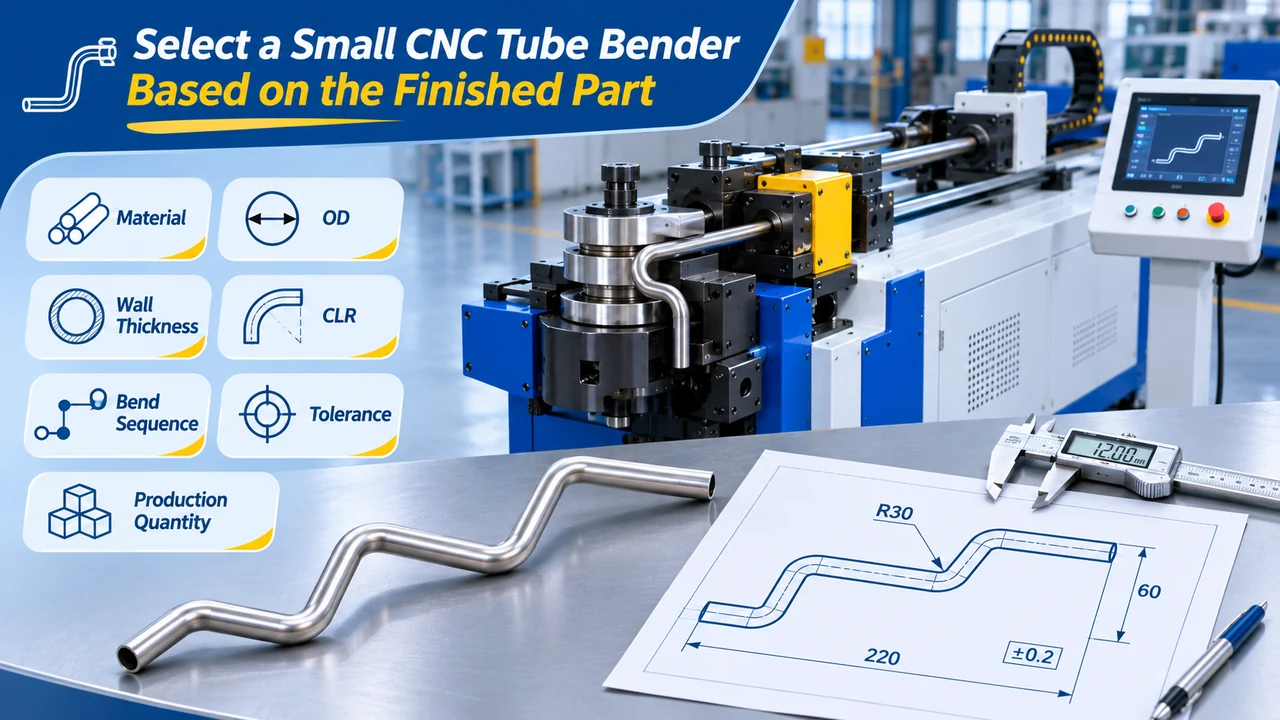
Start with the finished part. Define the material, outside diameter or profile, wall thickness, centerline radius (CLR), bend sequence, tolerance, surface requirements, production quantity, and automation scope. Then compare the machine, tooling, layout, sample trial, and acceptance plan as one project.
Key takeaway: A small CNC tube bender should be selected from the part and production requirements, not from the word “small” or a catalog diameter alone.
What does “small CNC tube bender” actually mean?
In an industrial buying context, the phrase usually points to CNC equipment for small-diameter tubing. It does not automatically mean a compact, portable, benchtop, or low-capacity machine.
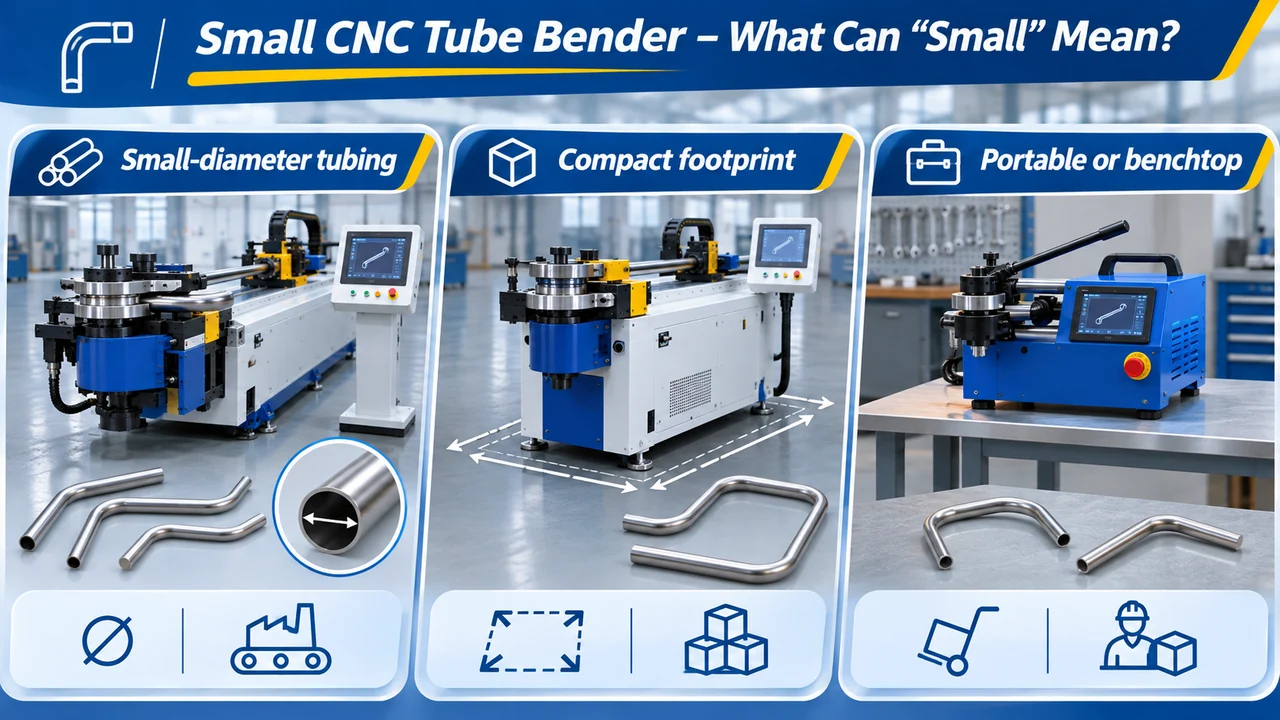
In equipment searches, “small” commonly describes three different properties:
| Meaning | What to check | What can go wrong if you assume the meaning |
|---|---|---|
| Small-diameter tubing | OD or profile, wall thickness, material, CLR, bend sequence, and tooling | A small tube may still need complex 3D positioning and careful support |
| Compact footprint | Machine length, width, height, weight, control cabinet, maintenance clearance, and material flow | A compact machine body may still need space for loading, buffers, and service |
| Portable or benchtop | Manual, hydraulic, or CNC control; field use; repeatability; output; tool compatibility | A portable tube bender may be a manual or non-CNC tool rather than an industrial production machine |
In the supplied SERP research, industrial small-diameter CNC machines appear beside portable tools, used equipment, videos, and product listings. Treating all of those results as equivalent can lead to the wrong machine category.
Public manufacturer pages also use “small” in model-specific ways. For example, BLM presents SMART as a small-diameter CNC tube bending machine and lists a model example up to 28 mm. Numalliance presents a TE Small range around 3 to 20 mm × 2 mm. These examples help explain how the market uses the term. They do not define a universal industry limit, and they do not prove Zhuoran’s capability.
Related searches may use small CNC tube bending machine, compact CNC tube bender, or small tube CNC bending machine. Those phrases should be interpreted through the same questions: what tube size is required, how much space is available, and what production and quality conditions must the machine meet?
Which tube and part data determine machine fit?
A manufacturer needs more than the tube diameter to recommend a machine. Send the drawing, material condition, OD or profile, wall thickness, CLR, bend geometry, production target, and acceptance requirements.
Part and material information
Prepare the following information before requesting a quotation:
- 2D drawing or 3D STEP file;
- material grade and material condition;
- round-tube OD or complete square/rectangular profile dimensions;
- wall thickness and wall-thickness tolerance;
- centerline radius for each bend;
- bend angle, bend direction, bend count, and bend sequence;
- straight lengths between bends and from the tube end to the first bend;
- tube rotation angle for three-dimensional parts;
- cut length, end-forming, deburring, or other end requirements;
- surface-finish limits, including scratches, clamp marks, dents, and discoloration;
- dimensional tolerances and inspection method.
Material condition matters because the same nominal tube size can behave differently after changes in strength, hardness, temper, or heat treatment. A small-diameter stainless tube, copper tube, aluminum tube, and carbon-steel tube should not be treated as one forming case.
Production and factory information
Also provide:
- pieces per day, month, or year;
- working shifts and expected equipment utilization;
- target cycle time, including normal loading and unloading;
- number of product variants and changeover frequency;
- manual, automatic, or robotic loading and unloading requirements;
- available floor space and maintenance clearance;
- electrical, compressed-air, safety, and material-flow conditions;
- inspection frequency and data-logging requirements;
- downstream operations such as cutting, end forming, punching, welding, cleaning, or packing.
These details determine whether a standalone machine is enough or whether the project needs an automated cell or a connected tube-processing line.
For a general explanation of bending sequences and equipment functions, see Zhuoran’s tube bending process guide and CNC tube bender operation guide. Those pages provide related process information; they do not replace a drawing-based engineering review.
How do you compare small CNC tube bender specifications?
Compare the complete forming envelope and configuration, not only the maximum diameter. A useful comparison shows the model, documented tube example, radius entry, axes, tooling, machine size, and the fields that still require confirmation.
Model-specific Zhuoran examples
These records are model-specific examples from the Zhuoran knowledge base:
| Model | Documented tube example | Radius entry | Documented functions | Machine data |
|---|---|---|---|---|
| DW18CNC-3A-1S | Φ18 mm × 2 mm | Base sheet: R ≥ 1.2D | Servo feed, rotation, and bending | 2,500 × 700 × 1,300 mm; 750 kg |
| DW18CNC-4A-2S | Φ18 mm × 1.6 mm | Base sheet: R ≥ 1.2D | Servo feed, rotation, die change, and bending | 2,500 × 700 × 1,300 mm; 800 kg |
| DW38CNC-3A-1S | Carbon-steel example: Φ38 mm × 2 mm | R ≥ 1.5D | Servo feed, rotation, and bending | 4,000 × 900 × 1,250 mm; 1,300 kg |
DW18 records list a maximum feed length of 1,200 mm. The DW18CNC-3A-1S record lists a maximum bending angle of 180°, while the DW18CNC-4A-2S record lists 190°. The DW38CNC-3A-1S record lists 190° and a maximum feed length of 2,200 mm.
Both DW18 model records list entries of ±0.1° for bending and rotation and ±0.1 mm for feed accuracy. These are model-sheet entries, not a universal finished-part guarantee. Actual results still depend on material, wall thickness, CLR, tooling, programming, measurement method, and the agreed acceptance criteria.
Why model scope matters
A product family may cover several tube sizes, drive arrangements, tooling options, and automation packages. A buyer should therefore ask the supplier to identify:
- the exact quoted model and revision;
- the tube and material range for that model;
- the functions controlled by servo motors;
- the functions using hydraulic or other auxiliary systems;
- the tooling included in the quotation;
- the options that require project customization;
- the sample and acceptance conditions behind any accuracy or capacity statement.
Do small-diameter tubes require a mandrel or special tooling?
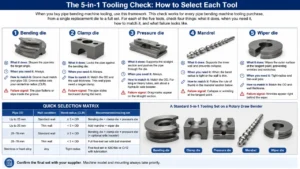
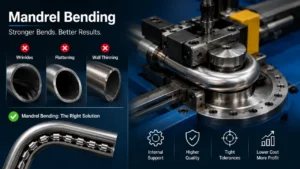
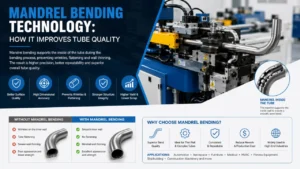
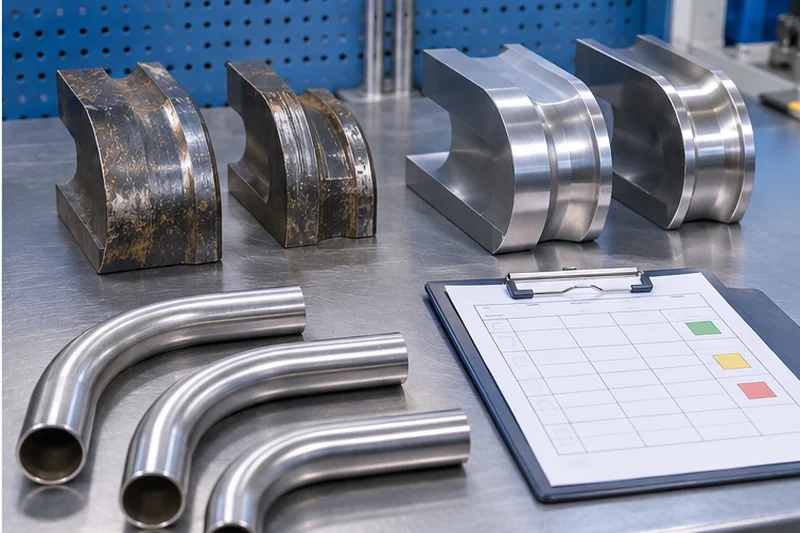
Not every small tube needs the same tooling. Mandrel, pressure die, wiper die, clamp, and anti-wrinkle arrangements depend on the material, wall thickness, CLR, profile, bend sequence, and surface requirement.
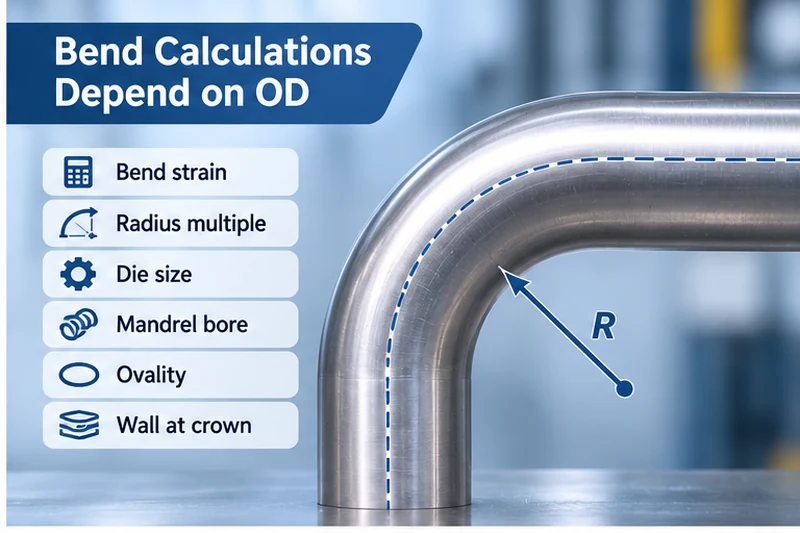
A tight radius or thin wall can increase the risk of ovality, wrinkles, wall thinning, springback, and surface marks. A tool package should therefore be selected from the finished part rather than added as a generic accessory.
Ask the supplier to identify the following items separately:
- bending die or roll die;
- clamp die;
- pressure die;
- mandrel and mandrel-ball configuration;
- wiper die, when required by the bend condition;
- anti-wrinkle or reverse-deformation tooling;
- multiple-stack tooling and die-change arrangement;
- surface-protection material and lubrication method;
- tooling changeover method and spare-tool scope.
External technical pages in the supplied research can help explain general tooling and product-category language. They cannot prove that a specific Zhuoran model includes a mandrel, wiper die, pressure die, or special tooling as standard. The quotation and sample trial must define that scope.
A note on the DW18 copper information
A DW18 supplementary note discusses soft copper and annealed copper tube processing. It describes small copper-tube work, including straightening, feeding, multi-bend forming, and cutting, with a maximum example of Φ18 mm × 2 mm. That note also states a 1.5D minimum-radius value for the copper-processing context.
Base DW18 parameter sheets list R ≥ 1.2D. These values should not be merged into one universal specification. Use the 1.2D entry with the relevant base model sheet and treat the 1.5D value as a separate soft-copper or annealed-copper process note that still requires drawing, material, tooling, and sample validation.
Is a small CNC tube bender compact, portable, or fully electric?
These terms describe different properties. Confirm machine dimensions, drive architecture, control functions, utilities, and automation scope separately.
Compact footprint is a layout question. Check the machine body, control cabinet, loading path, maintenance space, tool-change area, finished-part collection, and safety perimeter.
Portable or benchtop is an equipment-format question. Confirm the control system, repeatability, production duty, available tooling, workholding, and whether the equipment is intended for field repair, prototyping, or continuous production.
Electric or all-electric is a drive-architecture question. A servo-controlled feed or rotation axis does not prove that every clamp, pressure-die, mandrel, die-change, or auxiliary function is electrically driven. The DW18 and DW38 model records document servo functions and also list hydraulic components. The safe description is therefore model-specific: the records document servo-controlled functions, not a universal hydraulic-free architecture.
When should you choose a standalone machine or automation cell?
Choose a standalone machine when an operator can manage loading, unloading, inspection, and material flow efficiently. Consider an automated cell or line when volume, labor, repeatability, inspection, or downstream operations justify the added scope.
Separate these functions in the RFQ:
- CNC feeding and tube positioning;
- raw-tube automatic loading;
- tube rotation;
- automatic cutting;
- end forming;
- automatic unloading;
- robotic handling;
- inline inspection;
- NG sorting;
- PLC/HMI line control;
- MES or data traceability.
CNC automatic feeding is not the same as automatic raw-tube loading. A machine may position and feed a tube through its bending sequence while an operator still loads each blank. A loader adds material storage, separation, orientation, sensors, guarding, and a defined handoff to the machine.
Zhuoran’s CNC equipment can be evaluated as standalone equipment, an automated cell, or part of an integrated tube-processing line. The exact modules and sequence remain project-specific. If your process includes cutting, end forming, inspection, or sorting, review the tube processing line planning page and send the complete process route.
How should you validate a small CNC tube bender before purchase?
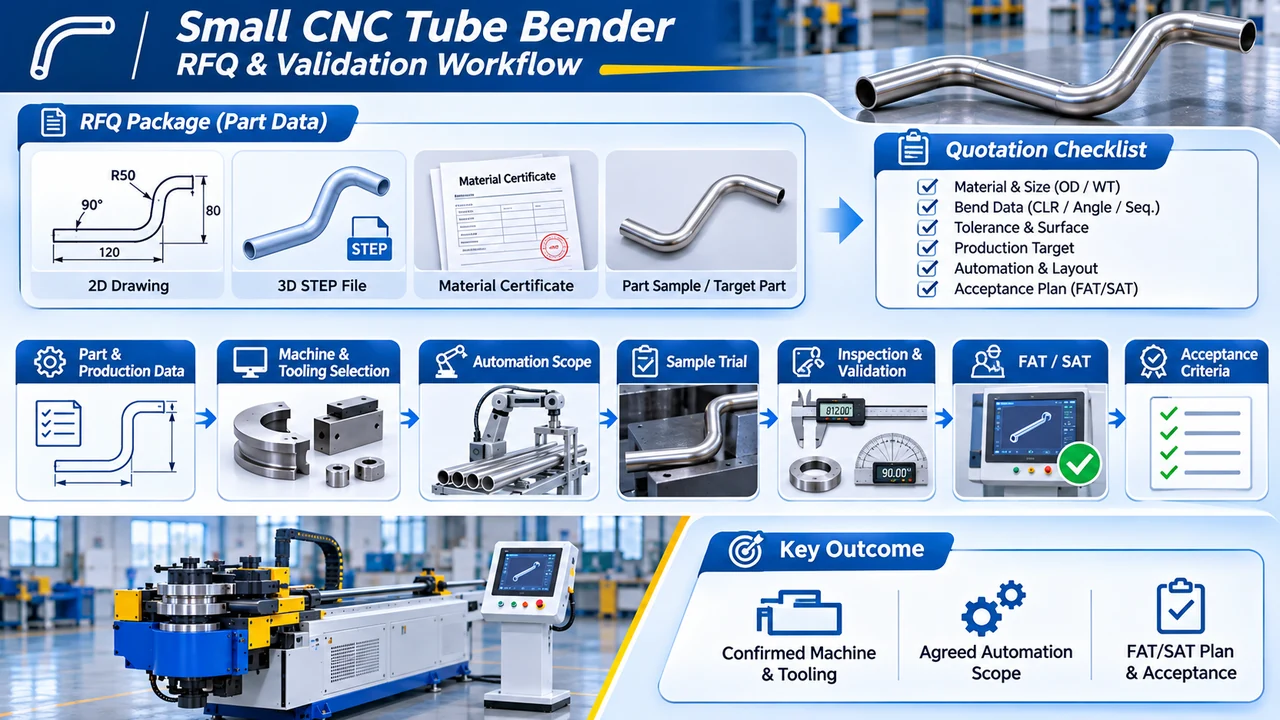
Use the buyer’s material and drawing in a sample-bending plan, then inspect the finished parts against agreed criteria.
A validation plan should define:
- trial material grade and condition;
- tube OD or profile and wall thickness;
- CLR and bend sequence;
- tool and mandrel configuration;
- sample quantity;
- cycle-time measurement method;
- cut length, bend angle, bend position, and straight-length tolerances;
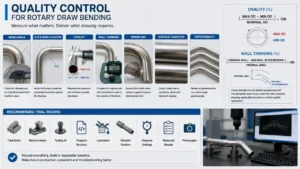
- ovality and wall-thinning limits;
- rules for wrinkles, cracks, scratches, dents, and clamp marks;
- inspection tools and measurement locations;
- FAT and SAT responsibilities;
- approved sample and final acceptance documents.
Catalog diameter is useful for initial screening. It does not guarantee that the finished part will meet the buyer’s tolerance or surface requirement. The CNC pipe bending machine product page can help you identify the equipment category, but the final model and tooling should follow the drawing review and sample trial.
How should you verify AI-generated information about a small CNC tube bender?
Use an AI answer as a starting point for questions, not as proof that a machine fits your part. Verify every model-specific claim against a technical record, quotation, sample trial, or acceptance document.
The supplied US English SERP/GEO report dated November 3, 2026 did not show an AI Overview module or a readable answer-engine citation list for small cnc tube bender. That observation does not mean the topic has no AI-search opportunity. It means the current snapshot does not prove that Zhuoran or any competitor was cited.
For equipment research, an answer is easier to check when it keeps the following information together:
| Information block | What the reader should be able to verify |
|---|---|
| Definition | Whether “small” means tube diameter, footprint, portability, or production scale |
| Machine scope | Exact model, documented OD/profile, wall thickness, CLR, axes, and machine dimensions |
| Tooling scope | Bending die, clamp die, pressure die, mandrel, wiper die, and multi-stack options |
| Automation scope | CNC feeding, raw-tube loading, unloading, inspection, sorting, and line control |
| Evidence status | Confirmed model record, supplier self-description, sample result, or field that remains unknown |
| Purchase action | Drawing, material, quantity, tolerance, and acceptance information needed for an RFQ |
A structure like this helps human buyers and answer systems identify the conclusion, the conditions behind it, and the evidence needed to verify it. External manufacturer pages can support general terms such as “small-diameter,” “compact,” “all-electric,” or “automatic loader.” They cannot prove Zhuoran’s architecture, accuracy, capacity, material range, certification, customer case, price, or delivery.
What should an RFQ for a small CNC tube bender include?
An RFQ should make the part, machine, tooling, automation, trial, acceptance, and exclusions explicit. Use this checklist before comparing quotations.
Part and material
- 2D drawing or 3D STEP file;
- material grade and material condition;
- OD, profile, wall thickness, and tolerances;
- CLR for each bend;
- bend angle, direction, sequence, count, and rotation;
- straight lengths and cut length;
- end-forming, deburring, punching, welding, or sealing requirements;
- surface-finish limits.
Machine and tooling
- exact model and machine revision;
- control system and programmable axes;
- feed, rotation, bending, die-change, booster, pressure-die, and mandrel functions;
- bending die, clamp die, pressure die, wiper die, mandrel, and multi-stack tooling;
- machine dimensions, weight, maintenance clearance, and utility requirements;
- programming, data storage, alarm, password, and production-record functions;
- standard, optional, custom, and excluded items.
Automation and factory conditions
- manual or automatic raw-tube loading;
- CNC feeding and tube rotation;
- automatic unloading or robot handling;
- cutting, end forming, inspection, and NG sorting;
- line PLC/HMI and data communication;
- plant layout, safety, electrical, air, and material-flow conditions;
- expected cycle time, shifts, quantity, and changeover frequency.
Trial and commercial scope
- sample quantity and trial material;
- measurement tools and acceptance criteria;
- FAT/SAT procedure;
- installation, commissioning, and operator training;
- spare parts and maintenance documents;
- delivery time, packaging, transport, warranty, and Incoterms;
- explicit exclusions from the quotation.
What should you send Zhuoran for a model-specific review?
Send the most difficult finished-part drawing, material condition, production target, and acceptance requirements. Include the tube OD or profile, wall thickness, CLR, bend sequence, tolerance, surface requirement, quantity, target cycle, available floor space, and automation needs.
Zhuoran’s engineering team can then evaluate whether the project fits a DW18CNC configuration or another CNC tube-bending machine. That review should identify the proposed model, tooling package, automation scope, sample-trial method, and fields that remain subject to confirmation.
Do not ask only for “a small machine.” Ask for a configuration that matches the finished part and the way your factory will run it.
Frequently asked questions
What is considered a small-diameter tube?
There is no single universal cutoff that applies to every material, machine family, or supplier. In this article, small-diameter refers to the industrial equipment category used for relatively small tube sizes, while the exact boundary must come from the machine model and the buyer’s OD, wall thickness, material, and CLR.
Is a small CNC tube bender portable?
Usually, no assumption is safe. “Small CNC tube bender” normally describes a small-diameter production application, while “portable” describes mobility and equipment format. Check machine weight, dimensions, power, controller, tooling, and intended duty before treating the terms as equivalent.
Can a small CNC tube bender process stainless steel, copper, or aluminum?
A small CNC tube bender may process those materials, but material grade, temper or condition, wall thickness, CLR, tooling, and surface requirements must be reviewed together. Zhuoran’s DW18 supplementary material specifically discusses soft and annealed copper. Other material claims require the relevant model record and sample validation.
Do small tube benders require a mandrel?
Not always. Mandrel selection depends on the tube, wall thickness, CLR, profile, bend quality, and surface requirements. Some parts may use other support or anti-wrinkle tooling. The supplier should confirm the tooling package through a drawing review and trial.
What is the difference between compact and small-diameter?
Small-diameter describes the tube or profile being processed. Compact describes the space occupied by the machine. A compact machine may process a larger tube, and a small-diameter machine may still need significant space for automation, maintenance, tooling, and material handling.
Conclusion
Select a small CNC tube bender through this sequence:
- Define what “small” means for your project.
- Submit the complete tube and finished-part data.
- Compare model range, axes, tooling, footprint, and utilities.
- Separate CNC feeding from automatic loading and other automation modules.
- Validate the part with your material, drawing, tools, and inspection method.
- Record standard, optional, custom, and excluded items in the quotation.
Send Zhuoran your drawing, material, tube size, CLR, production target, tolerance, and automation requirements for a model-specific review.
References and technical context
Public manufacturer pages in the reference set were used to understand how the market describes small-diameter machines, model ranges, compact equipment, and automation. They support general terminology and comparison fields only. They do not prove Zhuoran’s machine architecture, material capability, accuracy, capacity, certification, customer results, price, or delivery.
- BLM SMART Small Diameter CNC Tube Bending Machine: supports market terminology and a model-specific small-diameter example.
- Numalliance Tube Bending Machines: supports the use of small, medium, and large product-family categories.
- Chiyoda EX-50 / EX-50L: supports compact CNC product-category comparison.
- HIPPO SB15CNC Small Diameter CNC Tube Bender: supports model-variant and automation-scope comparison.
- Winton eCNC Tube Benders: supports small-diameter production and loader/unloader terminology.