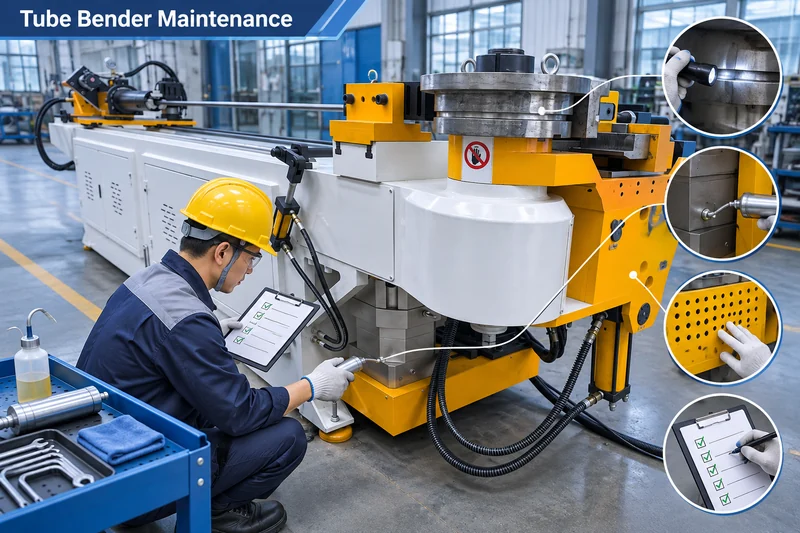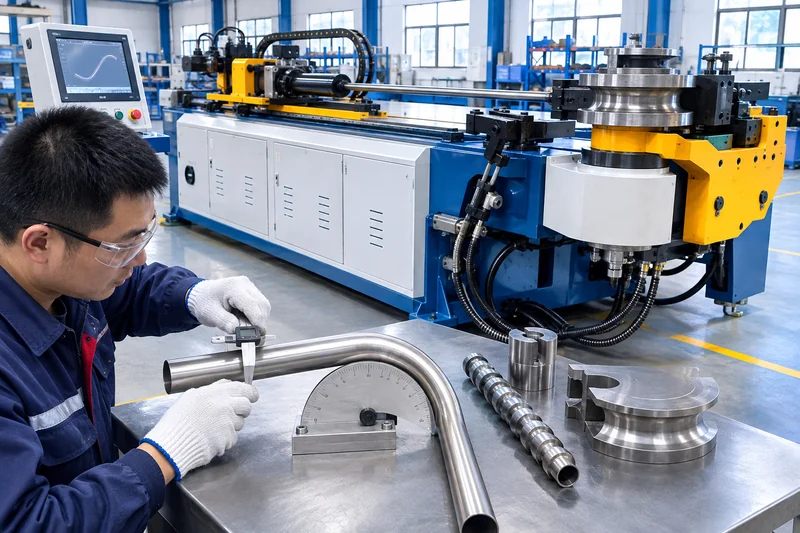
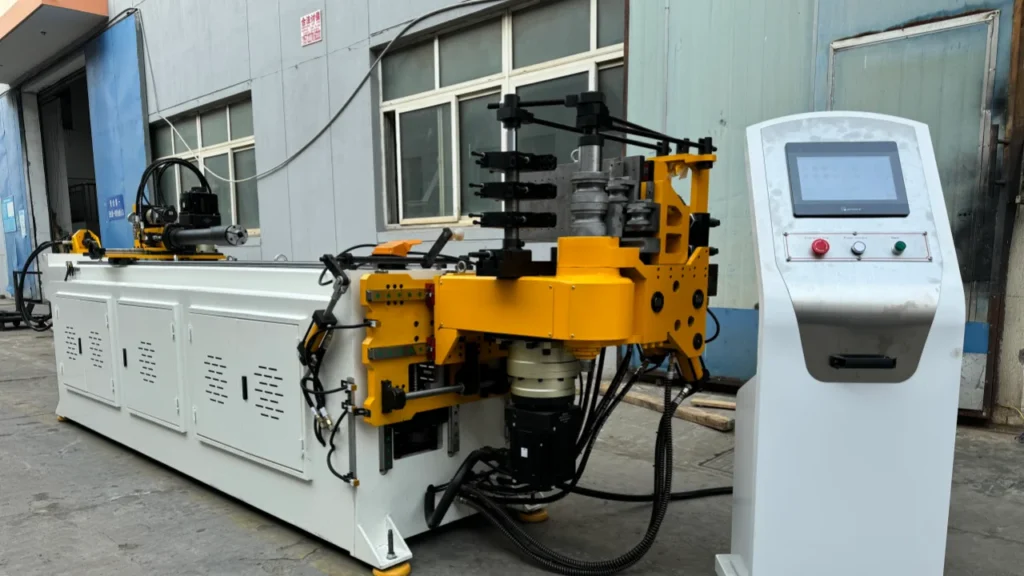
When you search for CNC electric pipe bender manufacturers, you may see terms such as electric CNC, all-electric, hybrid, and hydraulic used in different ways. A supplier may use “electric” to describe the main bending axes, the control system, or an entire machine family. Those descriptions are not automatically equivalent.
Start with the complete project: tube material, outside diameter, wall thickness, centerline radius (CLR), bend sequence, tooling, automation, trial method, and acceptance criteria. Ask each manufacturer to identify which functions are standard, optional, or project-custom.
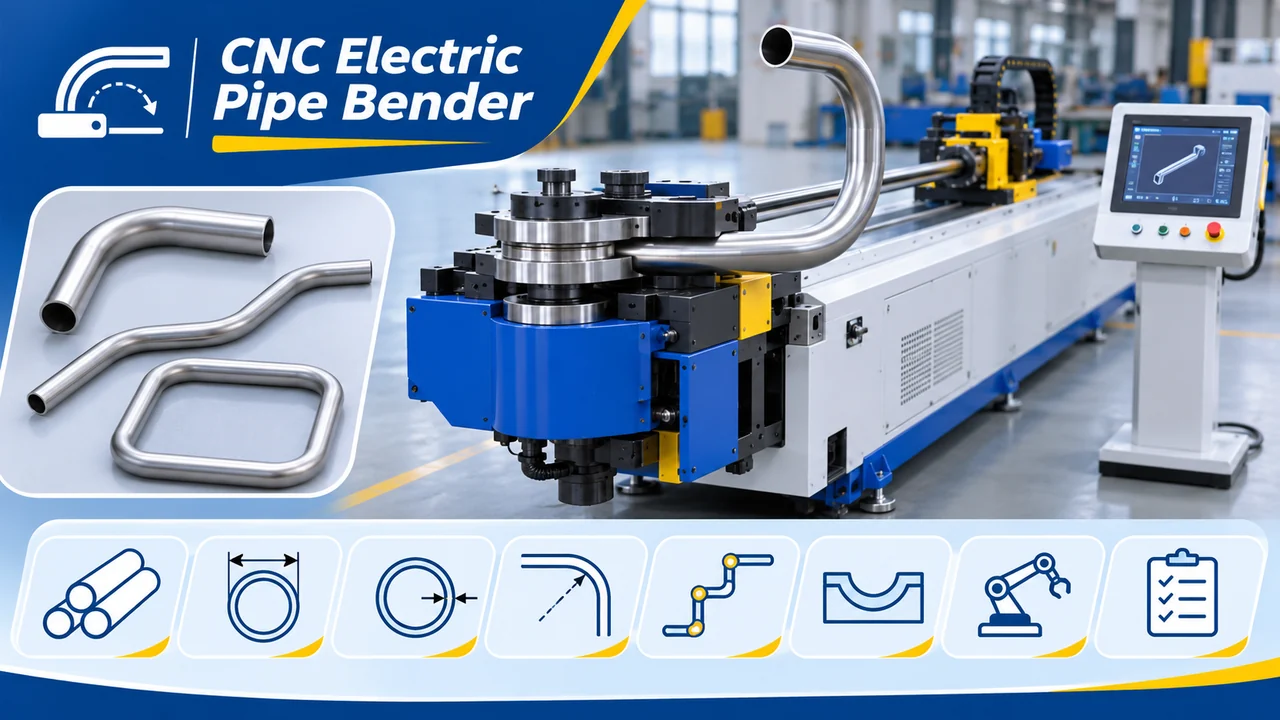
Use the guide to compare CNC electric pipe and tube bender manufacturers by machine architecture, evidence, and RFQ requirements instead of relying on an unsupported ranking.
Buyers may enter the same search in several forms, including CNC electric pipe bending machine manufacturers and CNC electric tube bender manufacturers. These phrases describe closely related supplier searches, so one decision page is more useful than several competing pages.
Key takeaway: The word “electric” is a starting point, not a complete machine specification. Confirm the drive source of each relevant axis, match the machine to the finished part, and validate the result with a sample-bending and acceptance plan.
What do CNC, electric, all-electric, hybrid, and hydraulic mean?
CNC describes how the machine is controlled and programmed. Electric describes a drive or actuation approach. All-electric is a stronger architecture claim that must be verified by model. Hybrid means that different drive systems or technologies are used in one machine. Hydraulic machines use hydraulic power for one or more forming or auxiliary functions.
These terms overlap, but they answer different questions:
| Term | What it usually describes | What you still need to confirm |
|---|---|---|
| CNC | Programmable control of feed, rotation, bending, and other axes | Which axes are programmable, how programs are entered, and which functions are included |
| Electric CNC | A CNC machine with one or more electrically driven functions | Which axes use servo/electric drives and whether hydraulic auxiliaries remain |
| All-electric | A machine architecture presented as electric across the relevant motion system | The exact model architecture, axis list, auxiliaries, and technical definition used by the supplier |
| Hybrid CNC | A machine combining electric/servo control with hydraulic or other power functions | Which functions are electric and which are hydraulic or otherwise powered |
| Hydraulic tube bender | A machine using hydraulic power for forming or motion functions | Control method, programmable axes, energy system, tooling, and automation scope |
Supplier terminology cannot replace a technical sheet. One manufacturer may list separate electric and hybrid machine families, while another describes servo-controlled axes alongside hydraulic auxiliary components. Your RFQ should therefore request an axis-by-axis and function-by-function description.
Control system versus drive architecture
A touch screen, PLC, or industrial CNC controller tells you about the control layer. It does not by itself prove how every mechanical function is powered. Similarly, a servo motor on the feed axis does not prove that clamping, pressure-die movement, mandrel extraction, or other auxiliaries are also electric.
Ask the manufacturer to separate:
- feed axis and feed motor;
- tube rotation axis and rotation motor;
- bending axis and bending motor;
- die-change or stack-change movement;
- booster or pressure-die movement;
- mandrel extraction and support functions;
- clamping and hydraulic auxiliaries;
- loading, unloading, inspection, and line-control modules.
For engineering and procurement teams, the axis-by-axis list creates a comparable specification when supplier labels use different definitions.
Does an electric CNC tube bender have electric drive on every axis?
Not necessarily. You must verify the drive source and scope of every relevant axis by machine model. “Electric CNC” may identify a product category, while “all-electric” may describe a specific architecture. Neither term should be assumed to include automatic loading, inspection, or complete line integration.
What the Zhuoran model records show
Zhuoran’s confirmed model records provide useful examples of servo-controlled CNC motion:
- The DW38CNC-3A-1S record documents servo-controlled feeding, rotation, and bending. It lists a carbon-steel example of approximately Φ38 × 2 mm and a recorded minimum-radius entry of R ≥ 1.5D.
- The DW50CNC-3A-1S record documents servo-controlled feeding, rotation, and bending. It lists a carbon-steel example of approximately Φ50 × 2 mm and a recorded minimum-radius entry of R ≥ 1.5D.
- The DW63CNC-4A-2S record states that feeding, rotation, die change, and bending can be servo-controlled. The phrase “can be” matters because the exact configuration still requires confirmation.
- The DW75CNC-3A-1S record documents servo-controlled feeding, rotation, and bending. It lists a carbon-steel example of approximately Φ75 × 6 mm and a recorded minimum-radius entry of R ≥ 1.5D.
These records support a model-specific statement about documented servo functions. They do not support the stronger statement that the entire DW series is all-electric. The same model records also list hydraulic motors and pumps, so “servo-controlled” should not be rewritten as “hydraulic-free.”
How to ask the manufacturer the right question
Instead of asking only, “Is this machine electric?” ask:
- Which axes are servo-driven on the quoted model?
- Which functions use hydraulic power or other auxiliary systems?
- Are feed, rotation, bending, die change, pressure die, booster, and mandrel functions included in the same configuration?
- Does the quoted machine include only CNC feeding, or also raw-tube automatic loading?
- Which options are included in the base price, and which require project customization?
These questions keep a servo-controlled machine, a fully electric machine, and a hybrid machine from being compared as identical systems.
What tube and part data should you send before comparing manufacturers?
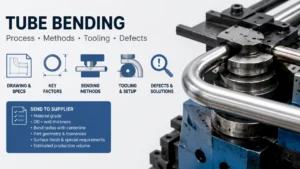
Send a controlled drawing or 3D model together with material, production, and acceptance data before asking for a final machine recommendation. A manufacturer cannot reliably select the machine from the material name or outside diameter alone.
Minimum technical data
Include:
- material grade and condition, such as annealed, cold-worked, or heat-treated;
- round, square, rectangular, oval, or special profile;
- outside diameter or complete section dimensions;
- wall thickness and tolerance;
- centerline radius for every bend;
- bend angle, bend count, bend order, and distance between bends;
- tube rotation between bend planes;
- straight lengths and tube-end orientation;
- cutting length or blank length;
- end forming, holes, threads, welded features, or sealing surfaces;
- dimensional, profile, surface, and assembly tolerances.
For three-dimensional parts, provide the datum and coordinate direction. If your drawing uses 3D CAD, identify the file format and the software workflow the supplier supports. Do not assume that every controller or programming system imports every CAD format directly; confirm the actual machine-side workflow.
Production and factory data
Also state:
- parts per day, month, or shift;
- number of shifts and planned operating time;
- product mix and changeover frequency;
- target cycle time, including loading and unloading;
- manual, automatic, or robotic handling requirements;
- power, compressed-air, floor-space, and safety conditions;
- inspection frequency and data-logging needs;
- whether cutting, end forming, punching, welding, cleaning, or packing follows bending.
With these inputs, a manufacturer can decide whether the project needs a standalone bender, an automated cell, or a connected tube-processing line. For general process context, review Zhuoran’s tube bending process guide and CNC tube bender operation guide. These pages explain related topics; they do not replace a project-specific machine review.
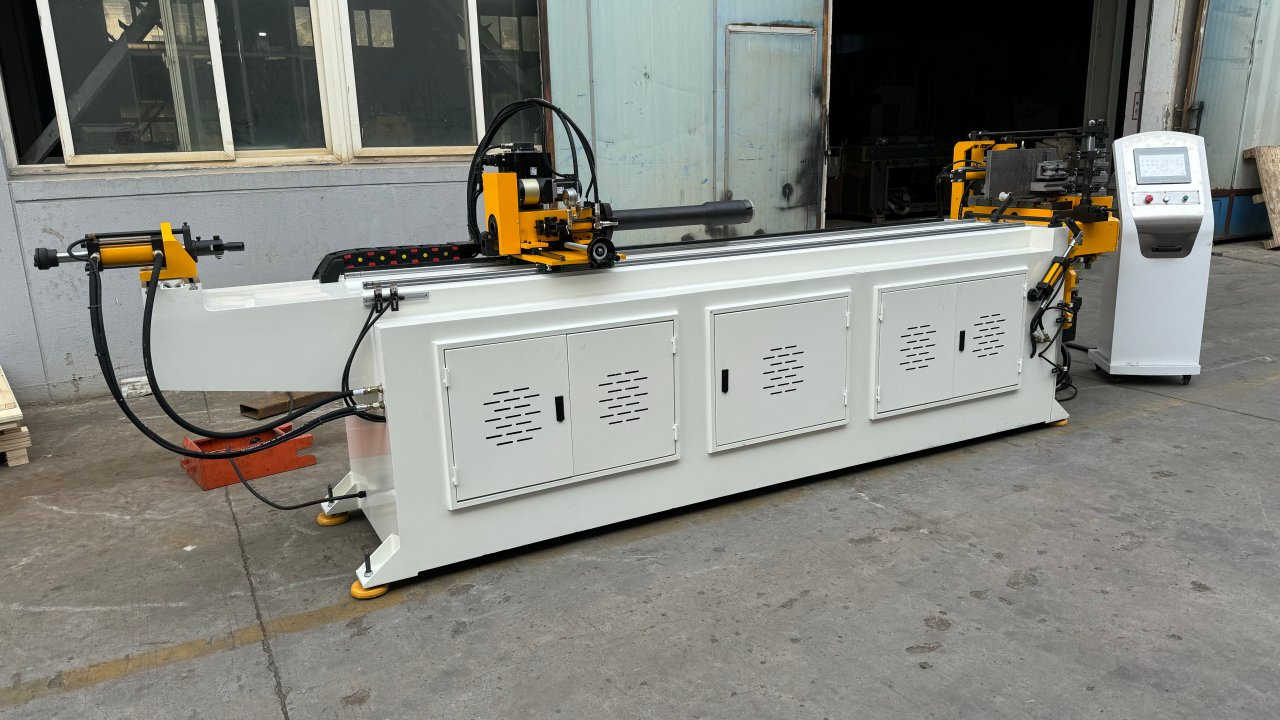
How should you compare machine range, axes, tooling, and automation?
Compare the complete forming process, not only the maximum diameter or number of axes. A useful comparison shows the supplier’s answer, the evidence behind it, and the fields that remain unknown.
| Comparison field | What to ask | Evidence to request |
|---|---|---|
| Working range | OD, WT, profile, material and CLR limits for your part | Model technical sheet and drawing review |
| Axes | Feed, rotation, bending, die change, booster and other axes | Axis list and drive description |
| Tooling | Bend die, clamp die, pressure die, mandrel, wiper die and multi-stack | Tooling list, layout or design confirmation |
| Programming | XYZ/YBC input, compensation, part storage and error handling | Controller information and sample program workflow |
| Surface protection | Contact materials, lubrication and allowable marks | Trial method and approved surface standard |
| Automation | Feeding, loading, cutting, unloading, inspection and sorting | Itemized scope and process layout |
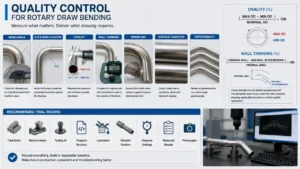
| Acceptance | Dimensions, sample quantity, inspection tools and pass/fail rules | Trial report and FAT/SAT plan |
Tooling is part of machine selection
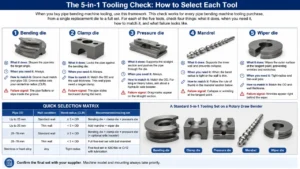
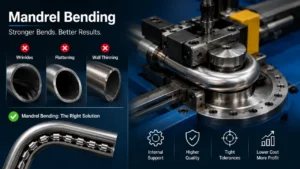
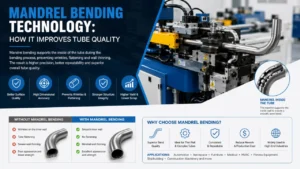
A machine can have enough nominal diameter capacity and still require the wrong tooling for your part. Tight CLR, thin wall, difficult material, multiple close bends, and strict surface requirements may change the need for a mandrel, wiper die, pressure die, booster, or multi-stack arrangement.
Ask the manufacturer to identify which tooling is included and which is optional. The final tooling decision should be based on your material, OD, wall thickness, CLR, bend sequence, surface requirements, and inspection criteria.
CNC feeding is not raw-material automatic loading
CNC feeding moves and positions the tube during the bending cycle. Automatic loading normally means moving raw tubes from a rack, bundle, or storage area into the process. These functions may be connected, but they are not the same quotation item.
Your RFQ should list separately:
- CNC feed and tube rotation;
- raw-tube storage and separation;
- automatic loading;
- cutting or cut-to-length;
- automatic unloading;
- robot handling;
- inspection and NG sorting;
- PLC/HMI line control and MES connectivity.
What is the difference between a standalone bender, an automated cell, and a processing line?
The difference is the number of connected process and handling modules, not simply whether a machine is called “automatic.”
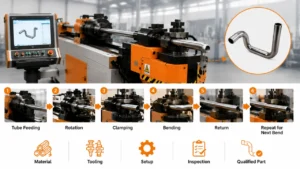
A standalone CNC tube bender normally focuses on feeding, rotating, and bending. An automated cell may add loading, unloading, part handling, cutting, inspection, or collection. An integrated tube-processing line connects several operations and coordinates their sequence through controls and interfaces.
For example, a project route may be:
Raw tube → loading → cutting → CNC feeding → CNC bending → end forming → inspection → OK/NG sorting
Another product may require end forming before bending, or a separate cutting and deburring step after bending. The correct order depends on the part and downstream assembly requirements.
Zhuoran can evaluate standalone CNC equipment, automatic cells, and integrated tube-processing lines. However, the exact modules remain project-specific. If your project needs multiple operations, see the tube processing line planning page and submit the full process route rather than asking for an “automatic bender” without further detail.
What evidence should a CNC electric tube bender manufacturer provide?
Ask for evidence that connects the quoted model to your part, tooling, trial, and acceptance requirements. A product page is useful for initial screening, but it is not a substitute for a project review.
Minimum evidence package
Request:
- Model technical sheet and current configuration.
- Axis-by-axis drive description.
- Working range for your OD, WT, material, profile, and CLR.
- Tooling list and tooling-scope statement.
- Sample-bending proposal using your material and drawing.
- Sample quantity and inspection method.
- Dimensional, surface, and assembly acceptance limits.
- FAT/SAT or another agreed acceptance procedure.
- Installation, commissioning, training, and service scope.
- Spare-parts and maintenance information.
What external technical sources support
Public manufacturer pages can help you understand how the market uses terms such as all-electric, hybrid, axes, diameter range, multi-stack, automation, and tube-processing cells. They can also show which comparison fields are commonly displayed by equipment suppliers.
For example, Unison’s CNC tube-bender page separates all-electric and hybrid machine families. Pines’ electric CNC page displays electric CNC options and programmable functions. Winton’s CNC bender page connects CNC benders with automated fabrication cells. These pages support terminology and market-context analysis; the linked references are listed at the end of this article.
What external sources cannot prove
Those sources cannot prove:
- that a Zhuoran model has the same architecture;
- that Zhuoran can meet your material, CLR, or tolerance;
- that a quoted accuracy or output applies to your part;
- that Zhuoran has a particular certification or customer case;
- that a function is included in your quotation;
- that a project will meet a particular price or delivery date.
Use external sources to define and limit a technical conclusion. Use Zhuoran’s approved model records, trial reports, inspection results, and technical agreements to support Zhuoran-specific claims.
What should an RFQ for an electric CNC tube bender include?
An RFQ should remove ambiguity from the machine, tooling, automation, trial, and acceptance scope. You can use the following checklist when contacting a manufacturer.
Part and material
- 2D drawing or 3D model;
- material grade and condition;
- tube/profile shape;
- OD or section dimensions;
- wall thickness and tolerance;
- CLR for each bend;
- bend angle, sequence, rotation and straight lengths;
- tube-end features and orientation;
- surface and assembly requirements.
Machine and tooling
- required machine model or recommended range;
- control system and axis count;
- drive source for every relevant axis;
- bending die, clamp die and pressure die;
- mandrel and wiper die, if required;
- multi-stack or left/right bending requirements;
- program input, compensation and data-storage requirements;
- standard, optional and project-custom scope.
Automation and line integration
- automatic feeding inside the bending cycle;
- raw-tube automatic loading;
- cutting and end preparation;
- automatic unloading;
- robot or mechanical handling;
- inspection, data logging and NG sorting;
- PLC/HMI, communication and MES requirements;
- layout, safety, power, air and material-flow constraints.
Trial and acceptance
- trial material and condition;
- sample quantity;
- tooling used;
- cycle-time measurement basis;
- critical dimensions and tolerances;
- surface and defect criteria;
- inspection tools;
- FAT/SAT or final-acceptance procedure;
- training, installation, packing and shipping scope.
Do not leave these items inside a general “automatic machine” description. Ask the supplier to return an itemized answer so that you can compare quotations on the same basis.For the complete 15-input RFQ template — including drawing revision control, bend sequence, and acceptance criteria — use the tube bending machine RFQ checklist alongside the electric-specific items above.
How should you compare manufacturers without relying on an unverified ranking?
Compare evidence quality and project fit instead of publishing or trusting an unsupported “top manufacturers” ranking. A manufacturer list may help you discover suppliers, but it rarely answers whether a specific machine can produce your part under your acceptance conditions.
Use a comparison table like this:
| Supplier/model | Drive architecture | OD/WT/CLR fit | Tooling scope | Automation scope | Trial evidence | Unknowns |
|---|---|---|---|---|---|---|
| Supplier A | Confirm by model | Drawing review | Itemized list | Module-by-module | Sample report | Record missing data |
| Supplier B | Confirm by model | Drawing review | Itemized list | Module-by-module | Sample report | Record missing data |
| Zhuoran quoted model | Use approved model wording | Engineering review required | Quotation and technical agreement | Standard/optional/custom | Trial plan required | Mark unconfirmed fields |
What should you send to Zhuoran for a model-specific review?
Send the most difficult finished-part drawing, material condition, production target, and acceptance requirements. Zhuoran’s engineering team can then evaluate whether the project should use a standalone CNC bender, an automated cell, or a customized tube-processing line.
Send:
- drawing or 3D model;
- material and condition;
- OD/section, WT and CLR;
- bend angles, sequence, rotation and straight lengths;
- quantity, shifts and target cycle;
- dimensional, profile and surface tolerances;
- tooling requirements;
- loading, unloading, cutting, inspection and sorting requirements;
- factory layout and utility conditions;
- sample quantity and acceptance criteria.
You can begin with Zhuoran’s CNC pipe bending machine product page, then request an engineering review. The final model, drive architecture, tooling, automation scope, trial result, price, delivery and acceptance terms must be confirmed through the quotation and technical agreement.
Frequently Asked Questions
Is an electric CNC tube bender the same as an all-electric tube bender?
No. Electric CNC may describe one or more electrically driven axes or a product category. All-electric is a stronger architecture claim that must be confirmed for the specific model and auxiliary functions.
What is the difference between an electric and hybrid CNC tube bender?
An electric CNC machine uses electric or servo-driven functions in the documented scope. A hybrid machine combines electric/servo control with hydraulic or other power functions. Ask the manufacturer to identify the drive source of each relevant axis and auxiliary system.
Can one CNC machine bend both pipe and tube?
One machine may handle both, but the answer depends on the actual OD, wall thickness, material, profile, CLR, bend sequence, tooling, and acceptance criteria. “Pipe” and “tube” are often overlapping search terms, not a complete machine specification.
What information should I send to a tube bender manufacturer?
Send a drawing or 3D model, material and condition, OD or profile dimensions, wall thickness, CLR, bend geometry, quantity, cycle target, tolerances, surface requirements, automation scope, and acceptance criteria.
Can a catalog diameter guarantee my finished part?
No. Catalog diameter is useful for initial screening. A drawing review, appropriate tooling, sample bending, measurement method, and agreed acceptance plan are still required.
Conclusion
Choose a CNC electric tube bender manufacturer by starting with the part and working through the complete decision chain, rather than matching one keyword or advertised diameter:
material and geometry → drive architecture → axes and tooling → automation scope → sample trial → inspection → acceptance
Use electric, all-electric, and hybrid as terms to investigate, not as assumptions. Request model-level documentation, separate standard and optional functions, and require the supplier to explain what each external or internal claim actually proves.
If you are evaluating CNC electric pipe or tube bender manufacturers, send Zhuoran your drawing, material data, production target, and acceptance requirements. The engineering team can then review the suitable configuration and identify which functions require standard equipment, optional modules, or project customization.
References and technical context
These public manufacturer pages were used to explain market terminology and comparison fields. They support general equipment-category context only; they do not prove Zhuoran’s machine architecture, capacity, accuracy, customer results, certification, price, or delivery commitment:
- Unison CNC Tube Bending Machines: supports the distinction between all-electric and hybrid product families.
- Pines Electric CNC Tube & Pipe Benders: supports general electric CNC feature and option terminology.
- Winton CNC Tube Bending Machines: supports the distinction between standalone CNC benders and automated fabrication cells.
- SOCO Tube Benders: supports the observation that manufacturers may separate all-electric, hybrid, heavy-duty and hydraulic product categories.
- Macri Electric CNC Tube Bending Machines: supports general axis-count and diameter-series comparison language.