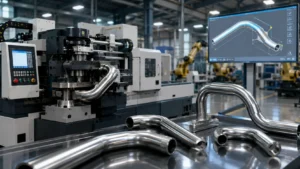

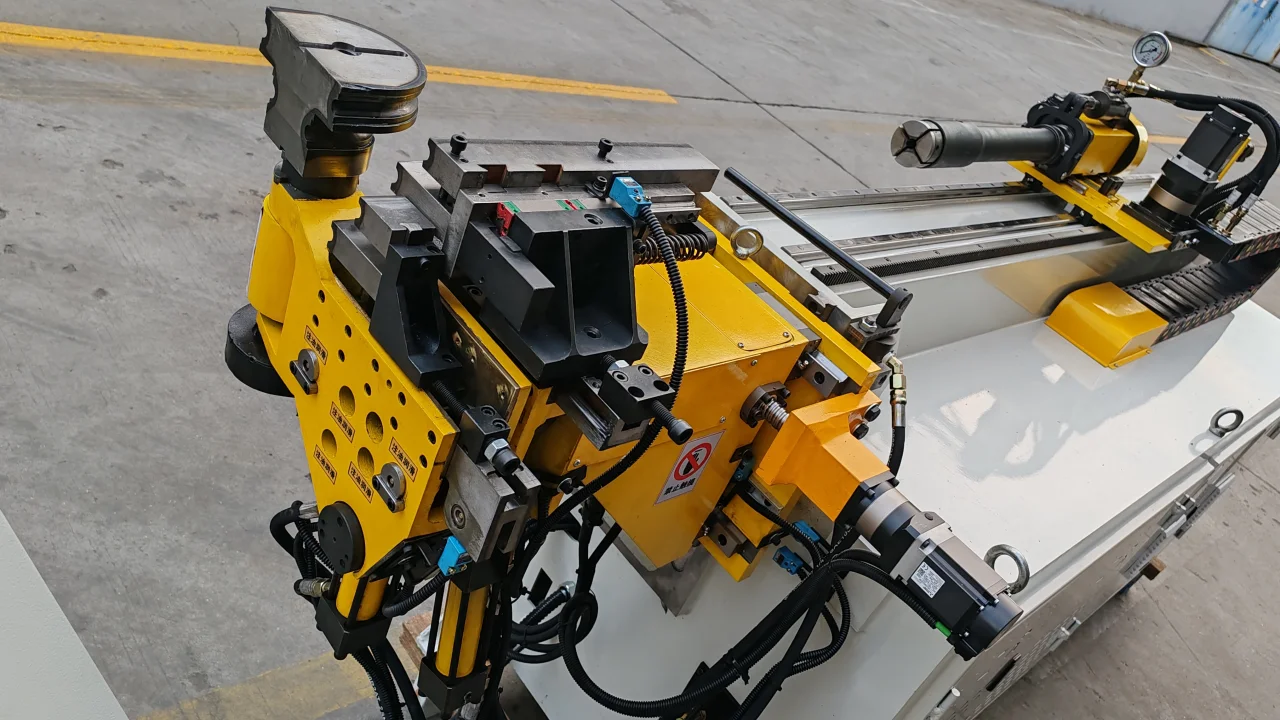
Choosing a CNC tube bending machine starts with the material on your drawing — but the material name alone does not define the job. The same machine platform may bend carbon steel, aluminum, and copper, yet each material changes the clamping force, tooling contact, springback behavior, surface protection, and radius limits that the setup has to respect.
This guide works through material selection for CNC tube bending: what aluminum, copper, carbon steel, and stainless steel each demand from the machine and tooling, which data a drawing review needs beyond the material label, and how a trial bend should be measured for each material group.
By the end, you will know which material questions to settle before machine configuration, tooling scope, or automation level can be quoted responsibly.
Can One CNC Tube Bending Machine Process Aluminum, Copper, and Steel?
Sometimes, yes—but only after a part-specific engineering review. A CNC tube bender can be configured for different materials, yet material changes can affect clamping force, tooling contact, springback, surface protection, wall deformation, and the acceptable bending radius.
In practice, you should separate four decisions:
- Whether the machine platform has enough working range and forming force.
- Whether the tooling package matches the tube size, section, and material.
- Whether the control system can repeat the required feed, rotation, and bend sequence.
- Whether a sample trial can meet your dimensional and surface requirements.
The phrase “multi-material CNC tube bender” is therefore useful for an initial search, but it is not a production guarantee. Two tubes with the same outside diameter can require different support, clamping, lubrication, or tooling details if their wall thickness, temper, hardness, or surface finish differs.
What the material label does not tell you
“Aluminum,” “copper,” and “steel” are broad material groups. You still need the grade, temper or heat-treatment condition, tube manufacturing method, and surface condition. For example, a soft copper tube and a hardened copper tube should not be treated as the same bending job. Likewise, an aluminum alloy in a harder temper may behave differently from the same alloy in an annealed or softer condition.
The drawing also matters. A tight CLR, several bends close together, a long unsupported section, a visible surface, or a square profile can change the tooling and process review even when the material is unchanged.
Why the same OD can need different tooling
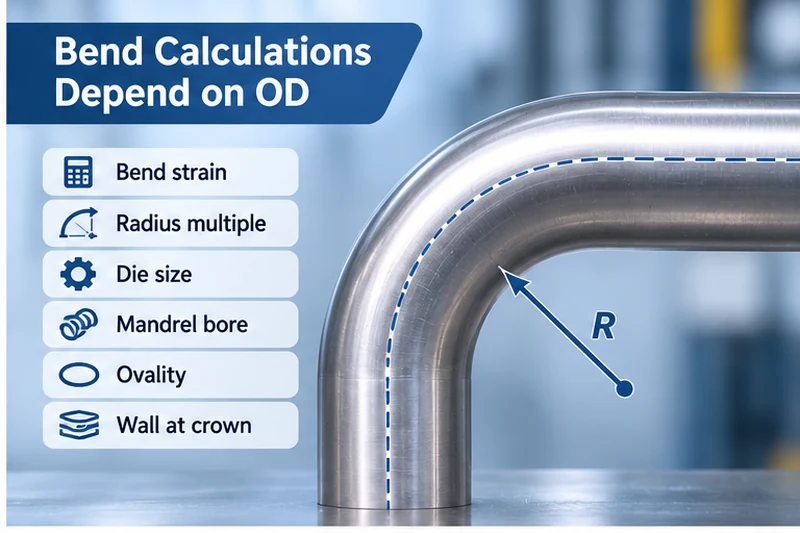
Outside diameter does not define the entire forming problem. Wall thickness changes the tube’s resistance to collapse. The ratio between CLR and OD affects the severity of the bend. Bend count and rotation affect how the tube is positioned and supported. The required surface quality determines how much contact marking can be accepted.
For that reason, a manufacturer should review the drawing and a representative tube sample before confirming the machine and tooling scope. If the manufacturer gives a general answer based only on OD, ask which assumptions were made about wall thickness, material condition, CLR, and acceptance criteria.
Start with the Part, Not the Material Label
The most useful RFQ starts with a controlled drawing or 3D model and a complete material description. Do not send only “304 stainless tube” or “aluminum pipe.” Send enough data for the manufacturer to reproduce the forming problem on paper before recommending a machine.
Minimum RFQ data
Include the following information whenever it is available:
- Material grade and condition, such as annealed, cold-worked, or heat-treated.
- Tube or profile type: round, square, rectangular, oval, or another section.
- Outside diameter or section dimensions.
- Wall thickness and wall-thickness tolerance.
- Centerline radius (CLR), preferably as a dimension and as a CLR/OD ratio.
- Number of bends per part.
- Bend angle for every bend.
- Distance between bends and required straight lengths.
- Rotation angle between bend planes for three-dimensional parts.
- Tube-end orientation and datum reference.
- Cutting length or blank length.
- Dimensional tolerances, profile tolerance, and surface requirements.
- Required quantity, shifts, target cycle time, and expected product mix.
- Sample quantity and inspection method for trial bending.
If the part includes end forming, holes, welded flanges, threads, or other features, mark the sequence clearly. A feature that is easy to access before bending may become difficult to fixture after bending. That sequence can affect whether cutting, end forming, or inspection should be integrated into the cell.
Production and factory information
Your supplier also needs the production context. State whether the machine will make one high-volume part or many low-volume variants. Explain whether an operator will load the tube manually, whether raw tubes should be automatically loaded, and whether finished parts need automatic unloading or sorting.
These functions are not interchangeable. CNC feeding and tube rotation inside the bending cycle do not necessarily mean automatic raw-material loading. Automatic cutting, unloading, robotics, inline inspection, NG sorting, line PLC/HMI control, and MES connectivity should be listed separately in the RFQ.
For a planned automated cell, describe the order of operations, for example: raw tube loading, cutting, bending, end forming, inspection, sorting, and packing. The supplier can then evaluate interfaces and cycle-time constraints instead of quoting a standalone machine for a line-level requirement. This is also the point where searches for cnc aluminium tube bending machine manufacturers, cnc copper tube bending machine manufacturers, and cnc steel tube bending machine manufacturers should become a part-specific engineering comparison rather than a list of generic supplier names.
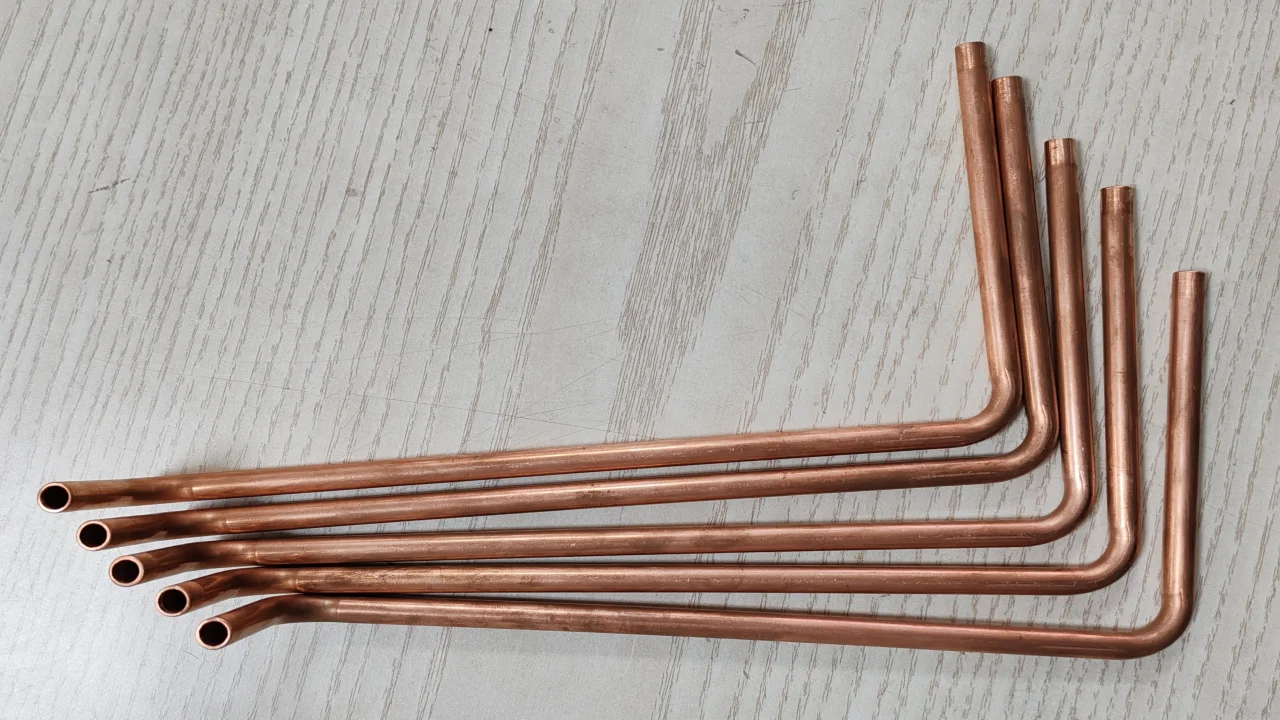
Aluminum Tube Bending Requires Alloy, Temper, and Surface Review
For aluminum, the alloy and temper are as important as the tube diameter. Before choosing a manufacturer, ask how the supplier will evaluate springback, section deformation, clamping marks, and the effect of the specified CLR on the finished profile.
Aluminum is often selected for weight reduction, but a lighter tube does not automatically mean an easier tube to bend. The required surface appearance, wall thickness, profile shape, and post-bending dimensional tolerance may require a different tooling approach from a visually similar steel part.
Questions for an aluminum tube bending manufacturer
Ask the supplier to confirm:
- Which aluminum alloy and temper were used in any relevant trial.
- Whether the trial tube matches your wall thickness and surface condition.
- How the supplier controls surface marks at the clamp, pressure die, and bend die.
- How the machine compensates for springback, if compensation is needed.
- How ovality and local wall deformation will be measured.
- Whether the tooling is dedicated, interchangeable, or adjustable.
- Which acceptance dimensions will be recorded in the trial report.
Do not use a successful trial on one alloy or temper as proof that every aluminum tube will produce the same result. In Zhuoran’s current evidence pack, a model-specific aluminum trial record is not confirmed. Therefore, aluminum applications should be described as requiring engineering review and sample validation rather than as a universal machine capability.
What to measure in the trial
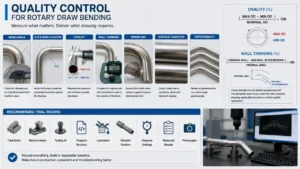
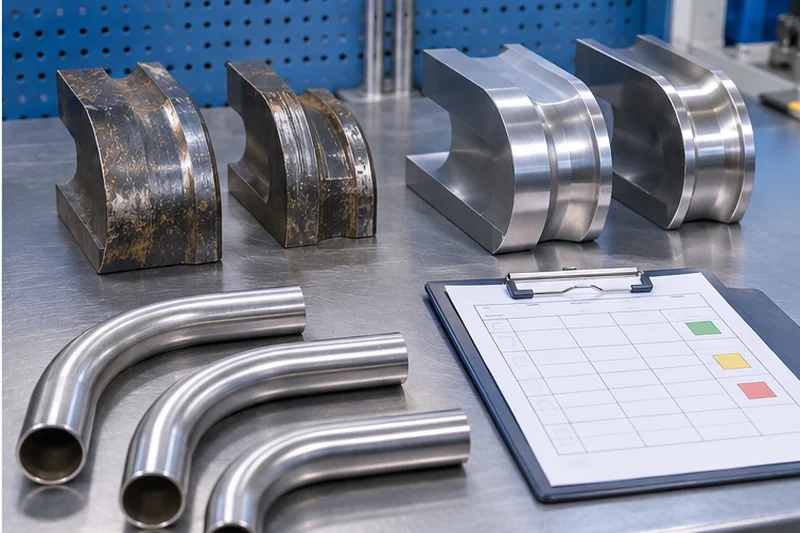
For a structural or visible aluminum part, measure more than bend angle. A useful trial plan may include bend position, end position, section dimensions, ovality, surface marks, and any required profile or assembly dimensions. If the part will be welded or assembled later, also inspect the dimensions that control the next operation.
The acceptance report should identify the tube used, the tooling configuration, machine settings or recipe reference, sample quantity, measurement equipment, and pass/fail criteria. This makes the result reusable when you compare manufacturers or repeat the trial.
For a deeper treatment of alloy and temper behavior, surface control, and machine setup on aluminum tube, see the aluminum tube bending guide.
Copper Tube Bending: Match the Machine to the Tube and Process
Copper tube bending should be evaluated by tube condition, wall thickness, CLR, cross-section retention, and downstream requirements. Soft or annealed copper may require careful support and surface protection, while another copper condition may create a different forming response.
Zhuoran’s evidence pack contains a model-specific DW18CNC-3A-1S record for soft or annealed copper, with a recorded example of approximately Φ18 × 2 mm. This is useful evidence for that model and material condition. It should not be presented as a universal diameter or material guarantee for every copper application.
The copper tube bending guide covers machine selection and defect prevention for copper in more depth, including HVAC and heat-exchanger applications.
Internal support and tooling
Ask whether the tube needs internal support, how the tube will be clamped, and how the tooling will prevent unacceptable flattening or marks. The right answer depends on the material, wall thickness, CLR, bend sequence, and the required cross-section after bending.
For copper parts used in fluid or heat-transfer systems, dimensional stability and surface condition may affect assembly or sealing. Include those downstream requirements in the RFQ. If the tube will be expanded, flared, brazed, welded, or connected to another part after bending, the supplier should know which dimensions are function-critical.
When to combine feeding, bending, and cutting
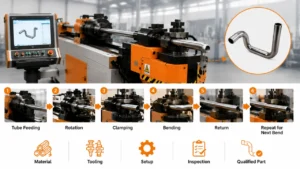
If you need a high-volume copper tube operation, review the complete cycle rather than the bending stroke alone. A line may include feeding, tube rotation, bending, cutting, unloading, and inspection. The practical cycle time must include normal loading, positioning, tool movement, and part handling.
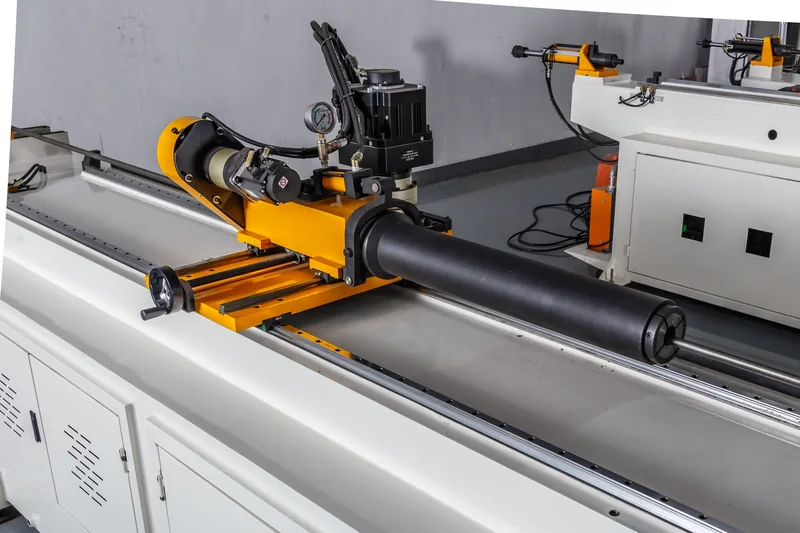
Zhuoran’s CNC equipment can be evaluated as a standalone machine, an automated cell, or part of an integrated line. However, the final scope of automatic loading, unloading, cutting, inspection, sorting, and line control remains project-specific and should be confirmed in the quotation and technical agreement.
Steel and Stainless-Steel Tube Bending Have Different Capacity Boundaries
Steel and stainless steel should not be treated as one capacity category. Carbon steel, austenitic stainless steel, and other steel grades can differ in strength, work hardening, springback, surface sensitivity, and forming force. The same machine family may require different tooling, process settings, and trial criteria.
Carbon-steel model examples
The current Zhuoran evidence pack records model-specific examples for carbon steel:
- DW38CNC-3A-1S: recorded carbon-steel example around Φ38 × 2 mm, with a recorded minimum-radius entry of R ≥ 1.5D.
- DW75CNC-4A-2S: recorded carbon-steel example around Φ75 × 6 mm, with a recorded minimum-radius entry of R ≥ 1.5D.
These entries belong to the documented models and application conditions. They do not establish that every DW-series machine has the same maximum diameter, wall thickness, minimum radius, or accuracy. Your supplier should confirm the final working range against your actual drawing and trial material.
Stainless-steel review questions
For stainless-steel tube bending, ask how the supplier will evaluate:
- Work hardening during repeated forming.
- Springback and angle correction.
- Surface protection and allowable contact marks.
- Ovality and wall thinning at the bend.
- The effect of a tight CLR or multiple close bends.
- Whether internal support or a special tooling configuration is required.
If the part has a sealing, sanitary, or visible surface requirement, define the limit in measurable terms or by an approved sample. “No damage” is not enough for a supplier to quote consistently unless both sides agree on what counts as damage.
Material Comparison Table for a Manufacturer Review
No material is universally easiest to bend. The practical difficulty comes from the combination of material condition, tube geometry, tooling, production volume, and acceptance criteria.
| Material group | Data to provide | Typical review risks | Tooling question | Trial check | Zhuoran evidence status |
|---|---|---|---|---|---|
| Aluminum tube | Alloy, temper, OD, WT, CLR, surface | Springback, marks, section deformation | How will contact surfaces protect the tube? | Angle, position, profile, ovality, surface | Engineering review required; no model-specific aluminum trial confirmed |
| Soft/annealed copper | Grade, condition, OD, WT, CLR | Flattening, marks, support, downstream sealing | Is internal support or special clamping required? | Section retention, dimensions, surface, assembly fit | DW18CNC example is model- and condition-specific |
| Carbon steel | Grade, OD, WT, CLR, bend sequence | Forming force, springback, wall deformation | What machine and die capacity match the part? | Angle, position, radius, wall condition | DW38CNC and DW75CNC examples are model-specific |
| Stainless steel | Grade, condition, OD, WT, CLR | Work hardening, springback, surface marks | What tooling and lubrication approach is proposed? | Angle, ovality, thinning, scratches, cracks | Project-specific review required |
Use this table as a discussion framework, not as a substitute for a drawing review. A manufacturer that asks for the missing information is usually giving you a more useful engineering answer than one that confirms compatibility from the material name alone.
Where Manufacturer Comparison Fits
Material selection tells you what the machine and tooling must handle; it does not by itself tell you which manufacturer to buy from. Once the material review has fixed your requirements, compare manufacturers on engineering evidence: model-level records for your material and tube size, an itemized tooling scope, and a trial plan with agreed acceptance limits. That comparison method is covered in the guide to comparing CNC tube bending machine manufacturers.
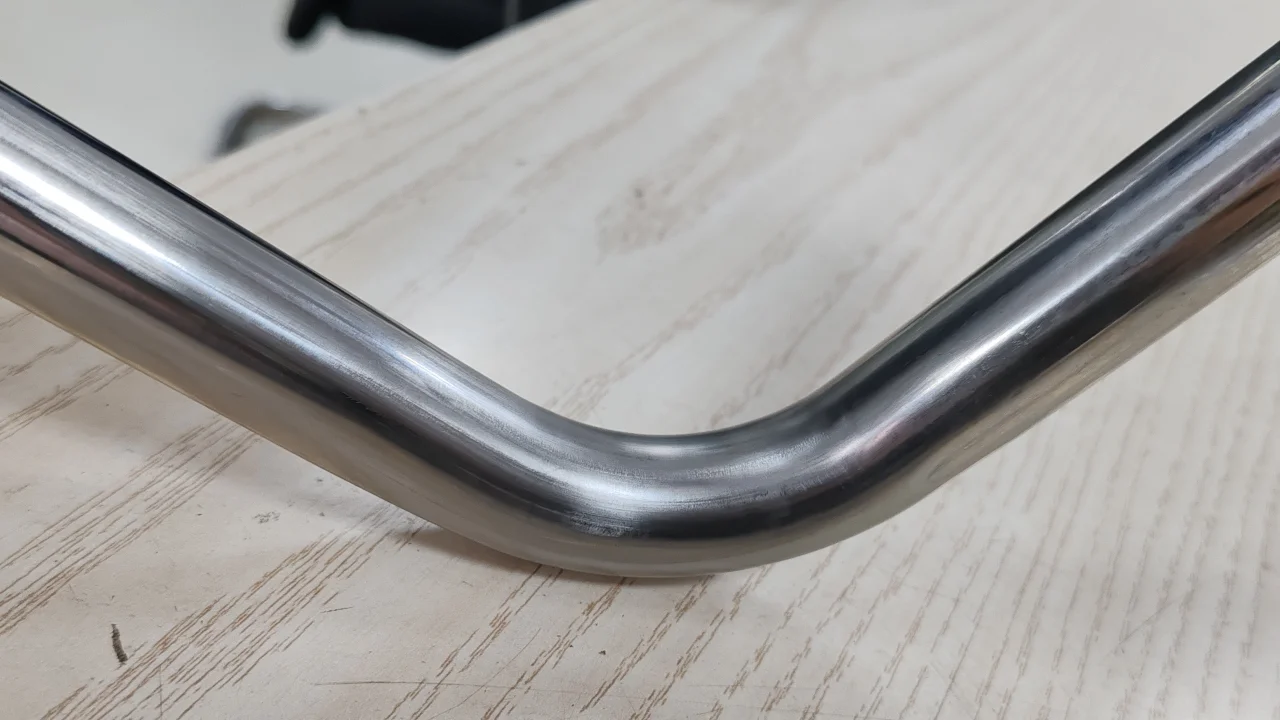
RFQ and Trial-Bending Checklist
Send part data first, then ask for an itemized technical and commercial response; the complete RFQ field list is in the tube bending machine RFQ checklist. For a multi-material project, add one line per material — grade, condition, and the trial sample you will supply — because the trial plan is written per material, not per machine.
What Should You Send to Zhuoran for a Recommendation?
Send the most difficult finished-part drawing with material, production and acceptance data. This lets Zhuoran’s engineers size the machine, tooling, automation and trial plan. The itemized input list is in the RFQ checklist.
The review ends with a drawing review, sample bend and written technical agreement. Contact Zhuoran to start.
Frequently Asked Questions
Can one CNC tube bender process aluminum, copper, and steel?
It may, but the answer depends on the exact material condition, tube geometry, tooling, and acceptance requirements. Confirm the application with a model-specific engineering review and sample trial.
What material information should I send to a manufacturer?
Send the grade, temper or heat-treatment condition, tube manufacturing condition if relevant, OD, wall thickness, tolerance, surface requirement, and a drawing showing the complete bend geometry.
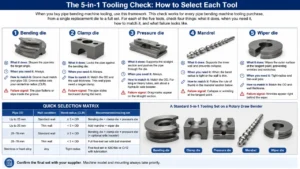
When do I need a mandrel or wiper die?
That decision depends on CLR, wall thickness, material behavior, bend severity, and the surface and ovality limits. Ask the manufacturer to justify the tooling against your actual part rather than selecting it from diameter alone.
Can a catalog capacity guarantee production?
No. A catalog range can help with initial screening, but it does not replace a trial using your material, tooling, geometry, and acceptance criteria. Model specifications must be applied only within their documented scope.
What should a tube bending trial include?
It should include an identified material and part, agreed tooling, sample quantity, machine and process details, critical dimensions, inspection methods, surface criteria, and a pass/fail report.
Conclusion
No material group is universally easiest to bend. The right machine choice follows from how your material condition, tube geometry, and acceptance limits interact with tooling and process settings — which is why this guide treats material selection as an engineering review, not a compatibility checkbox.
If your project mixes aluminum, copper, or steel parts, send Zhuoran the drawing and material details for the most demanding part first. The engineering team can then assess the configuration, tooling plan, and trial method that the material requires.
References and technical context
The following public manufacturer sources were used only to understand general machine categories, tube-bending terminology, and common technical discussion points. They do not prove Zhuoran’s capabilities, model range, accuracy, output, certifications, or customer results:
- WAFIOS tube bending machines — supports general machine-category and application context; does not establish Zhuoran specifications.
- Numalliance tube bending — supports general process and equipment terminology; does not validate Zhuoran performance.
- NISSIN CNC tube bender information — supports general terminology and machine-feature context; does not serve as a Zhuoran test record.