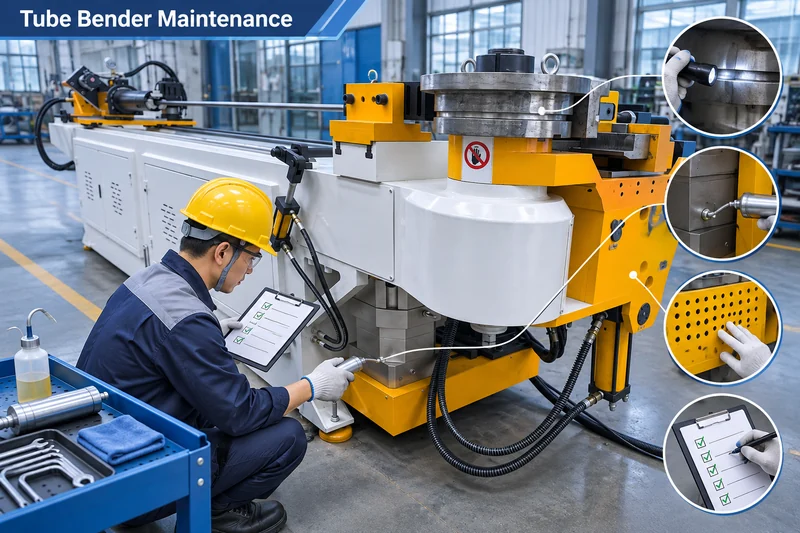
Tube bending machine maintenance is usually described as a list of things to grease and wipe. That list matters, and every manufacturer already supplies it. What the manufacturer’s schedule rarely includes is the set of trend measurements that reveal a failing component weeks before it stops the machine.
A bender fails in three families: electrical, hydraulic and mechanical. Each one gives notice if somebody is measuring. This guide covers the notice — what to measure, how often, and how to compare it — and then ties measurement to the two commercial questions owners actually ask: how long the machine should last, and when repair stops making sense.
What Really Decides a Tube Bender’s Life
Three variables decide machine life, and only one of them is maintenance.
The three variables
- Machine architecture: an all-electric servo bender and a hydraulic hybrid age differently, and their expensive components are not the same
- Usage intensity: cycles per shift, bend severity, material abrasiveness and how often operators push the machine to its rated limit
- Maintenance quality: not how often oil is added, but whether degradation is measured
Most shops control the third variable well and the first not at all, having bought the machine years earlier. Order books set the second. Maintenance is the only lever still available, which is why it deserves better than a checklist.
Why architecture changes the answer
A hydraulic machine concentrates wear in the pump, valves, seals and oil. An all-electric machine moves that wear into servo motors, drives, belts and the control system, and it removes the hydraulic oil as a consumable. Neither is automatically longer-lived. What changes is which trend tests are worth running.
The Maintenance You Already Do, and What It Misses
Manufacturer schedules for tube bending machine maintenance are generally good, focusing on lubrication and cleanliness. Both genuinely extend life. The gap is that a scheduled task tells you what was done, not what the machine is becoming.
Why a task is not a measurement
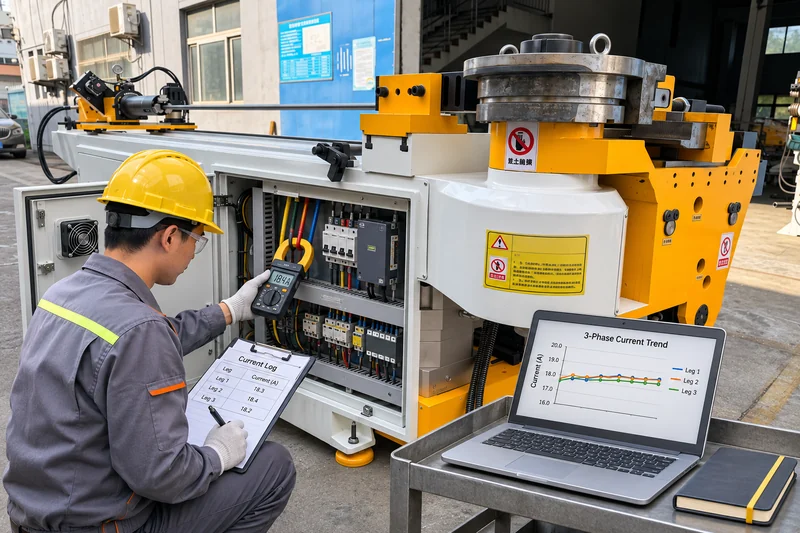
“Greased the ways” is a task. “Amperage on leg 3 rose from last quarter” is a measurement, and only the second one predicts a failure.
Shops that track tasks know their maintenance is up to date. Shops that track measurements know which component is degrading. The second group replaces parts during planned downtime; the first group replaces them during a breakdown, and pays for the difference in lost output.
Why records matter more than intervals
An interval assumes conditions are stable, which is a weak assumption in tube bending machine maintenance. They are not — summer heat, a new material, a heavier part family and a longer shift all change load. A recorded measurement with a date turns any of those changes into a visible trend, and a trend is the only thing that tells an owner whether the machine is ageing normally or failing abnormally.
An amperage log you can actually keep
A tube bending machine maintenance record fails when it asks for more than a shift supervisor will write.
- Note the date, the machine hours and the three leg readings, nothing else
- Keep the same instrument, because two clamp meters disagree slightly
- Record the season, since summer readings run higher and would otherwise look like a fault
Four columns and one row every six months is enough to spot a leg climbing away from its own history. A log that would catch a failing leg looks like this, with the readings illustrative rather than taken from any particular machine:
| Visit | Leg 1 (A) | Leg 2 (A) | Leg 3 (A) |
|---|---|---|---|
| New machine | 12.4 | 12.6 | 13.1 |
| 6 months | 12.5 | 12.6 | 13.0 |
| 12 months | 12.6 | 12.7 | 13.4 |
| 18 months | 12.8 | 12.9 | 14.6 |
Leg 3 climbing against its own history is the signal, and it appears while every part still passes.
Recording a temperature delta
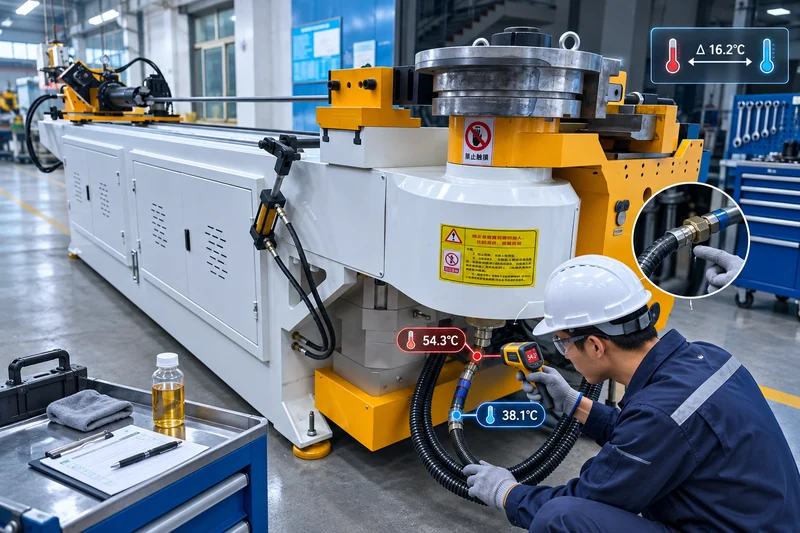
Temperature is only comparable when the reading point is fixed, and that is the whole of this tube bending machine maintenance method.
- Mark the pressure-line and return-line fittings once, with paint
- Measure both on the same visit, in the same order
- Record the difference as well as the two absolute values
A delta that shrinks over successive visits points at the cooling circuit, even while the absolute temperatures still look acceptable.
Storage matters as much as measurement. Photograph the instrument display and file it against the machine number, because a paper log left on the machine will be lost within a quarter. Two photographs a year per machine is a trivial habit that makes every later comparison possible.
Calibration is the other half. A clamp meter that reads high by a fixed amount still produces a usable trend, because the trend compares the instrument with itself. Absolute thresholds need a calibrated instrument, which is a different purpose entirely.
| Visit | Oil in (°F) | Oil out (°F) | Delta (°F) |
|---|---|---|---|
| Commissioning | 118 | 96 | 22 |
| 12 months | 121 | 101 | 20 |
| 24 months | 126 | 112 | 14 |
| 30 months | 131 | 124 | 7 |
Nothing in that table looks alarming on its own. The delta halves over thirty months, and that slope is what schedules a chiller service before the oil reaches its own limit.
Electrical Trend Tests That Catch a Failure Early
Electrical problems are the cheapest to detect and the easiest to ignore, because nothing looks wrong until something stops.
Amperage across the three legs
Most CNC benders run on three-phase supply, with three current-carrying conductors feeding the machine. A clamp meter reading on each leg, taken every six months and written down, gives a baseline that costs minutes.
Three details make a reading useful:
- Each leg should draw close to the same current
- One leg sitting slightly higher is normal, because control transformers often hang off a single leg
- A small seasonal rise in summer is also normal, since ambient heat raises load
Trend across readings matters far more than the figure itself. A leg climbing against its own history points at a failing component in the system that leg feeds, often before any other symptom appears.
Terminal tightness once a year
Benders heat during operation and cool overnight and at weekends. That cycle works screw terminals loose. A loose terminal draws more current, generates more heat and eventually fails the component behind it.
One annual pass with the power off, checking and tightening every screw terminal in the main panel, prevents a category of failure that otherwise appears as a mystery trip. Spring terminals deserve a gentle tug as well, since the wire can release without any visible change.
What a hydraulic oil report tells you
In tube bending machine maintenance, an oil sample converts three symptoms into one document.
- Water content rising points at condensation from thermal cycling, common in a machine that idles cold
- Solid content points at filter performance or ingressed contamination
- Metal content points at pump, valve or cylinder wear, and the trend matters more than the absolute figure
A single sample gives a snapshot. Three samples across two years give a trend, and a trend is what identifies a component family before failure.
Hydraulic Checks: Fittings, Temperature and Oil
Hydraulics reward attention because the failure modes are dangerous as well as expensive.
Fittings and hoses every six months
In practice, the same heat cycle that loosens electrical terminals loosens hydraulic fittings. A weeping fitting is a mess; a high-pressure oil stream is a hazard that can injure or kill, which is why tightening is a safety task rather than a housekeeping one.
While checking fittings, inspect every hose for wear, bulging or dry rot. Any of the three means replacement, not monitoring.
Temperature at a marked point
A handheld infrared thermometer, used on the fittings of the pressure and return lines at a manifold, gives a repeatable reading only if the reading point is repeatable. Mark the fittings — paint is enough — so the same spot is measured every time.
Recording the number matters more than the number itself. A fitting running warmer than its own history indicates flow restriction, oil degradation or a failing component upstream.
The chiller tells you by its delta
Most hydraulic benders cool the oil on the low-pressure return line, through a radiator-style chiller or a chilled-water exchanger. Measuring the temperature on both sides and recording the difference gives a health figure for the cooling circuit.
If the difference shrinks over successive readings, the chiller is losing capacity. Oil that runs hot degrades faster, and degraded oil makes the pump and valves work harder — a loop that ends with a failed servo valve rather than a failed chiller.
140 °F is the line that matters
Hydraulic oil begins to break down around 140 °F. Anything approaching that figure deserves investigation rather than a note, because the consequences cascade through the whole hydraulic system.
Oil sampling once a year
A sample sent for analysis, tested for water, solids and metal content, converts the hydraulic system into a trend chart. Rising metal content points at a specific component family — pump, valve, strainer or filter — and the report usually recommends filtration or replacement before failure.
Sampling is the highest-value annual task on a hydraulic bender, and the cheapest per unit of information.
The winter shutdown checklist
Long shutdowns expose every weakness a running machine hides.
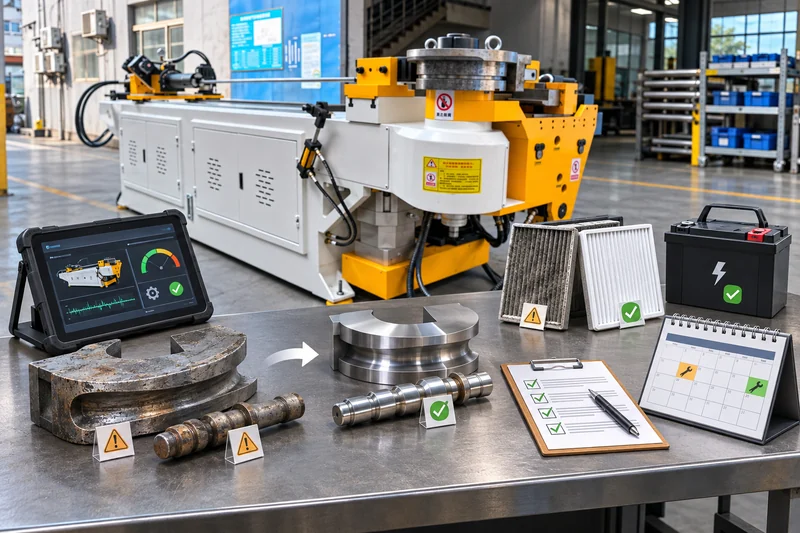
- Replace control batteries before the break, not after
- Check cabinet filters, and fit new ones if the old ones are loaded
- Tighten hydraulic fittings while the machine is cold
- Record amperage and temperatures before stopping, so the restart has a baseline
- Confirm lubricant levels and top up before restart rather than after the first cycle
A machine that restarts cleanly after a two-week break usually had this list applied to it.
Filters, Batteries and the Long Shutdown
Two items sit outside the usual lubrication schedule and cause disproportionate trouble.
Filters beyond the hydraulic ones
Hydraulic filters appear in every manufacturer schedule. Air filters protecting the electrical and computer cabinets often do not, and a clogged cabinet filter lets dust and oil mist reach the electronics that run the machine.
Batteries and the holiday trap
Some servo and PLC systems hold position data and parameters in memory backed by a battery. If that battery dies during a long power-off, the machine may start erratically or not at all, and the recovery is a service call rather than a restart.
Annual replacement prevents it, and timing the change to just before the longest shutdown of the year — the winter holidays in most markets — is the practical habit. A fresh battery before a two-week shutdown costs little; a lost parameter set after one costs a day.
How duty changes the interval
Published tube bending machine maintenance intervals assume a normal working pattern, and yours may not be normal.
- Single shift on mild steel: the published six-month and annual intervals fit well
- Two shifts, or regular stainless work: shorten the six-month checks to quarterly
- Three shifts, or titanium and heavy wall: measure monthly, and treat every reading as a trend point
- Any machine run near its rated capacity: add a monthly amperage check regardless of shift pattern
The interval is not the discipline. The measurement is.
What tube bending machine maintenance costs against what it saves
Maintenance competes with production for hours, so the comparison has to be in money.
An illustrative calculation, with figures chosen for the arithmetic: two planned maintenance days a year at a nominal internal cost, against one unplanned ten-hour stoppage at 1,000 in lost margin plus restart scrap and expedited freight. Add the second-order cost — a missed delivery on a repeat customer — and the planned route is cheaper in almost every case where the stoppage is avoidable.
| Scenario | Stopped hours | Margin lost | Notes |
|---|---|---|---|
| Planned service day | 8 | scheduled | Work re-sequenced in advance |
| Bearing failure | 10 | 1,000 | Plus restart scrap and freight |
| Pump failure | 26 | 2,600 | Plus a week of late deliveries |
That is the argument for measurement. It converts an unplanned stoppage into a planned one, and the price difference is the whole of the maintenance budget.
A Daily, Monthly and Annual Schedule
A workable schedule splits by how fast a check can catch something.
| Interval | What to do | What it catches |
|---|---|---|
| Every shift | Visual check of hydraulics, guarding and lubrication points; note any new noise | Leaks, damage, developing faults |
| Weekly | Confirm lubrication points are actually taking grease; check cabinet filters | Blocked lubrication, restricted airflow |
| Every 6 months | Amperage on each leg; tighten hydraulic fittings; hose inspection; temperature at marked points; chiller delta | Component degradation, leaks, cooling loss |
| Annually | Tighten all panel terminals; oil sampling; battery replacement; filter replacement; full alignment and calibration check | Loose connections, oil condition, memory loss, drift |
| After any crash or overload | Inspect tooling, alignment and hydraulics before restarting | Damage that a routine check would miss |
Intervals come from published shop practice rather than from a standard, and a machine running three shifts may need them shortened.
Three failure patterns worth recognising
As a result, most tube bending machine maintenance failures follow one of three shapes, each with a different response.
- A single leg drawing high current: an electrical component is degrading, and the trend says which
- A shrinking chiller delta: the cooling circuit is losing capacity, which will shorten oil life and valve life
- Rising metal content in oil samples: a hydraulic component is wearing, and the report narrows the family
Recognising the shape early is what makes tube bending machine maintenance predictive rather than reactive, and it is the difference between a planned service day and a lost week.
Troubleshooting: What Wears Out First
Knowing the wear order turns a vague inspection into a short list.
| Component | Why it wears | Signal |
|---|---|---|
| Tooling: wiper die and mandrel | Direct rubbing contact with the tube | Ovality drift, inner-radius marking |
| Hydraulic oil and filters | Heat, contamination, time | Temperature rise, metal content in samples |
| Seals and fittings | Pressure cycles, thermal cycling | Weeping, pressure loss, temperature change |
| Electrical terminals | Thermal cycling | Rising amperage on one leg |
| Servo drives and belts | Load and hours | Position error, noise, following error alarms |
| Control batteries | Age | Parameter loss after a long power-off |
For tube bending machine maintenance, tooling wear is covered in its own guide — see bend die wear and tooling life for the measurement side, and pipe bending machine tooling for how a set is scoped.
Downtime Cost and Why Records Pay
Tube bending machine maintenance competes with production for the same hours, so it needs a number rather than an argument.
downtime cost = stopped hours × hourly output value + restart and scrap cost
An illustrative calculation, with figures chosen to show the arithmetic rather than to represent any shop: a cell producing 40 an hour, worth 25 an hour in margin, loses 1,000 in margin across a single 10-hour stoppage, before restart scrap and expedited freight. Two planned maintenance days a year cost less than one unplanned week.
As a result, records pay for themselves quickly. A shop that can show a component degrading can schedule the replacement into a quiet week. A shop without records discovers the same component on the day it fails, and pays the difference.
What to record
- Date, machine and hours
- The measurement taken, at the same point each time
- The value, not a tick
- Action taken and by whom
- Anything abnormal noticed while nearby
Five fields turn maintenance into evidence, and evidence is what a service provider or a buyer will ask for when the machine is eventually sold or assessed.
Two habits make those five fields work. Write the value, never a tick, because a tick records that somebody visited rather than what the machine did. And date every row, since a reading without a date cannot be compared with anything.
Six months of consistent rows is enough to start seeing slopes, and slopes are where tube bending machine maintenance becomes predictive. Three readings over 18 months has already caught more failures in most shops than any single inspection ever will, and the record costs less time than ordering the part after it fails. Keep it, and keep it visible.
Decision Matrix: Repair, Rebuild or Replace
Sooner or later the commercial question arrives: keep fixing, rebuild, or replace.
| Situation | Route to evaluate | What decides it |
|---|---|---|
| Single component failing, structure sound | Repair | Cost against downtime cost of one stoppage |
| Hydraulic system tired, control healthy | Rebuild hydraulics | Rebuild cost against replacement cost of the machine |
| Control system obsolete, spares unavailable | Replace, or plan retrofit | Availability of spares and programming support |
| Structural wear or alignment beyond correction | Replace | Geometry cannot be restored economically |
| Repeated failures across unrelated systems | Replace | A pattern of failures usually means the machine is at the end of its economic life |
What matters is the distinction between components that can be renewed and geometry that cannot. Pumps, valves, drives, seals and controls are replaceable. A frame or a bend head worn out of alignment is not, and no maintenance budget fixes it.
For the buying side of that decision, see how to choose a tube bending machine and the industrial bending equipment buying guide.
A one-page maintenance record
Tube bending machine maintenance records that fit on one page get used; databases that need training do not.
- Machine identity, hours and last service date
- The four trend figures: three leg amperages and the chiller delta
- The oil sample date and the three results
- Actions taken, parts replaced, and the next due date
Post it at the machine. A record nobody can see is a record nobody updates.
Spares Worth Holding
Spares for tube bending machine maintenance should be ranked by how long the machine would be stopped without them.
- The component with the longest lead time, even if it rarely fails
- The components that fail most often, in one set
- Consumables the machine cannot run without: filters, oil, seals
- Tooling spares for the highest-volume family, since tooling wear stops production sooner than most components
A spare held on the shelf is not inventory inefficiency; it is an option on uptime. The rule of thumb that works: hold what would otherwise stop the machine for longer than a week.
A simple ranking exercise makes the budget decision explicit. List the five most likely failures, put the lead time beside each, and multiply by the downtime cost from the previous section. A component with a 2-day lead time rarely justifies shelf space. A component with an 8-week lead time almost always does, even at a 1-in-5 failure likelihood.
That arithmetic is also the answer to a common objection: spares tie up cash. So does a stopped tube bending machine maintenance schedule, and the stoppage usually costs more.
Reading a lifespan figure correctly
A published lifespan for tube bending machine maintenance planning is an input rather than a promise, and it should be read with three questions.
- Which machine architecture does the figure assume
- Which duty pattern does it assume, since shifts change everything
- Does it assume measured maintenance or scheduled grease
Without those three, the range describes a hypothetical shop rather than yours.
How Long Should a Tube Bending Machine Last
For tube bending machine maintenance planning, one supplier publishes an average lifespan of roughly 8 to 15 years, depending on machine type, usage intensity and maintenance quality. That is a single vendor’s published range, not an industry standard, and it is worth treating as an order of magnitude rather than a target.
Four things move a machine within that range:
- Cycles per shift, since a three-shift machine ages roughly three times faster than a single-shift one and reaches the same wear in a third of the calendar time
Material severity, because stainless and titanium load the tooling and the hydraulics harder than mild steel, and heavy wall loads both further still
- Material severity, because stainless and titanium load the tooling and the hydraulics harder than mild steel
- Whether degradation is measured, since measured machines get components replaced before collateral damage
- Whether the machine is kept inside its rated capacity, because sustained overload shortens everything
A shop that wants a longer life should buy for the duty it actually runs, measure degradation, and keep the machine inside its envelope. Those three decisions outweigh any lubrication interval.
Rebuild economics belong in the same conversation. A machine at 10 years with a sound frame and tired hydraulics is a rebuild candidate. A machine at 10 years with obsolete controls and no spares is a replacement candidate, whatever the hydraulics look like. Frame condition decides the answer for one group; control support decides it for the other.
What a service visit should leave behind
A supplier visit is only useful if it produces something the shop can compare next time.
- The trend figures it measured, with the readings written down
- Any component identified as degrading, with the evidence
- The interval recommendation for this machine’s actual duty
- The next visit date, in the calendar rather than in the email
For tube bending machine maintenance, a visit without readings is a visit that has to be repeated next year from the same starting point.
When to call the supplier rather than keep running
Most faults can wait until a planned stop. A short list cannot.
- Oil temperature approaching the degradation point, since continued running damages valves
- A leg drawing markedly more current than its own history, since the failure is usually abrupt
- Any hydraulic leak near a heat source or an operator position
- Control faults that clear on restart, because they rarely mean the fault has gone
Calling early is cheaper than most people expect, and waiting is dearer than most budgets allow.
What to Ask Before Buying on Service
Maintenance questions belong in the purchase decision, not after it.
- Which components are serviceable in place, and which require removal
- What the spare parts lead time is for the highest-risk components
- Whether the control system is supported, and for how long
- What the supplier’s remote diagnostics can see
- Whether a first-year service schedule is included
In practice, the RFQ checklist covers the machine specification side, and the maintenance questions belong on the same sheet.
Frequently Asked Questions
How often should a tube bender be serviced?
In practice, the published shop practice used here sets six-monthly checks on amperage, hydraulic fittings and temperatures, and annual work on terminal tightness, oil sampling, batteries and filters. A machine running three shifts or exotic material should shorten those intervals.
What is the first sign a tube bender is failing?
A single leg drawing more current than its own history, or a fitting running hotter than last time. Both appear before any part is out of tolerance, which is why they are worth measuring.
How long does a tube bending machine last?
One supplier publishes roughly 8 to 15 years, depending on type, usage and maintenance. Treat it as an order of magnitude: a three-shift shop on stainless will sit at the low end regardless of care.
Is oil sampling worth the cost?
It is the cheapest information per unit of cost on a hydraulic machine, because it identifies which component family is degrading before failure. Without it, hydraulic health is guesswork.
Can maintenance extend a machine’s life indefinitely?
No. Components can be renewed and geometry cannot. A machine worn out of alignment has reached its end regardless of service quality, and the decision becomes rebuild or replace.
What spare should a shop hold first?
The component with the longest lead time, even if it rarely fails. A part that arrives in two days needs no shelf space; a part that takes eight weeks needs one.
Reference Sources
- The Tube & Pipe Journal / The FABRICATOR, How a shop can improve tube bender maintenance — source for the six-monthly three-phase amperage test and its interpretation, annual terminal tightening, six-monthly hydraulic fitting tightening and hose inspection, marked-point temperature readings, chiller delta checks, the 140 °F oil degradation point, annual oil sampling, cabinet air filters and annual battery replacement. thefabricator.com
- Harsle, Why Understanding Tube Bender Lifespan is Crucial for Buyers — source for the published 8 to 15 year average lifespan range, quoted here as one vendor’s figure rather than an industry standard. harsle.com
- Mac-Tech, Ensuring Precision: Maintenance for Tube Bending Machines — maintenance practice as it relates to calibration and bend consistency. mac-tech.com
- Osapiens CMMS, Tube Bending Machine Maintenance Checklist — checklist structure covering hydraulic checks, tooling inspection and calibration tasks. osapiens-cmms.com
Related reading on tube bending machine maintenance: how to choose a tube bending machine, bend die wear and tooling life, pipe bending machine tooling, tube bending machine RFQ checklist, bent tube inspection, services FAQ.