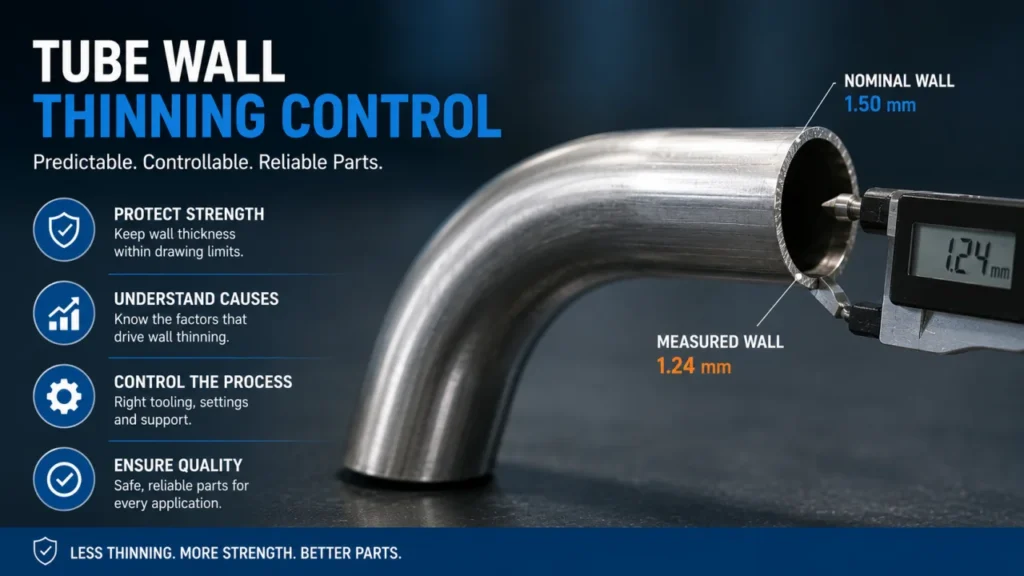
Tube wall thinning during bending is a serious quality issue. You bend a tube, and the outer wall gets thinner than the drawing allows. The part weakens, and in pressure applications, it can fail. The good news is that thinning is predictable and controllable. This guide explains what tube wall thinning is, why it happens, what factors drive it, and how to keep it within limits. By the end, you will know how to control thinning on your own parts and what to look for in a bending partner. For anyone in tube processing, mastering this topic is essential for producing safe, reliable parts.
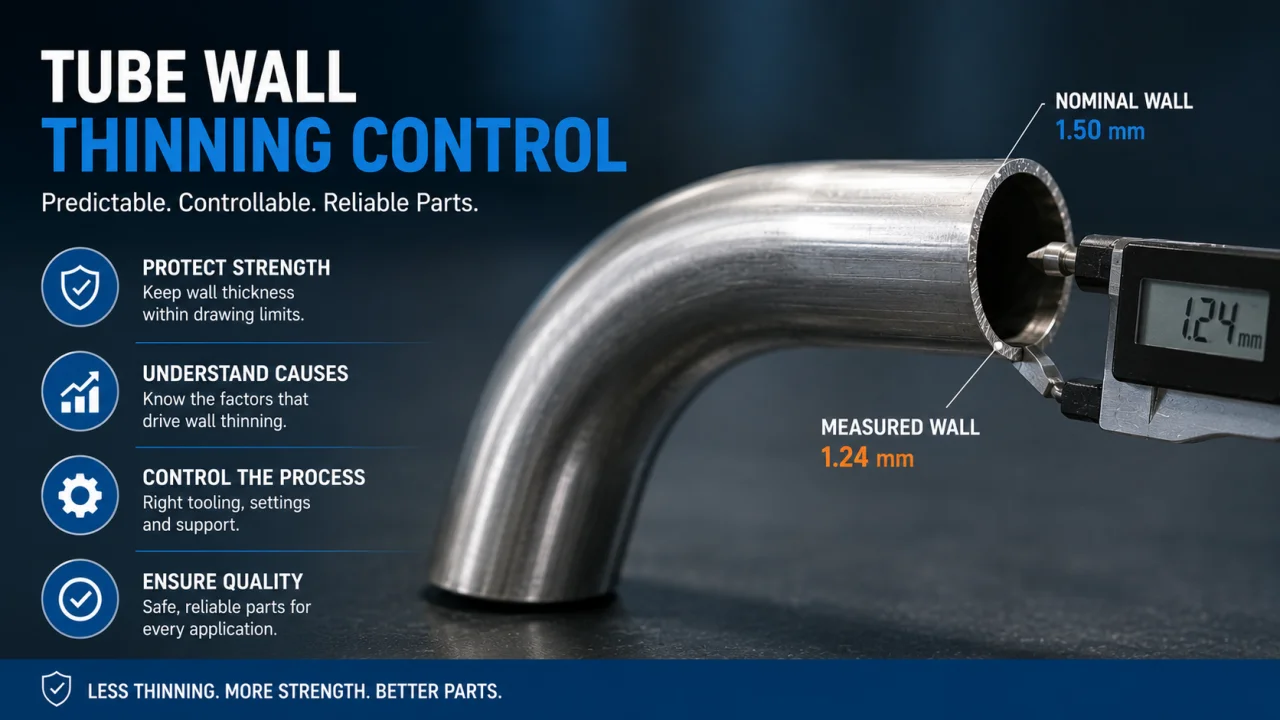
What Is Wall Thinning in Tube Bending?
Wall thinning is the reduction of the tube wall on the outside of a bend. Every bend thins the outer wall to some degree. The question is how much thinning your part can tolerate. Understanding this concept is the first step to controlling it.
The Outer Wall Stretches Under Tension
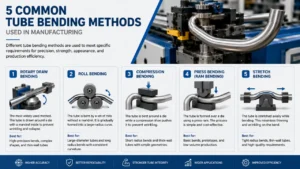
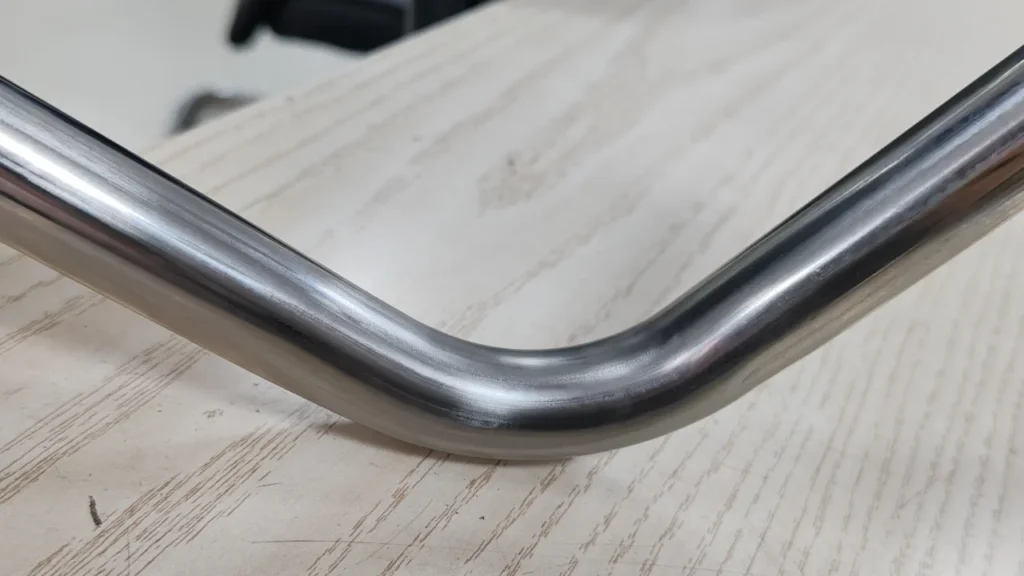
When a tube bends, the outer wall of the bend is stretched under tension. The inner wall is compressed. The neutral axis, the line where stress is zero, shifts toward the inner wall. This means the outer wall must stretch more than the tube moves, and that stretching thins the wall. The tighter the bend, the more the outer wall stretches, and the thinner it gets. This is the fundamental cause of tube wall thinning. Once you see this force at work, the defect makes sense.
Why Wall Thinning Matters
Wall thinning matters because it weakens the part. A thinner wall carries less pressure and less load. In applications like boilers, hydraulic lines, and structural parts, the minimum wall thickness is often specified and inspected. If the bend thins the wall below that limit, the part fails acceptance or, worse, fails in service. Controlling tube wall thinning is therefore a production quality issue, not just a cosmetic one. Your customer’s safety may depend on it.
What Causes Tube Wall Thinning?
Three factors drive how much thinning you get. Understanding them helps you design parts and choose the right process. Check these numbers before you bend.
Bend Radius (R/D Ratio)
The bend radius compared to the tube diameter, written as R/D, is the biggest driver of tube wall thinning. A small R/D means a tight bend, which stretches the outer wall more. As a rule of thumb, tight radii below about 2D produce significant thinning. Larger radii stretch the wall less and thin it less. If your design can use a larger bend radius, you will reduce thinning automatically. This is the cheapest control you have, and it works before you even touch a machine.
Wall Thickness (t/D Ratio)
The wall thickness compared to the tube diameter, written as t/D, also matters. A thin wall relative to the diameter has less material to stretch, so the thinning is proportionally larger. Thicker walls absorb the stretching better. This is why thin-wall tubes are more sensitive to tube wall thinning and need more careful process control. When you evaluate a thin-wall part, plan for extra support from the start.
Material Behavior
Material matters as much as geometry. Stainless steel work-hardens and resists stretching, but it still thins under tight radii. Carbon steel is more forgiving. Aluminum thins readily and needs gentle handling. Copper has good elongation and distributes the stretch. Each material responds differently, and your process must match it. Your material choice sets the difficulty of controlling tube wall thinning on the whole job. For more on this topic, read Keensaw’s guide to eliminating wall thinning.
How Much Wall Thinning Is Acceptable?
The acceptable amount of thinning depends on your application and the governing requirements. Here is how to think about the limit. This is the question every engineer asks before accepting a bend.
Practical Thinning Limits
In practice, the acceptable thinning depends on the bend radius and the application. Tight bends thin more, and the design must account for that. As a rule of thumb, larger bend radii produce less thinning and are safer for pressure parts. When you design a part, check the minimum wall thickness required at the bend, and verify that the bending process can meet it. A sample bend is the most reliable way to confirm the actual thinning before you commit.
Code Requirements
Pressure piping applications often reference codes such as ASME B31.3, which set minimum wall thickness requirements for bends. These codes require that the finished bend meets a specified minimum wall after thinning. Designers and engineers check the bend against these requirements before acceptance. For pressure work, verify the governing code and confirm the process can meet it. When codes apply, the tube wall thinning question becomes a compliance question, not just a quality preference. See Bend Tooling’s formulas for tube bending calculations for reference.
How to Prevent Wall Thinning
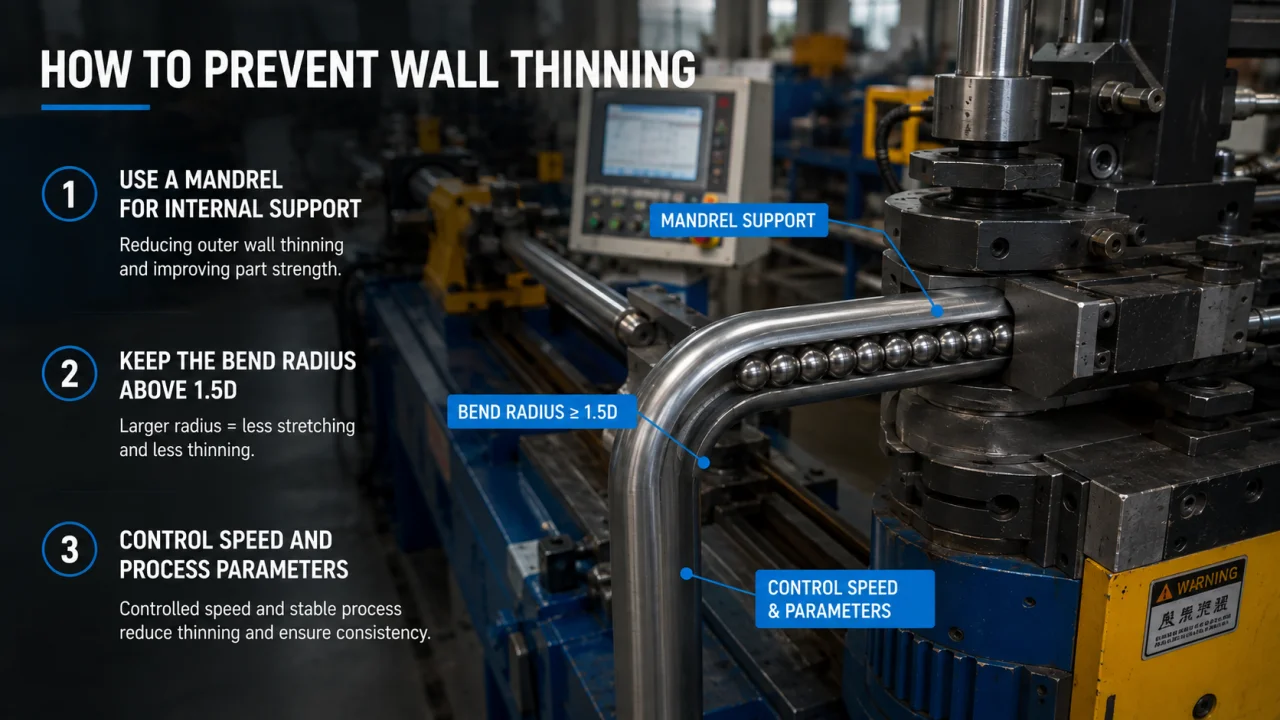
Wall thinning cannot be eliminated entirely, but it can be controlled. Three approaches work together to keep it within limits. Apply all three for the best result on your parts.
Use a Mandrel for Internal Support
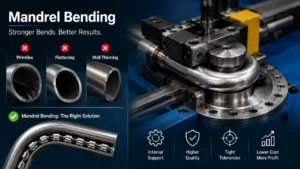
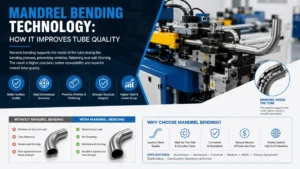
A mandrel inside the tube redistributes the strain during bending. It supports the inner wall, which shifts stress away from the outer wall and reduces stretching. The result is less tube wall thinning on the outside of the bend. For thin-wall and tight-radius work, a mandrel is the single most effective tool for controlling thinning. Our machines use a mandrel as standard for this reason. The mandrel is the difference between a weak bend and a strong one. Our design and engineering service supports custom mandrel tooling.
Keep the Bend Radius Above 1.5D
The bend radius is the easiest factor to control. A larger radius stretches the outer wall less and reduces thinning. As a practical minimum, keep the bend radius at or above 1.5D, where D is the tube diameter. Our machines achieve bend radii down to 1.5D, and this is the safe lower limit for most materials. When your design allows a larger radius, use it. The radius is your first and cheapest defense against thinning.
Control Speed and Process Parameters
Process parameters influence how the material flows. Controlled bending speed gives the metal time to distribute the strain, which reduces localized thinning. For stainless steel and thin-wall tubes, slower speeds help. Based on our machine specifications, larger tube diameters run at slower bending speeds for this exact reason. Consistent material batches and stable process settings also keep the thinning predictable. When the process is stable, the thinning is stable, and you can design for it with confidence.
Preventing Wall Thinning with the Right Equipment
The right equipment makes tube wall thinning control automatic instead of manual. Here is what to look for. The right machine removes the guesswork from the whole process.
Mandrel-Equipped CNC Bending
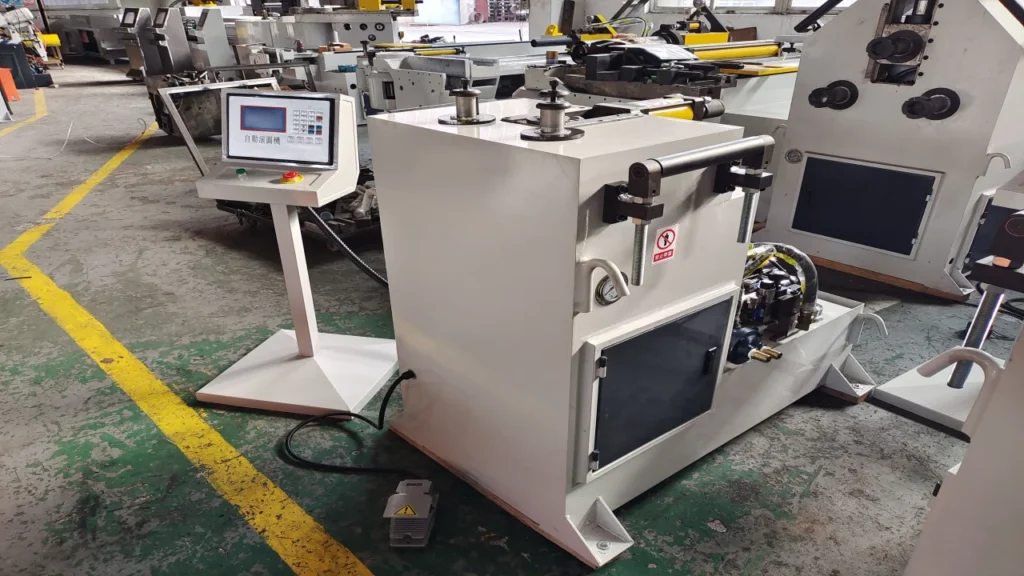
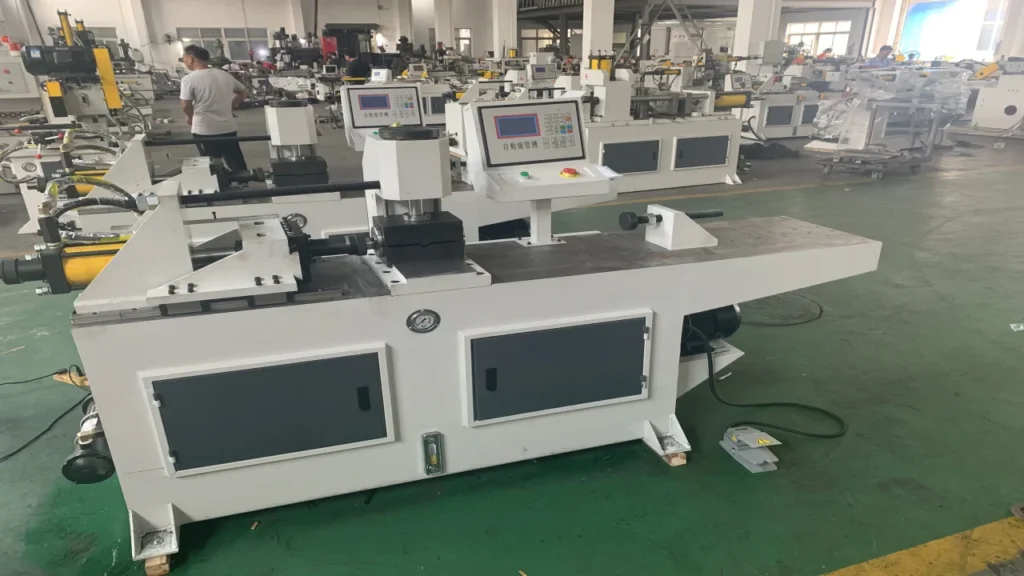
A CNC bending machine with mandrel as standard controls tube wall thinning reliably. The mandrel supports the inner wall, reducing outer-wall stretching. Servo control holds the bend angle within ±0.1 degrees for repeatability. Features like slow mandrel retraction and springback compensation are built in. This is the reliable way to hold wall thickness within limits batch after batch. If your parts have a wall thickness requirement, a mandrel-equipped CNC machine is the foundation you should build on. Explore the CNC pipe bending machine collection.
Verify with Samples Before Production
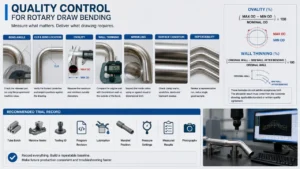
Wall thinning is easy to predict but also easy to get wrong. Before committing to full production, verify with a sample bend using your own tube. Measure the wall thickness at the bend, check it against your minimum, and confirm the result meets your drawing. A supplier who confirms parameters, builds tooling, produces a sample, and only ships after acceptance protects your production from the start. A sample is your proof that the thinning is under control before you spend on a full run. Our sample service lets you verify your parts first.
Frequently Asked Questions About Tube Wall Thinning
What is wall thinning in tube bending?
Wall thinning is the reduction of the tube wall on the outside of a bend. It happens because the outer wall stretches under tension during bending. Every bend thins the outer wall to some degree, and the amount depends on the bend radius, wall thickness, and material.
What causes wall thinning during tube bending?
Wall thinning is caused by the outer wall stretching under tension. Tight bend radii stretch the wall more and thin it more. Thin walls relative to the tube diameter are more affected. Material behavior also plays a role. A mandrel reduces the thinning by supporting the inner wall.
How much wall thinning is acceptable?
The acceptable thinning depends on the application and the minimum wall thickness required. Pressure parts often follow code requirements such as ASME B31.3. In practice, larger bend radii produce less thinning and are safer. Verify the actual thinning with a sample bend before production.
How do you prevent wall thinning in tube bending?
Prevent wall thinning by using a mandrel for internal support, keeping the bend radius above 1.5D, and controlling the bending speed. A larger radius stretches the outer wall less. Consistent material and process parameters keep the thinning predictable.
How does bend radius affect wall thinning?
The bend radius is the biggest factor. A smaller radius stretches the outer wall more and produces more thinning. A larger radius stretches less and thins less. Keeping the radius above 1.5D is a practical way to control thinning.
Does a mandrel reduce wall thinning?
Yes, a mandrel reduces wall thinning. It supports the inner wall during bending, which redistributes the strain and reduces stretching on the outer wall. For thin-wall and tight-radius bends, a mandrel is the most effective tool for controlling thinning.
What is the minimum wall thickness after bending?
The minimum wall thickness after bending depends on the application and governing code. Pressure piping codes such as ASME B31.3 set minimum requirements. Measure the wall at the bend with a sample and confirm it meets the requirement before full production. You can also review our general FAQ for more guidance.
Conclusion
Tube wall thinning is predictable and controllable. You now know why the outer wall thins, what factors drive it, and how to keep it within limits. You also know the tooling, radius, and process controls that reduce thinning. Apply these principles, and your parts will meet the wall thickness requirement more consistently. Keep this guide close when you design or quote your next bending job.
At Zhangjiagang Zhuoran Machinery, we build CNC pipe bending machines with mandrel as standard. Our machines feature slow mandrel retraction, springback compensation, and bending accuracy around ±0.1 degrees. We manufacture our own mandrel and die tooling, matched to your product dimensions. Our machines achieve bend radii down to 1.5D. We are built to ISO 9001 quality standards and CE compliance requirements, and our equipment is exported to more than 80 countries. Explore how our equipment serves different applications.
Ready to control tube wall thinning on your parts? Send us your tube OD, wall thickness, bend radius, and material. Our engineers will recommend the right tooling and process for minimum wall thinning. Whatever your wall thickness challenge, the solution starts with the right setup.