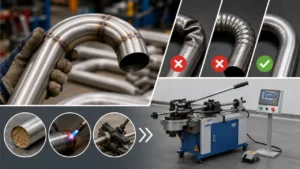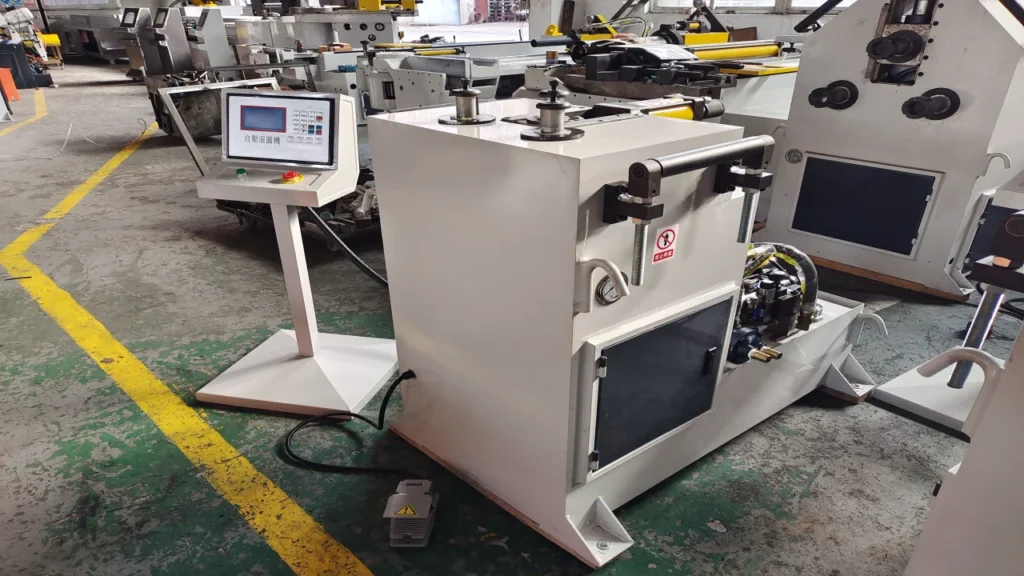
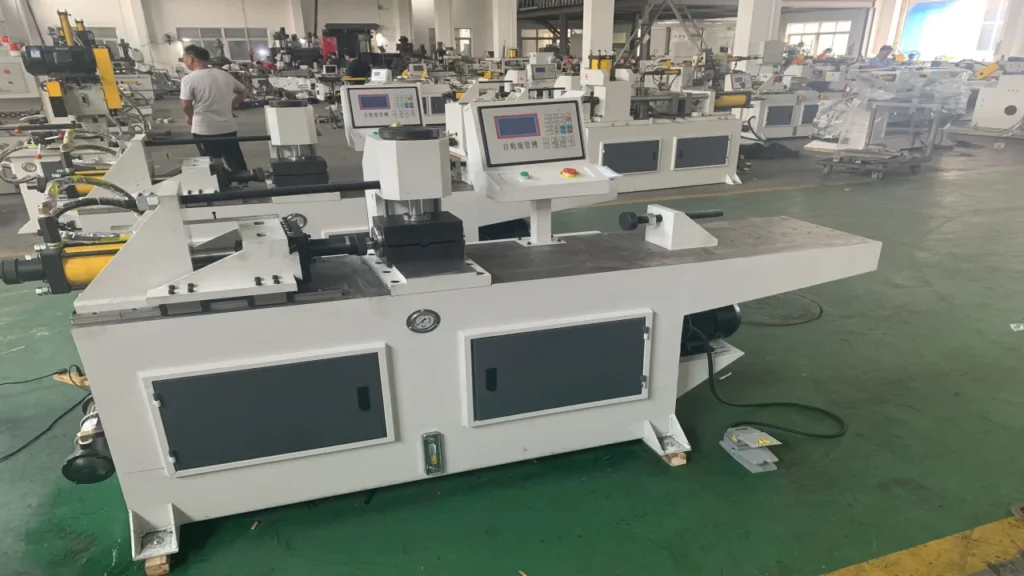
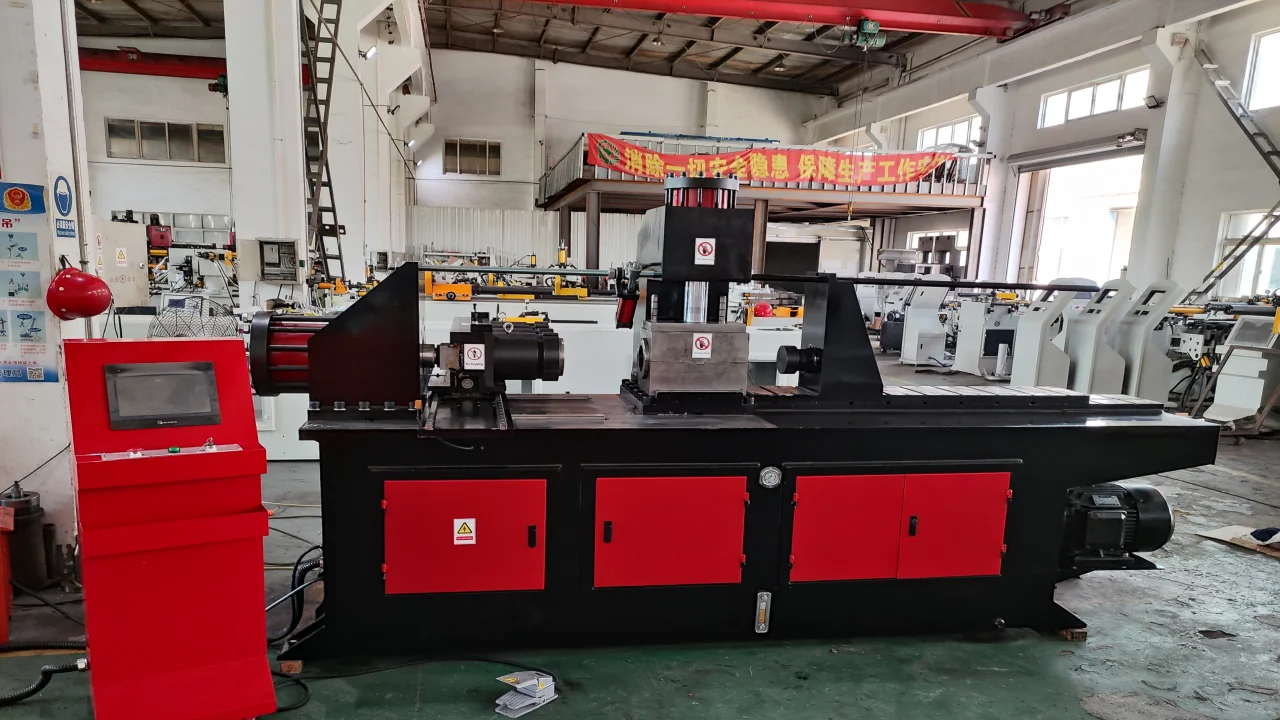
Choosing a tube end forming machine starts with the finished tube end, not the largest diameter shown in a brochure. You need to match the machine, forming dies, number of stations, material condition, production target, and inspection requirements to the actual part. A machine that looks suitable by diameter may still be wrong for a thin-wall stainless steel tube, a large expansion ratio, or a multi-step end profile.
This guide explains how to choose a tube end forming machine for reducing, expanding, beading, flanging, upsetting, and other customized end forms. It also shows how to compare NC, CNC, double-head, multi-station, and automated configurations. Zhuoran’s TM40NC, TM60NC, TM80NC, TM120NC, and customized solutions are used as model references. Final suitability still requires a drawing review and sample validation.
If you are deciding how to choose a tube end forming machine, use the finished part and the production route as your reference instead of selecting a model from maximum diameter alone.
Is Tube Diameter Enough to Choose a Tube End Forming Machine?
No. Tube diameter is only an initial screening value. A reliable selection also needs the material, wall thickness, material condition, finished OD or ID, forming length, deformation ratio, production volume, and quality requirements.
For example, two tubes may both have an outside diameter of 38 mm but require different machines if one is annealed copper and the other is 316L stainless steel. A thin-wall tube may need internal support. A large expansion or reduction may require progressive forming across several stations. A surface-sensitive automotive part may also need different tooling from a general structural tube.
Use the finished tube end as the starting point. Then work backward to the raw tube, forming process, tooling, station quantity, automation level, and acceptance method.
What Information Should You Send Before Requesting a Machine Recommendation?
Send enough information for the supplier to evaluate the complete forming process. A tube OD and a target quantity are not enough for a dependable recommendation.
What raw tube information should you provide?
Prepare the following raw tube data:
- Material and grade, such as carbon steel, 304 stainless steel, 316L stainless steel, 6061 aluminum, C12200 copper, or brass.
- Material condition, such as annealed, cold-worked, or heat-treated.
- Outside diameter and wall thickness.
- Wall thickness tolerance.
- Raw tube length.
- Tube straightness and cut quality.
- Existing burrs, chamfers, or surface restrictions.
Material condition matters because the same nominal grade can behave differently after heat treatment or cold working. Wall thickness also changes the forming force and the risk of cracking, wrinkling, or collapse.
What finished-end information should you provide?
Mark the finished tube-end requirements clearly:
- Finished outside diameter or inside diameter.
- Forming length.
- Reduction, expansion, beading, flanging, upsetting, or another profile.
- Single-end or double-end forming.
- Number and sequence of forming operations.
- Required concentricity, roundness, and dimensional tolerance.
- Surface requirements, including limits on scratches, dents, and tooling marks.
- Minimum allowable wall thickness after forming.
If the tube has more than one formed section, identify every section separately. A forming die cannot be designed correctly from a general product description alone.
Why should you send a 2D drawing or 3D STEP file?
A 2D drawing defines dimensions, tolerances, and inspection requirements. A 3D STEP file helps engineers check the part geometry, clamping space, tool access, and interference. You can send both when the product has a complex shape.
Zhuoran’s tube forming engineering service reviews the material, tube dimensions, wall thickness, forming geometry, and production requirement before recommending a machine or tooling route.
Which Tube End Forming Process Do You Need?
Your required process depends on the final connection, assembly, or reinforcement function of the tube end. Different names may describe related operations, so the finished dimensions should always control the decision.
What is reducing or swaging used for?
Reducing decreases the tube-end diameter or creates a stepped section. Manufacturers use it for insertion joints, sleeve connections, transitions, and other parts that need a smaller end.
Large reductions may not be suitable for one forming hit. A progressive sequence can distribute the deformation and reduce the risk of cracking or wrinkles.
What is expanding or flaring used for?
Expanding increases the tube-end diameter. Flaring can create a wider opening or a connection surface. These processes are common in tube assemblies that need a larger receiving end, a sealing interface, or a defined joining geometry.
Thin-wall expansion requires careful control of internal support, die alignment, material condition, and forming speed. The target diameter alone does not prove that the operation is feasible.
What are beading, bulging, and upsetting used for?
Beading and bulging create local features such as positioning beads, retaining sections, and reinforcement ribs. Upsetting moves material into a defined area to create a thicker or stronger end feature.
These processes require a die profile that matches the required material flow. The supplier may need to verify the forming sequence through a sample run before confirming the final tooling package.
When do you need flanging or a customized end profile?
Flanging creates a turned or expanded edge for connection, sealing, or assembly. Customized profiles may combine several operations, such as reduction followed by beading or expansion followed by flanging.
Zhuoran’s TM series documents include convex, concave, stepped, offset, square, V-shaped, open-elbow, flat-elbow, and other customized forms. Those shapes describe the available forming direction and tooling possibilities. They do not mean that one standard die can produce every material and size combination.
How Many Forming Stations Do You Need?
Choose the number of stations from the actual process sequence and deformation amount. More stations are useful only when the product needs them.
When is a single-station machine suitable?
A single-station configuration may suit a simple product with one main operation, such as a basic reduction or expansion. It can also be practical for prototypes, low-volume work, or products that require frequent manual die changes.
Single-station equipment normally has a lower initial cost and a simpler setup. Its limitations become clear when one part needs several forming steps or when repeated clamping would affect consistency.
When should you choose a multi-station machine?
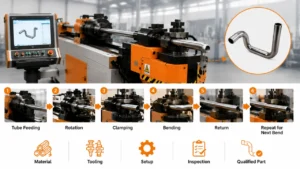
Choose multiple stations when the part needs sequential operations without manual die replacement between every step. Typical sequences include:
Chamfer or preparation
→ First reduction
→ Second reduction
→ Beading
Progressive forming can be useful when one large deformation would overload the tube or cause visible defects. A multi-station machine may also reduce repeated positioning and improve process consistency.
When does a double-head machine make sense?
A double-head machine is worth evaluating when both ends of one tube require forming. The two ends may operate independently or simultaneously, depending on the machine structure and process requirements.
Zhuoran’s supplied 40T documentation describes MT40T-180°, MT40T-90°, and MT40T-135° double-head, double-station configurations. The source lists the tube range as DN25–DN50, so the original DN notation should be confirmed against the actual OD, wall thickness, material, and tube standard before quotation.
Which Materials Can Zhuoran Tube End Forming Machines Process?
Zhuoran can evaluate tube end forming applications involving carbon steel, 304/304L stainless steel, 316/316L stainless steel, 6061/6063 aluminum alloy, C12200 copper, and brass. Final suitability depends on the exact grade, material condition, OD, wall thickness, forming profile, deformation ratio, tooling, and sample result.
If you need a tube end forming machine for stainless steel, confirm the grade, annealed or cold-worked condition, surface requirements, and finished-end tolerance before selecting the model.
How does stainless steel affect the selection?
Stainless steel may require closer control of forming force, surface contact, work hardening, and tooling alignment. A 304 or 316 series tube should not be selected only by its nominal diameter. Annealed material and cold-worked material may produce different results under the same tooling conditions.
How does aluminum affect the selection?
Aluminum is relatively light and formable, but the surface can be sensitive to scratches and local marks. The die surface, lubrication, clamping force, and forming sequence may need attention when appearance is important.
How do copper and brass affect the selection?
Copper and brass tubes can require different handling because of their material condition and surface sensitivity. Soft copper, annealed copper, and harder copper conditions should be identified before selecting the tooling and forming parameters.
Does a listed material range guarantee every application?
No. A material list identifies applications that can be evaluated. It does not replace a project-specific engineering review. You should confirm the material grade, condition, tube size, finished profile, and acceptance limits before treating a configuration as production-ready.
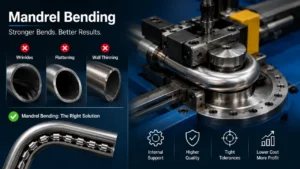
Do You Need a Mandrel, Wiper Die, or Pressure Die?
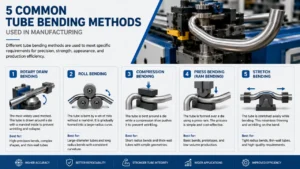
Not automatically. Tube bending tooling and tube end forming tooling use different forming principles, so one cannot be transferred to the other without an engineering review.
Why is tube bending tooling different from end-forming tooling?
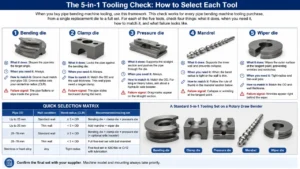
Rotary draw bending may use a bending mandrel, wiper die, pressure die, bend die, and clamp die. Those tools support the tube while it follows a bend radius.
Tube end forming normally uses dedicated forming dies, clamps, punches, and, where required, internal support. The tool package depends on whether the process is reducing, expanding, flanging, beading, or upsetting.
This distinction is important:
| Tooling | Tube bending | Tube end forming |
|---|---|---|
| Bending mandrel | Used for selected bend radius and wall-thickness conditions | Not automatically the same as an end-forming support |
| Wiper die | Used for selected rotary draw bending applications | Usually not a standard end-forming tool |
| Pressure die | Supports the tube during rotary draw bending | Normally replaced or supplemented by forming-specific tooling |
| Internal support | Used for selected bending or forming conditions | Evaluated for expansion, reduction, flaring, or thin-wall work |
| Forming die | Defines the bend profile | Defines the tube-end profile |
| Multi-station tooling | Based on bends and bend sequence | Based on forming steps and deformation amount |
When might internal support be needed?
Internal support may be needed when the tube wall is thin, the expansion or flaring ratio is high, or the finished profile is sensitive to collapse and wrinkling. The decision should be made from the actual tube and finished-end geometry.
Do not write “mandrel included” or “wiper die included” into a purchase order unless the tooling scope has been confirmed in the technical quotation.
Which Zhuoran Model Should You Evaluate First?
Use the following models as preliminary references rather than automatic machine recommendations.
| Model | Reference specification from supplied product data | Configuration reference |
|---|---|---|
| TM40NC | Approx. Ø40 mm × 2 mm; 100 mm stroke; 12 MPa; 4 kW | Three-station NC; manual or semi-automatic operation |
| TM60NC | Approx. Ø60 mm × 2 mm; 125 mm stroke; 12 MPa; 5.5 kW | Three-station NC; manual or semi-automatic operation |
| TM80NC | Approx. Ø80 mm × 2 mm; 150 mm stroke; 12 MPa; 7.5 kW | Three-station NC; manual or semi-automatic operation |
| TM120NC | Approx. Ø120 mm × 4 mm; 150 mm stroke; 14 MPa; 11 kW | Two-station NC; manual or semi-automatic operation |
| MT40T versions | DN25–DN50 as stated in the original source; 220 mm stroke; 7.5 kW | Double-head, double-station configuration |
Supplied TM60NC data lists a working speed of 100 mm in 3–4 seconds. Because the source uses this wording, confirm the value against the final technical document instead of treating it as a universal cycle time.
When might you evaluate the TM40NC?
Evaluate the TM40NC when the tube size is within its reference range and the part needs a compact three-station configuration for manual or semi-automatic production. The actual forming shape and material still determine the die design.
When might you evaluate the TM60NC?
Evaluate the TM60NC when the tube is within approximately Ø60 mm × 2 mm and the process benefits from three forming stations. A supplied AISI 304 stainless steel expansion trial used a customized TM60NC-3 project configuration, which is described below.
When might you evaluate the TM80NC or TM120NC?
Evaluate the TM80NC or TM120NC when the tube diameter, wall thickness, forming length, or number of sequential operations exceeds the smaller reference machines. The TM120NC data describes a two-station configuration and a reference capacity of approximately Ø120 mm × 4 mm.
When should you request a customized machine?
Request a customized solution when the project requires:
- Double-head forming.
- Double clamping.
- Unusual forming length.
- Large or progressive deformation.
- Customized gantry structure.
- Automatic loading and unloading.
- Integrated cutting, inspection, or NG sorting.
- A complete PLC/HMI-controlled processing line.
You can review the tube end forming machine product range before sending the application data.
Should You Choose an NC Machine, a CNC Machine, or an Automated Line?
Choose the control level from the product mix, forming complexity, changeover frequency, production volume, and automation plan.
When is an NC or semi-automatic machine suitable?
An NC or semi-automatic machine may suit stable products, moderate output, manual loading, and applications where operators can manage part handling. It can also be suitable when the forming sequence is clear and product changes are not frequent.
What does CNC add to the process?
CNC control can help manage programmed movements, positioning, feeding, rotation, and repeatable sequences. The value increases when the part has multiple operations, frequent model changes, or an automation requirement.
CNC does not remove the need for correct tooling. A programmed machine with an unsuitable die set will still produce unsuitable parts.
When should you consider an automated line?
Consider an automated line when production volume, labor reduction, traceability, and stable part flow justify the additional equipment. A project may combine:
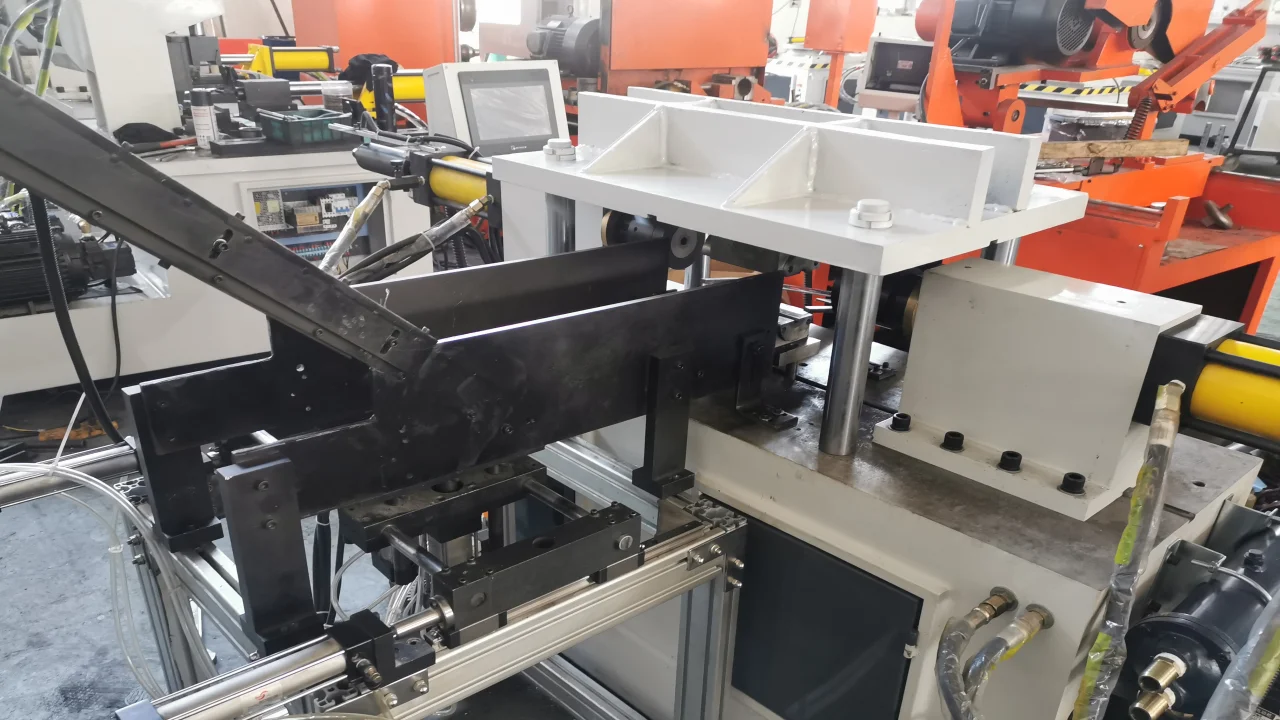
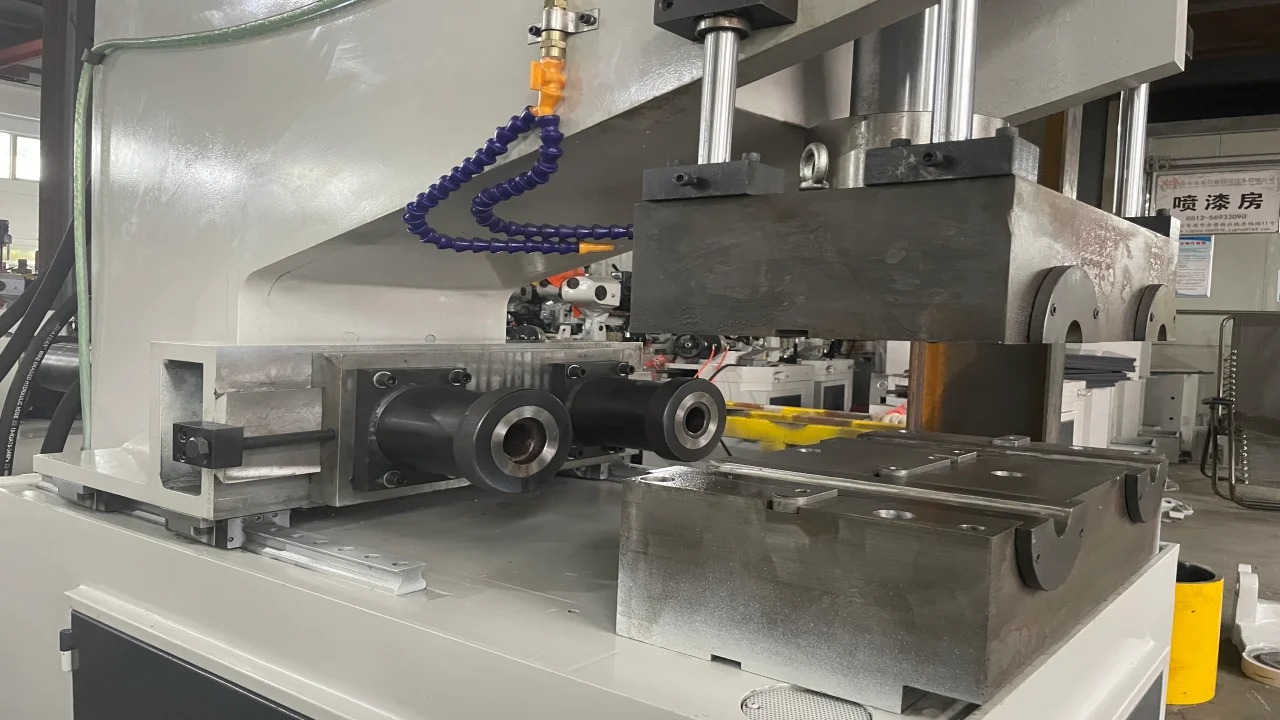
A tube end forming machine with automatic loading may use a raw-material magazine, positioning system, transfer mechanism, and finished-part unloading unit. The exact arrangement depends on tube length, part geometry, cycle time, and inspection requirements.
Raw tube loading
→ Cutting
→ Tube end forming
→ Bending
→ Inspection
→ Unloading
→ OK / NG sorting
Automatic loading, unloading, cutting, robotic handling, inline inspection, NG sorting, line PLC/HMI control, and MES data traceability should be listed as individual configuration items. They are not automatically included on every model.
Zhuoran can evaluate these requirements through its engineering and automation service.
What Should Be Included in a Tube End Forming Machine Quotation?
Compare the complete supply scope, not only the machine body price.
What should you confirm about the machine?
Confirm:
- Machine model and working range.
- Control system.
- Hydraulic or servo configuration.
- Number of stations.
- Clamping method.
- Forming stroke.
- Safety devices.
- Electrical requirements.
- Available automation interfaces.
What should you confirm about tooling?
Confirm whether the quotation includes:
- Forming dies.
- Clamps.
- Punches.
- Internal support or mandrel if required.
- Special forming tools.
- Multi-station tooling.
- Spare or replacement tooling.
- Tool change fixtures.
What should you confirm about automation and services?
Confirm separately:
- Automatic feeding.
- Cutting.
- Automatic unloading.
- Robot handling.
- Inspection equipment.
- NG sorting.
- Installation and commissioning.
- Operator training.
- Maintenance training.
- Sample trial.
- Transportation and packaging.
- Warranty and after-sales support.
This list prevents two suppliers from quoting different scopes under similar machine names.
How Should You Validate a Tube End Forming Machine With a Sample Trial?
Use the actual material and the actual finished-end requirements whenever possible. A catalog range can screen models, but a sample trial verifies the process.
What did the supplied AISI 304 expansion trial evaluate?
For the supplied Brazil automotive tubing project, annealed AISI 304 stainless steel tube was used for single-end expansion. The project input was:
| Item | Trial data |
|---|---|
| Raw tube | OD 38.00 mm × WT 1.50 mm |
| Raw length | 500 mm |
| Target expanded OD | 42.00 mm |
| Target forming length | 25.00 mm |
| Sample quantity | 100 pieces |
| Good quantity | 99 pieces |
| NG quantity | 1 piece |
| Sample pass rate | 99.0% |
| Simulated cycle time | 12 seconds per piece, including loading and unloading |
Project records identify the customer as Andes Automotive Tubing Ltda. in São Paulo, Brazil, and describe the equipment as a customized TM60NC-3 tube end forming solution.
What inspection results should you record?
Sample records included the following results:
| Inspection item | Requirement | Measured result |
|---|---|---|
| Raw tube OD | 38.00 ±0.10 mm | 38.03 mm |
| Raw tube wall thickness | 1.50 ±0.10 mm | 1.52 mm |
| Expanded OD | 42.00 ±0.20 mm | 42.08 mm |
| Expanded length | 25.00 ±0.30 mm | 25.12 mm |
| Expanded roundness | ≤0.30 mm | 0.16 mm |
| End concentricity | ≤0.30 mm | 0.18 mm |
| Minimum formed wall thickness | ≥1.20 mm | 1.29 mm |
| Burr height | ≤0.10 mm | 0.05 mm |
| Cracks and wrinkles | Not allowed | Not found |
These limits belong to the supplied trial condition. They should not be copied as universal requirements for every tube end forming project. Your drawing, technical agreement, or sample approval document should define the final acceptance limits.
How should you calculate good production output?
Use the complete cycle time and the sample pass rate. In this trial:
Theoretical output = 3,600 seconds ÷ 12 seconds = 300 pieces/hour
Estimated good output = 300 × 99% = 297 good pieces/hour
Actual production output may change when the process uses different loading, unloading, inspection, product lengths, forming steps, or changeover conditions. Good output is more useful than theoretical speed when you compare production options.
You can request a tube bending and forming sample service when the material and finished profile need practical validation.
What Should You Check During Final Acceptance?
Separate machine acceptance from sample-part acceptance.
What should machine acceptance cover?
Check:
- Control and operating functions.
- Hydraulic or servo movement.
- Forming station sequence.
- Tool change and clamping.
- Safety functions and emergency stop.
- Automatic sequence, if included.
- PLC/HMI communication, if part of the line.
- Loading, unloading, and inspection signals, if included.
What should sample-part acceptance cover?
Check:
- Finished OD and ID.
- Forming length.
- Position and concentricity.
- Roundness or ovality.
- Minimum wall thickness.
- Cracks and wrinkles.
- Scratches and dents.
- Burrs.
- Surface quality.
- Repeatability across the agreed sample quantity.
What should the acceptance document define?
Write down:
- Material grade and condition.
- Raw tube dimensions.
- Tooling identification.
- Sample quantity.
- Inspection instruments.
- Required tolerances.
- Cycle-time scope.
- Good and NG classification.
- Responsibility for rework or tooling adjustment.
- FAT and SAT requirements, if applicable.
Clear acceptance terms reduce disputes after delivery and make the supplier’s recommendation easier to evaluate.
What Questions Do Buyers Ask About Tube End Forming Machines?
Can one machine process different tube materials?
It may be possible to evaluate one machine for different materials, but each application still needs a material, OD, wall thickness, forming-profile, and tooling review. Do not assume that a machine configured for one stainless steel tube will produce the same result on copper, brass, aluminum, or carbon steel without parameter and tooling changes.
Is a mandrel always required for tube end forming?
No. Internal support depends on the material, wall thickness, forming direction, deformation ratio, and acceptable finished shape. Thin-wall expansion and flaring may need internal support, while other end-forming operations may use different punches and forming dies. Confirm the requirement from the actual sample.
How many forming stations do I need?
Match station quantity to the number of forming steps and the deformation per step. A simple one-step operation may use one station. A large reduction, a reduction followed by beading, or another progressive sequence may need multiple stations. More stations are not automatically better if the process does not use them.
Are tube bending dies the same as tube end forming dies?
No. A rotary draw bender may use a bend die, clamp die, pressure die, mandrel, and wiper die. A tube end forming machine normally uses dedicated forming dies, punches, clamps, and, when required, internal support. The two tooling packages should be evaluated separately.
Can automatic loading and unloading be added?
Yes, automatic loading, unloading, cutting, robotic handling, inspection, and NG sorting can be evaluated as individual options or as part of a complete line. The final configuration depends on the product geometry, tube length, production volume, quality requirements, and available space.
Should you choose NC or CNC?
NC may suit stable products and manual or semi-automatic production. CNC becomes more useful when the part has complex sequences, frequent changes, programmed positioning, or future automation requirements. The decision should be based on the complete production route, not only on the word “CNC”.
What should you send to a supplier first?
Send a 2D drawing or 3D STEP file, material and grade, material condition, OD, wall thickness, finished-end dimensions, forming length, target quantity, tolerances, surface requirements, and automation expectations. Those inputs allow a supplier to evaluate the machine and tooling together.
What Should You Do Before Ordering a Tube End Forming Machine?
Use this five-step process:
- Prepare the raw tube and finished-end data.
- Confirm the forming process and deformation sequence.
- Compare station quantity, tooling, automation, and service scope.
- Run samples using the actual tube material whenever possible.
- Define machine acceptance and sample-part acceptance before placing the order.
If you are comparing a standard TM model, a double-head machine, or a customized automated solution, send your tube drawing and production requirements to Zhuoran engineers. The engineering team can review whether a standard machine, customized tooling package, double-head solution, or integrated tube processing line is the right starting point.
That is how to choose a tube end forming machine with less risk: define the part, verify the forming route, test the tooling, and agree on acceptance criteria before ordering.