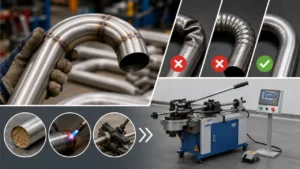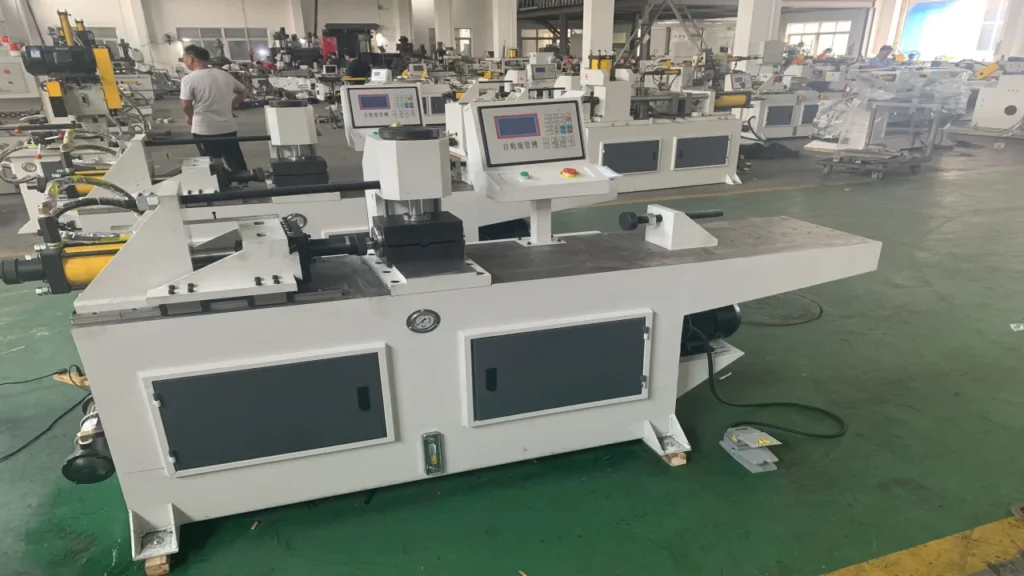
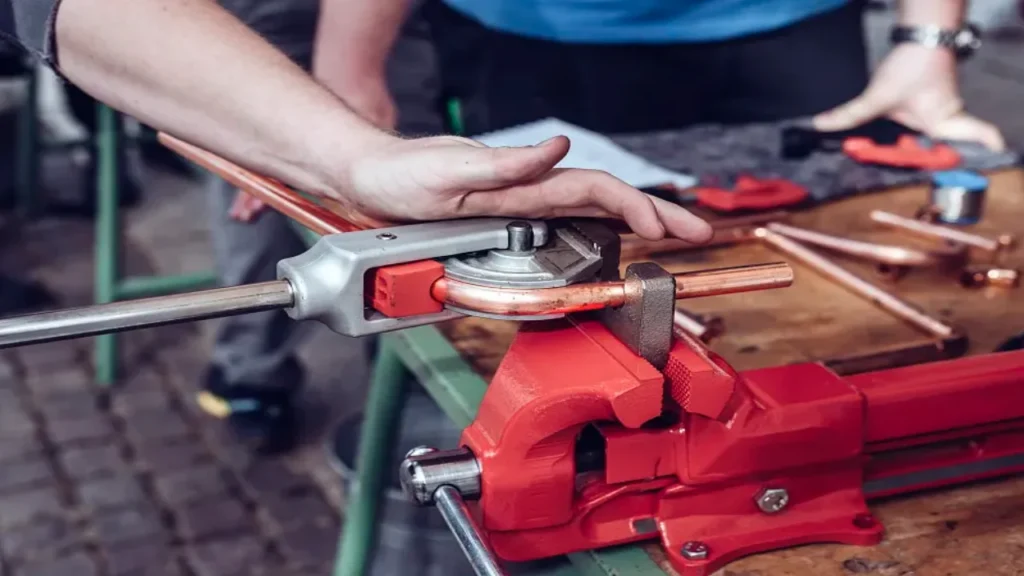
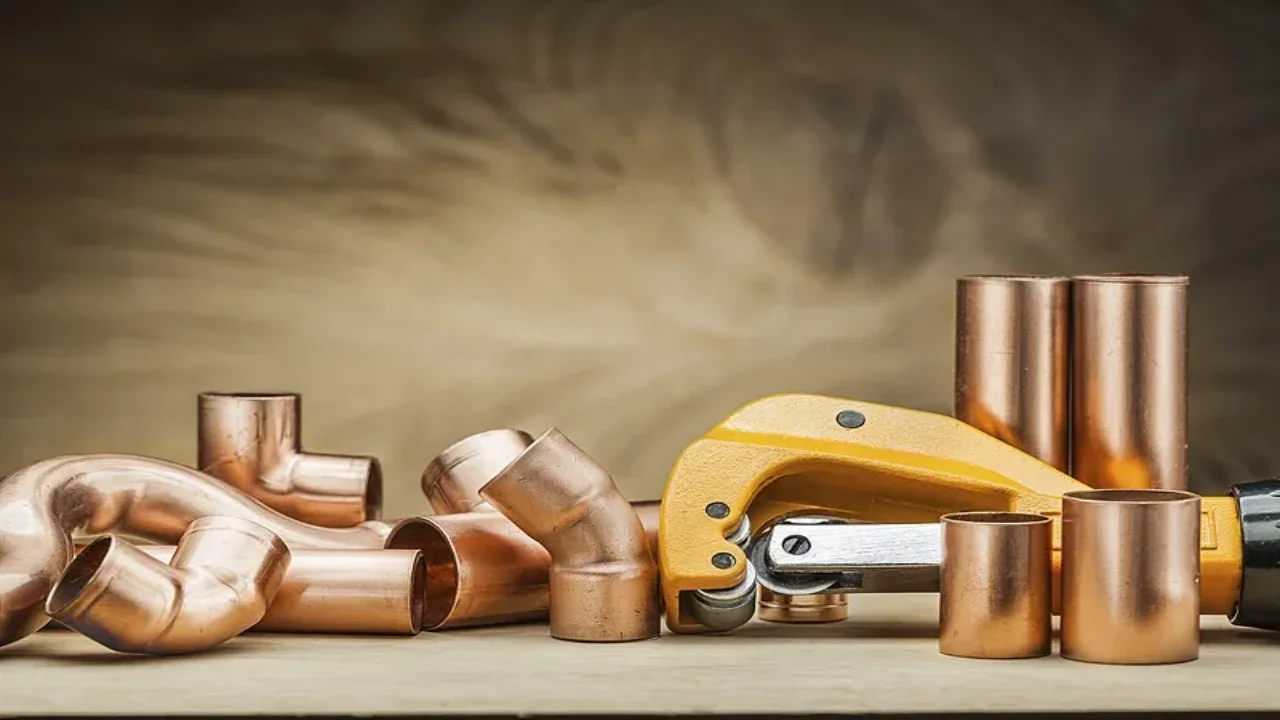
Coiled copper tubing is useful when you need long, continuous tube runs for refrigeration, air conditioning, plumbing, hydronic heating, solar thermal systems, heat exchangers, or other industrial assemblies. However, a coil is not automatically ready for stable forming. You may need to straighten it, control the feed, select the right dies, and then cut each part to length. This guide explains how to evaluate coiled copper tubing forming equipment and when a DW18CNC-3A-1S machine or a customized processing line may be suitable.
What Is Coiled Copper Tubing?
Coiled copper tubing, also called copper coil tubing or a copper tubing coil, is copper tube supplied in a continuous wound length instead of short straight sections. A coil can reduce joints, simplify routing, and make long continuous runs practical. Soft copper tubing coil and annealed copper tubing coil are commonly used when the tube must follow a curved path or pass through a compact installation area.
You should still separate the supply form from the forming process. A tube may arrive as a coil, but the material can retain a curved memory, develop local distortion during handling, or require straightening before it enters a bending machine. Stable production depends on more than the word “coil” on a product label.
Common application areas include:
- refrigeration and air-conditioning circuits;
- HVAC tubing and refrigerant lines;
- water and underground service lines, subject to the applicable code;
- hydronic heating and solar thermal systems;
- heat exchangers, condensers, and evaporators;
- industrial fluid routing;
- copper tube components that require repeated bends and fixed cut lengths.
Application approval is not automatic. A tubing supplier, system designer, or local code authority must confirm whether a particular tube, standard, cleanliness level, joining method, and material condition are suitable for the service.
Coiled Copper Tubing vs. Straight Copper Tubing
Coiled copper tubing and straight copper tubing can use similar material standards, but they create different production requirements. Straight tube starts with a more predictable centerline. Coiled material arrives with residual curvature, so the process may need uncoiling, straightening, controlled feeding, bending, and cutting in one sequence.
| Consideration | Coiled copper tubing | Straight copper tubing |
|---|---|---|
| Incoming condition | Wound length with residual coil memory | Predetermined straight length |
| First process step | Usually uncoiling and straightening | Loading and locating |
| Main production risk | Feed variation, stretching, and coil-end distortion | Misalignment, handling damage, and cut-length variation |
| Best production fit | Continuous or repeated cut-to-length parts | Short parts, batch work, or operations that start from blanks |
Your choice should follow the part drawing, production volume, tube condition, and joining requirements rather than the supply form alone.
How Do Soft and Annealed Copper Tubes Differ from Hard Tube?
Soft and annealed copper tubes are easier to form than hard-drawn straight tube, but easier forming does not mean risk-free forming. Material condition affects springback, surface damage, section distortion, and the amount of support needed during bending.
When you evaluate a coiled copper tube, record the material condition together with the size. “Copper tube” is not a complete process specification. Your engineering team should identify the alloy or grade, temper, outside diameter, wall thickness, supply form, and intended service.
Type K, Type L, and Type M are commonly used copper-tube designations in plumbing discussions. Type K is generally associated with a heavier wall than Type L or Type M, but exact selection must follow the product standard and service requirement. ASTM B75 covers seamless copper tube in a general material specification context, while ASTM B280 addresses seamless copper tube for air-conditioning and refrigeration field service. These standards are not automatically interchangeable, so your supplier and system designer should confirm the applicable specification.
ASTM B280 is a material specification; it does not define the capability of a bending machine. ASTM B75 and ASTM B280 also do not replace application approval, pressure design, cleanliness requirements, or local code review.
For refrigeration work, do not treat general-purpose copper coil as interchangeable with refrigeration-grade tube. Cleanliness, dehydration, end protection, internal contamination, and joining requirements may be important. Your exact tube datasheet and system specification must control the decision.
Why Does Coiled Copper Tubing Need Straightening Before Bending?
Straightening is often the first controlled operation after uncoiling. A coiled tube may have a residual curve, an uneven end, or a small section that was distorted during storage and handling. Feeding that tube directly into a bending process can make the first position unstable and can transfer variation into every later bend.
Straightening helps create a more predictable feed path. It can improve the relationship between the tube centerline and the machine tooling, which matters when a part contains several bends or when the final cut length is important.
Swagelok notes that softer tube materials such as copper are often supplied in coils and require straightening before use. Its tube-handling guidance also warns against unnecessary repeated uncoiling and recoiling because these actions can distort, harden, and stiffen the tube. You should therefore control the uncoiling direction, support the tube, protect the surface, and avoid pulling harder than the process requires.
For a production project, check the following points before selecting a straightening method:
- How much residual curvature does the incoming coil have?
- Does the first straight section need to meet a dimensional requirement?
- Will the tube pass directly into a feeder or bending machine?
- Can the straightening process mark or flatten the tube?
- Does the product require a separate straightening station or a complete coil-to-part line?
What Copper Tube Specifications Should You Check Before Choosing a Machine?
Machine selection should begin with the complete tube and product specification, not with a machine model name. Send the following information before asking for a final recommendation.
Outside Diameter, Inside Diameter, and Wall Thickness
Outside diameter determines the working size of the bend die, clamp die, guide die, and other tooling. Inside diameter matters when the tube carries a fluid, receives a fitting, or must maintain a specified flow area. Wall thickness affects the tube’s resistance to collapse, the support required during bending, and the result at a tight radius.
Record the nominal size, outside diameter, inside diameter, and wall thickness separately. Nominal size is a designation; it should not be treated as a substitute for the measured or specified OD and ID.
| Dimension | Why it matters during evaluation |
|---|---|
| Nominal size | Identifies the commercial tube designation and helps organize the RFQ |
| Outside diameter (OD) | Sets the working size for the dies, guides, clamps, and machine capacity |
| Inside diameter (ID) | Affects flow area, fitting compatibility, and any internal support requirement |
| Wall thickness | Affects collapse resistance, deformation, and the required forming support |
For the small copper tubing applications discussed in this guide, common processed outside diameters are approximately 10–18 mm. Zhuoran’s stated maximum processing specification for the DW18CNC application is up to 18 mm outside diameter with a wall thickness of up to 2 mm. Your complete drawing and sample still control final suitability.
Material Condition
State whether your tube is soft copper, annealed copper, or another condition. A soft copper tubing coil may be easy to route but still needs controlled handling before forming. If you are buying refrigeration tube, record the applicable material standard and product cleanliness requirements. If you are working with a tube supplied for plumbing, underground service, or a heat exchanger, record the service and design conditions separately.
Bend Radius and Bend Angle
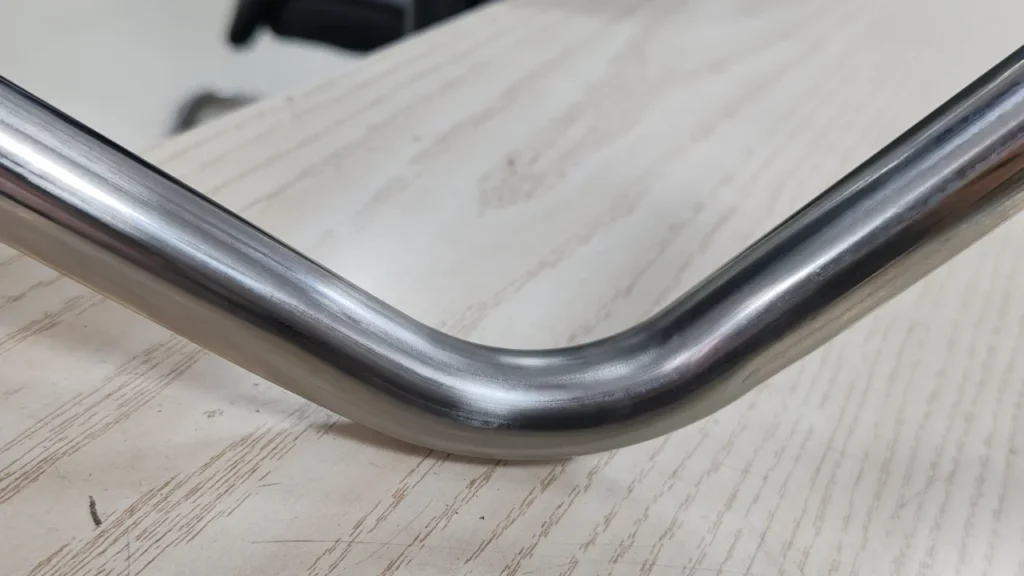
Provide the required centerline radius or the radius definition used on your drawing. For the copper-tube application described here, 1.5D is the minimum bend radius target. Actual results depend on tube diameter, wall thickness, temper, tooling, support, and product shape.
For the DW18CNC-3A-1S application described here, the maximum bending angle is 180°. Do not confuse the machine’s maximum programmed angle with the angle tolerance of the finished part. A production drawing should state both the required angle and the allowed deviation.
Number of Bends and Straight Lengths
One 90-degree bend is a different process problem from a part with several bends in different planes. Record:
- the number of bends;
- each bend angle;
- the bend order;
- the rotation between bends;
- the straight length between bends;
- the required end length;
- the final cut length;
- the inspection datums.
These details influence feeding, rotation, clamping, tooling access, and the choice between a standalone machine and an integrated line.
Can Soft and Annealed Copper Tubing Be Bent Without Kinking?
Yes, soft and annealed copper tubing can be formed when the machine, tooling, and process conditions match the tube. However, a small bend radius or poor support can still create flattening, wrinkles, section distortion, or surface damage.
Copper Development Association guidance shows that minimum bend radius depends on tube size, tube type, and temper. Its published table is a reference for mechanical bending equipment, not a universal promise for every production part. Use the table as a starting point, then validate the actual tube and tooling through a sample bend.
Your process should control more than the programmed angle. It should also control:
- the tube entry condition;
- the clamp force;
- the pressure support;
- the relationship between the bend die and tube OD;
- the feed and rotation sequence;
- the support of the free tube length;
- the handling of the soft finished part.
Soft copper can be damaged after it leaves the tooling. A part that meets the machine output condition can still develop a position error if an operator pulls it, drops it, strikes it against a fixture, or supports it at the wrong point. For this reason, sample evaluation should include handling as well as bending.
When Is the DW18CNC-3A-1S Suitable for Copper Tube Forming?
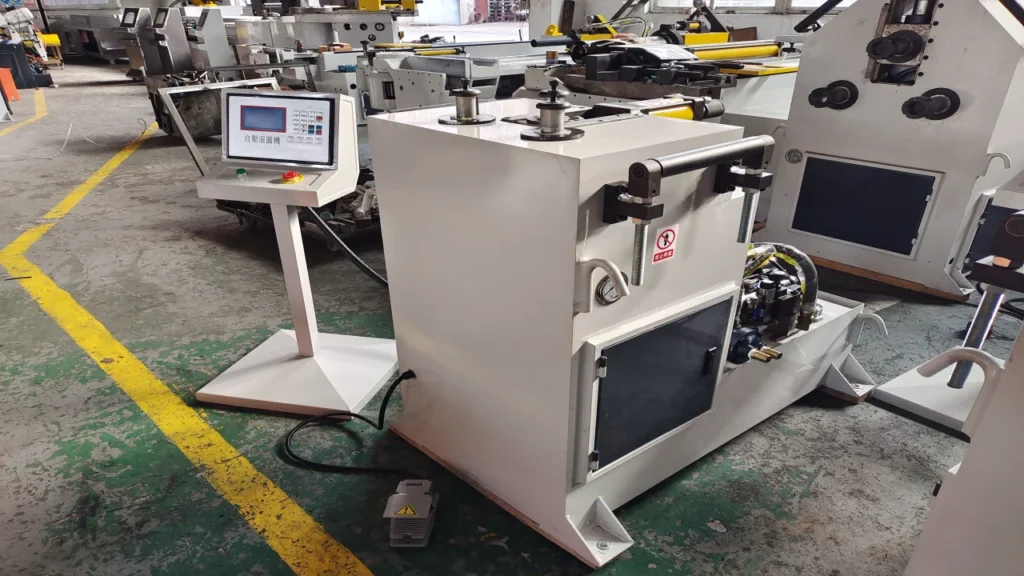
Zhuoran’s copper-tube processing videos are associated with the DW18CNC-3A-1S full-automatic CNC tube bending machine. This model is mainly considered for smaller soft copper and annealed copper tubing. Common application sizes are approximately 10–18 mm outside diameter, while the stated maximum processing specification is up to 18 mm × 2 mm.
You can evaluate the DW18CNC-3A-1S when your product requires:
- automatic tube feeding;
- tube rotation;
- multiple bends;
- a maximum bending angle of 180°;
- a copper-tube bending radius around the project target;
- optional mandrel support;
- optional anti-deformation tooling for selected small-diameter tubes;
- saw cutting after forming;
- repeated production of the same or similar part.
Nominal size alone does not mean that every copper tube will produce the same result. Your engineering review should compare the complete drawing, tube condition, wall thickness, bend radius, straight lengths, required cut length, and production quantity.
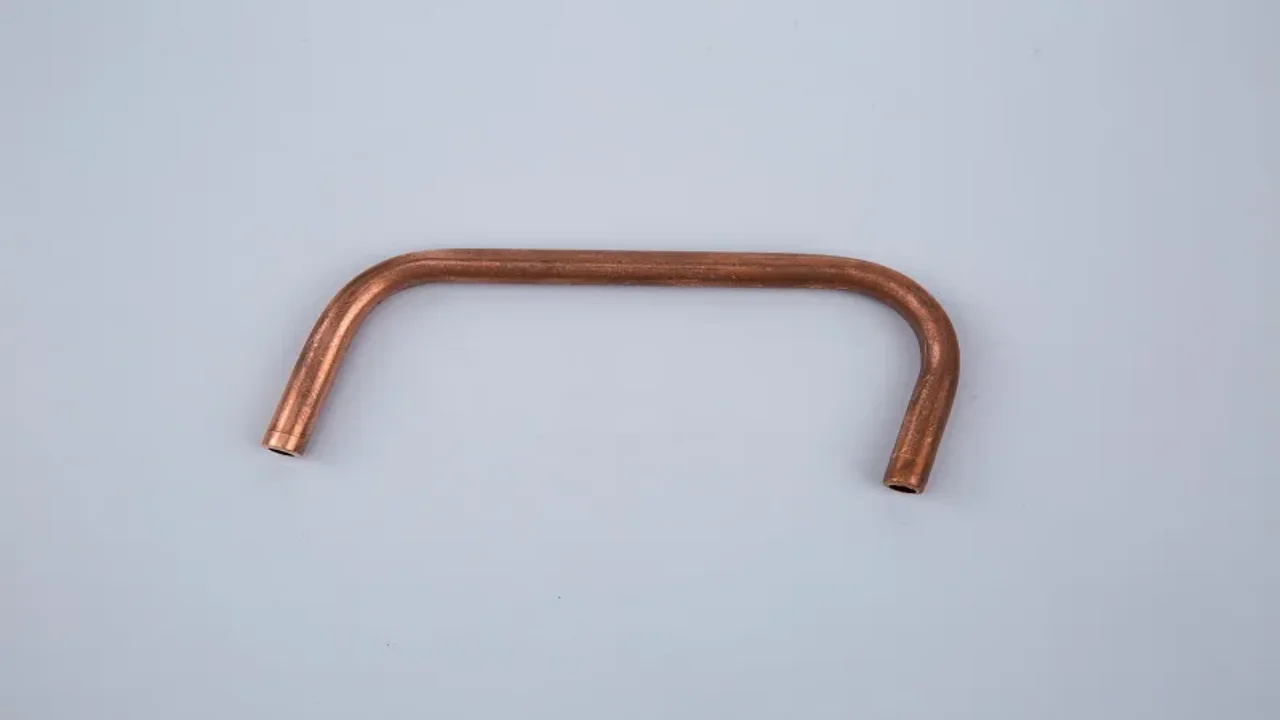
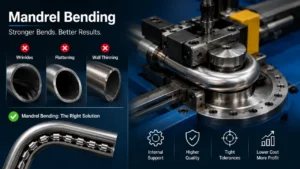
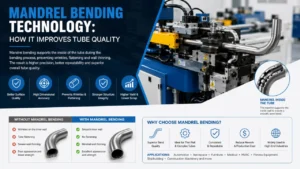
Mandrel or Anti-Deformation Die: Which Tooling Should You Use?
Small-diameter copper tube does not always require the same tooling arrangement as a larger or tighter-radius tube. A mandrel may be used when internal support is necessary, but it is not automatically required for every soft copper application.
For selected small-diameter copper tubes, an anti-deformation die may help control section change during bending. In some conditions, this approach can reduce or remove the need for a conventional mandrel. Engineers should base the decision on the actual tube section, wall thickness, bend radius, bend sequence, and sample result.
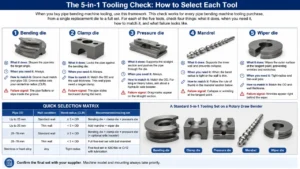
For the described DW18CNC copper-tube work, the basic tooling group includes:
| Tooling | Main function |
|---|---|
| Bend die | Defines the bend path and radius |
| Clamp die | Holds the tube during bending |
| Guide die | Supports the tube as it enters the forming area |
| Grabbing die | Supports tube holding and feeding |
| Wiper die | Optional support for selected wrinkling or tight-forming conditions |
| Mandrel | Optional internal support for selected tube and radius conditions |
| Anti-deformation die | Optional tooling for selected small-diameter applications |
Tooling is not a universal package. A die that works for one outside diameter or wall thickness may not be suitable for another. You should provide a tube sample or drawing before ordering a final mold set.
Servo Feeding or Geared-Motor Feeding?
You can configure the DW18CNC copper-tube solution with geared-motor feeding or servo-motor feeding. Your product and production plan should determine the choice rather than a simple “servo is always better” rule.
Geared-Motor Feeding
Geared-motor feeding may be considered when:
- the product is relatively simple;
- the production volume is moderate;
- the feeding requirement is stable;
- the project prioritizes a straightforward machine configuration;
- the product has fewer position changes.
Servo-Motor Feeding
Servo feeding may be considered when:
- the product contains several bends;
- feed length and position need tighter control;
- production requires repeatable positioning;
- the machine must coordinate feeding with rotation and bending;
- the line may later be integrated with additional automation.
Final selection should consider the required linear tolerance, product geometry, cycle time, operator method, and sample result. Zhuoran’s machine information states approximately ±0.1 mm for selected linear or position dimensions under suitable conditions. Finished-part accuracy can still be affected by soft-tube handling, coil condition, tooling, and inspection method.
How Are Coiled Copper Tubes Cut After Bending?
In the DW18CNC copper-tube process described here, saw cutting follows the specified forming sequence when the part requires a fixed length or a defined tube end.
Before approving the cutting process, check:
- the required cut length;
- the tube support near the cut;
- the saw blade condition;
- the amount of burr allowed;
- whether the tube end must remain round;
- whether the next operation is flaring, brazing, fitting, or end forming;
- whether cutting should occur before or after bending.
Inspect the cut end for a flat face, acceptable burr control, and the absence of obvious squeezing or collapse. A cutting video is useful evidence of the process, but a product drawing and a physical sample are still needed to confirm the acceptance criteria.
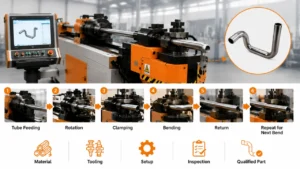
Straightening, Bending, and Cutting: The Complete Process
A practical copper-tube process may follow this sequence:
1. Load the Coil or Tube Stock
Protect the tube end and avoid dragging it across rough surfaces. Confirm that the coil is not already dented or sharply kinked.
2. Straighten the Tube
Use a suitable straightening process to reduce residual coil curvature and create a stable entry condition. Do not stretch the tube aggressively, because soft copper can change shape or develop unwanted hardening.
3. Feed the Tube
Choose geared-motor or servo feeding based on the product’s position requirements, production rhythm, and future automation plan.
4. Rotate and Form the Bends
With the described small-tube application, the DW18CNC-3A-1S supports automatic rotation and multi-bend forming. Your product drawing should define the bend order and rotation data.
5. Cut the Finished Part
Use saw cutting when the product and end condition are compatible with that method. Confirm the final length and inspect the end face.
6. Inspect the Part
Use calipers, angle tools, dedicated gauges, or coordinate measurement equipment as appropriate. Inspect linear dimensions, angle, position, overall contour, surface condition, and the cut end.
Single DW18CNC Machine or Customized Copper Tube Processing Line?
Your choice depends on product variety, production volume, labor, and process sequence.
A Standalone DW18CNC Machine May Be Suitable When:
- you process several tube sizes;
- you make small or medium batches;
- the product changes frequently;
- you need a flexible machine for samples and production;
- operators can manage loading and unloading;
- tooling changes are acceptable.
A Customized Line May Be More Suitable When:
- the product is made in high volume;
- tube size and part geometry are relatively stable;
- HVAC, refrigeration, or heat-exchanger production needs a repeatable cycle;
- you want to combine loading, straightening, cutting, bending, and inspection;
- manual handling creates too much variation;
- the production plan requires a dedicated process sequence.
Zhuoran can evaluate a customized line according to the product. A final line may include different modules for loading, straightening, feeding, saw cutting, bending, unloading, or inspection. Engineers should base a customized solution on the actual drawing, sample, target output, and acceptance requirements rather than a standard machine list.
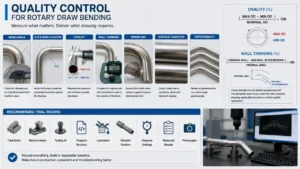
Accuracy and Inspection for Soft Copper Tube Forming
Machine accuracy and finished-part accuracy are related, but they are not the same thing. A stated accuracy of approximately ±0.1 mm may apply to selected linear or position dimensions under suitable operating conditions. Bending angle should be checked separately in degrees, such as ±0.1° when that tolerance is specified and verified.
Soft copper can create handling-related variation. Pulling, striking, dropping, or supporting the tube incorrectly may create a shape change after the machine has completed its operation. You should define the inspection method before the sample test.
Recommended Inspection Methods
- calipers for OD, cut length, and selected linear dimensions;
- angle gauges for bend angles;
- dedicated fixtures for repeatable part positioning;
- height gauges for reference dimensions;
- coordinate measuring machines for complex spatial parts;
- visual inspection for scratches, clamp marks, cracks, burrs, and obvious deformation.
Recommended Sample Checks
Inspect at least:
- tube OD at important locations;
- wall condition at the bend;
- bend angle;
- endpoint location;
- straight length;
- multi-bend spatial position;
- ovality or visible flattening;
- cut-end quality;
- surface marks;
- repeatability across several pieces.
Do not approve a machine from one visually acceptable sample only. Run enough pieces to check whether feeding, material handling, tooling, and dimensions remain stable.
Common Problems When Processing Coiled Copper Tubing
Unstable Feeding
Possible causes include insufficient straightening, an inconsistent coil end, unsuitable gripping, or excessive manual pulling. Review the coil condition and the complete feeding path before changing the bending angle.
Flattening or Section Distortion
Possible causes include an unsuitable die, an excessively tight radius, insufficient support, or incorrect clamping. Compare the tube OD, wall thickness, bend radius, and tooling before deciding whether a mandrel or anti-deformation die is needed.
Wrinkling on the Inside of the Bend
Wrinkling can relate to the material condition, radius, clamp and pressure support, or wiper-die requirement. Do not solve every wrinkle by simply increasing pressure. Excessive pressure can create surface marks or other deformation.
Position or Angle Error
Check feed length, rotation, springback compensation, the drawing datum, and post-process handling. A soft copper part can move after forming if the operator pulls or supports it incorrectly.
Damaged Surface
Inspect the bend die, clamp die, guide die, tube cleanliness, lubrication or forming condition, and operator handling. Decorative or exposed copper parts may require a stricter surface standard than hidden HVAC components.
Cut-End Deformation
Review the saw blade, clamping, tube support, cut location, and the amount of remaining straight length. If the next operation requires flaring, brazing, or a leak-tight fitting, define the end condition before selecting the cutting method.
What Should You Test Before Buying a Copper Tube Bending Machine?
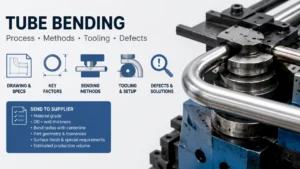
Send a complete coiled copper tubing RFQ package instead of only a machine keyword. A supplier or manufacturer needs enough information to judge the tube, tooling, machine, and process together. A useful evaluation package should include:
- outside diameter;
- wall thickness;
- copper grade or material description;
- soft or annealed condition;
- applicable standard, if known;
- bend radius;
- bend angle;
- number and order of bends;
- straight lengths;
- rotation requirements;
- final cut length;
- production quantity;
- surface requirements;
- inspection tolerance;
- photos, drawings, or physical samples.
If you are comparing a coiled copper tubing supplier, a copper tube bending machine manufacturer, or a custom line builder, ask each company to identify which parts of the proposal are based on standard capability and which parts require sample testing. That distinction helps you compare quotations without treating an advertised machine size as a guaranteed result for every coil.
During the trial, ask the supplier to record:
- the tube condition before forming;
- the selected tooling;
- whether a mandrel or anti-deformation die is used;
- the feeding method;
- the bending sequence;
- the cutting method;
- the inspection method;
- the result from repeated parts.
This record helps you compare suppliers on process understanding, not only on machine price.
Frequently Asked Questions
What is coiled copper tubing used for?
Coiled copper tubing is used for continuous tube runs in refrigeration, air conditioning, plumbing, hydronic heating, solar thermal systems, heat exchangers, and other industrial assemblies. Suitability depends on the tube standard, material condition, pressure, temperature, cleanliness, joining method, and local code.
Does coiled copper tubing need to be straightened before bending?
Often, yes. Straightening can reduce residual coil curvature and improve feeding stability. Required straightening depends on the coil condition and the final part. Avoid aggressive pulling because soft copper can be stretched, marked, or distorted.
Can the DW18CNC-3A-1S process soft copper tubing?
Zhuoran uses the DW18CNC-3A-1S for the described small-size soft copper and annealed copper applications. Common processed outside diameters are approximately 10–18 mm, with a stated maximum specification of up to 18 mm × 2 mm. Confirm the complete tube and drawing before final selection.
What copper tube size can an 18CNC process?
For the application described here, the common range covers approximately 10–18 mm outside diameter, with a stated maximum of up to 18 mm outside diameter and 2 mm wall thickness. Actual suitability depends on the tube condition, bend radius, tooling, number of bends, and required product geometry.
Does small-diameter copper tubing always need a mandrel?
No. Some small-diameter copper tube applications may use an anti-deformation die instead of a conventional mandrel. Your choice depends on OD, wall thickness, bend radius, section control, and sample results. Do not remove the mandrel from a tooling plan without testing the actual tube.
What is an anti-deformation die used for?
An anti-deformation die helps control section change during selected small-diameter tube bends. It may be useful when the product needs additional support but a conventional mandrel is not the preferred arrangement. Its design must match the tube and bend geometry.
Should I choose servo feeding or geared-motor feeding?
Choose based on the product geometry, required position control, production rhythm, and automation plan. Geared-motor feeding may suit simpler or flexible production. Servo feeding may be useful for coordinated multi-bend work and repeatable positioning. Sample testing should confirm the final choice.
When should I choose a customized copper tube processing line?
Consider a customized line when production volume is high, the product sequence is stable, and you want to integrate loading, straightening, feeding, cutting, bending, unloading, or inspection. A standalone DW18CNC machine may be more suitable when you process multiple sizes or smaller batches.
Request a Coiled Copper Tubing Forming Evaluation
If you are evaluating coiled copper tubing forming equipment, a small copper tube bending machine, or a complete coil-to-part process, send your tube OD, wall thickness, material condition, bend radius, bend angle, number of bends, cut length, production quantity, and drawing or sample photos.
Zhuoran can review whether a DW18CNC-3A-1S solution, selected tooling, or a customized straightening, bending, and cutting line is more suitable for your project. An engineering review should confirm the process through the actual tube and sample requirements.