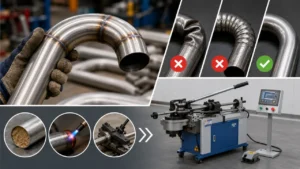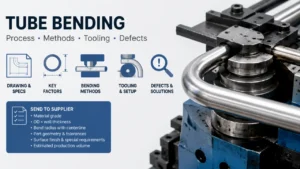
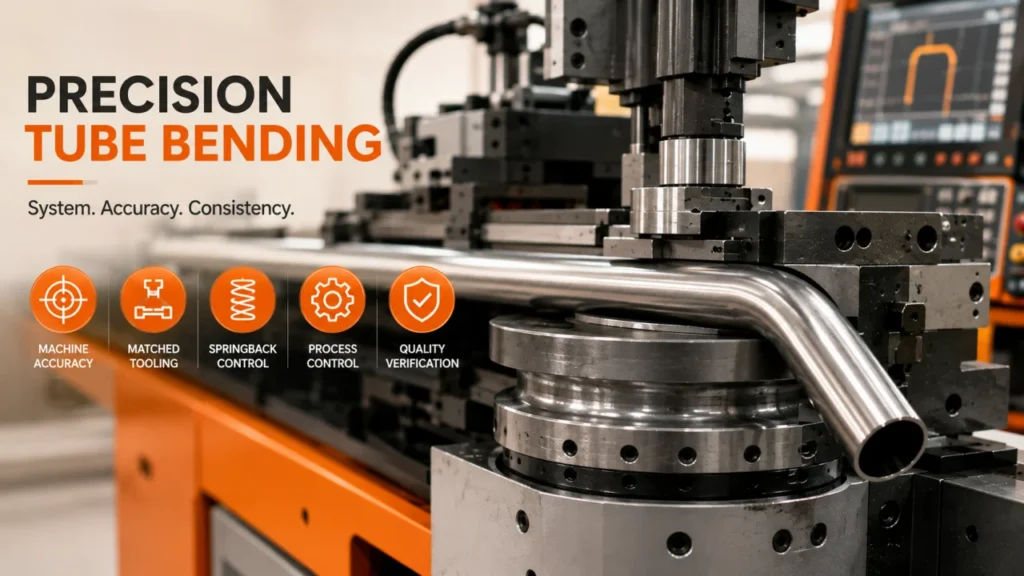
Precision tube bending is not about luck. It is a system of machine accuracy, matched tooling, and careful process control. If your bent parts fail to meet tolerance, you lose time, material, and customer trust. You may have wondered how some manufacturers hit tight angles batch after batch while others struggle.
This guide explains how manufacturers achieve precision tube bending. You will learn the five factors that control accuracy, how springback is compensated in practice, and how to verify quality before you commit. By the end, you will know exactly what to check when you buy a machine or select a bending partner. For anyone in tube processing, this precision tube bending roadmap turns a vague goal into a concrete plan.
What Is Precision Tube Bending?
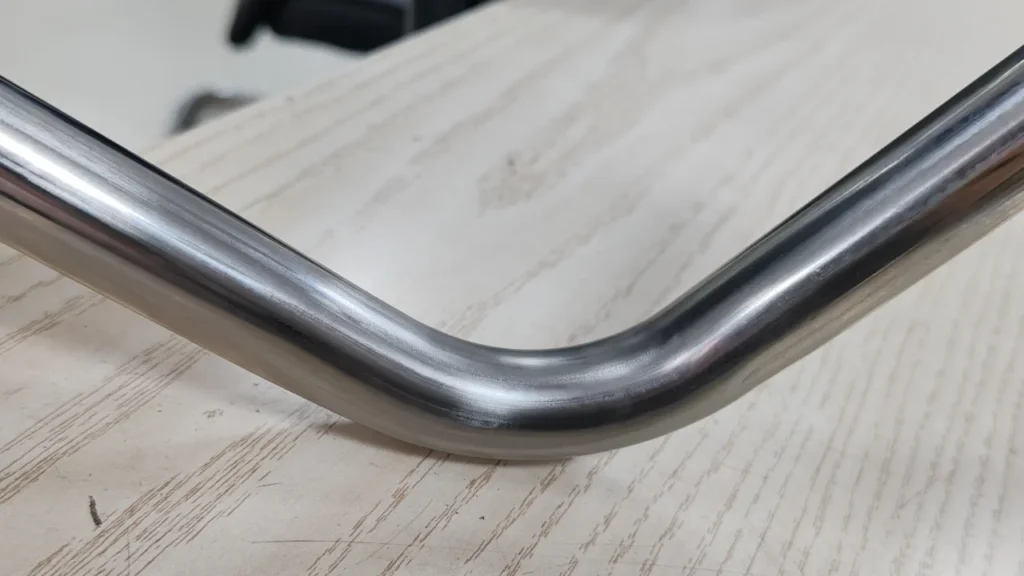
Precision tube bending means producing bends that meet specified dimensions within a defined tolerance. It covers bend angle, plane rotation, feeding position, and the roundness of the cross-section. In tube processing, precision decides whether parts assemble correctly and perform as designed. When you talk about precision tube bending with a supplier, you are really talking about tolerances and the ability to hold them consistently.
What Tolerance Can You Expect?
Precision is measured across three axes: bending angle, feeding position, and rotation. On a CNC machine, servo-controlled bending holds the angle within ±0.1 degrees, while feeding and rotation stay within ±0.1 mm. These numbers represent the machine’s capability, and they form the baseline for repeatable production. Your final part tolerance also depends on tooling, material, and process control. Think of the machine number as the ceiling, and the rest of the system as what you actually achieve.
Why Precision Matters in Tube Processing
Precision affects assembly, sealing, and function. A bend angle off by half a degree can stop a fitting from aligning. Ovality can ruin a seal. Inconsistent feeding can shift hole positions. For industrial manufacturing, precision directly translates into fewer rejected parts and smoother production. Customers notice the difference in fit and finish, and repeat business follows quality.
The Five Factors Behind Precision Tube Bending
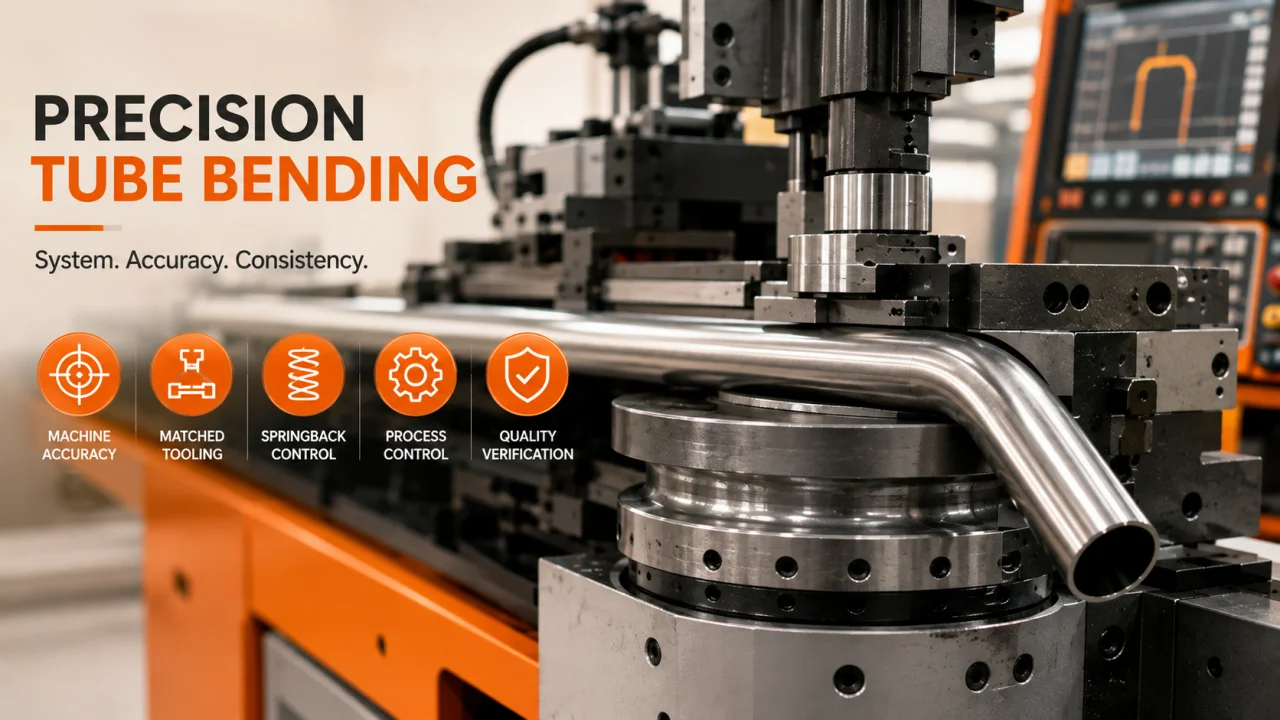
Manufacturers achieve precision through five coordinated factors. Miss one, and the others cannot fully compensate. Work through all five with your own parts in mind, and you will see where your process is strong and where it can improve. These five factors are the practical definition of precision tube bending in production.
Machine Accuracy: Bending, Feeding, and Rotation
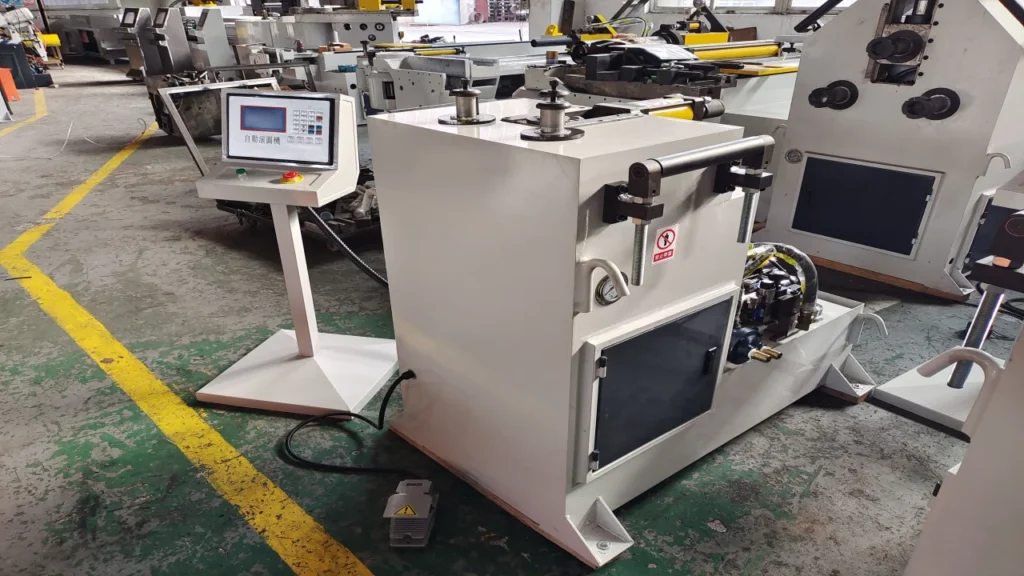
The machine sets the ceiling for precision. Three axes matter: bending accuracy, feeding accuracy, and rotation accuracy. Servo motors control each axis precisely and repeatably. On modern CNC machines, bending accuracy reaches ±0.1 degrees, with feeding and rotation at ±0.1 mm. If the machine cannot hold these numbers, no amount of tooling will fix the part. Start your precision program with a machine that can hold your tolerance. The machine is the foundation, and everything else builds on it. See the CNC pipe bending machine collection for configurations that meet tight requirements.
Tooling That Matches Your Part
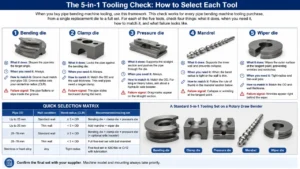
Tooling is the second factor, and it is often underestimated. The bend die, clamp die, pressure die, wiper die, and mandrel must all match your tube’s exact dimensions. Tooling built to the customer’s product size ensures the tube is supported and shaped correctly. When tooling matches the part, the bend comes out clean and consistent. When it does not, even a precise machine produces poor results. Custom tooling matters most for tight radii and thin walls. Ask your supplier whether they manufacture their own tooling and how they match it to your product. Our design and engineering service supports custom tooling for your parts.
Springback Compensation
Springback is the tendency of metal to return toward its original shape after bending. Every material springs back differently. Aluminum springs back more than steel, and different alloys behave differently. Compensation means measuring the actual bend and adjusting the programmed angle to correct the difference. This step turns a good machine into a precision system. Without compensation, your angles drift and your parts miss tolerance. With it, the machine delivers the angle you actually need. In precision tube bending, springback control separates reliable suppliers from the rest. See CRD Manufacturing’s guide to springback compensation for more technical background.
Material and Process Parameters
Material consistency affects precision as much as the machine. Tube from the same manufacturer and the same batch behaves predictably. Mixed batches introduce variation in hardness, wall thickness, and springback.
The material itself also sets the rules for bending speed and tooling. Copper and carbon steel have good elongation, so they bend well at higher speeds. Aluminum is more sensitive; it can show marks on the surface, so manufacturers often use nylon tooling and moderate speed to protect the finish. Stainless steel is the most demanding material. It needs harder tooling, such as 42CrMo steel dies, and a slower bending speed to avoid defects and hold tolerance.
Process parameters such as bend speed, clamp force, and lubrication also influence the result. Controlling these inputs keeps the output stable. When you standardize your tube sourcing and process settings, precision becomes repeatable instead of accidental. Therefore, material control deserves a place in every precision tube bending checklist.
Verification: Sampling, First Article, and Batch Control
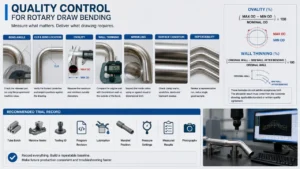
Precision requires proof. A sample bend confirms the tooling and program before production. A first article inspection verifies the first production part against the drawing. Batch control checks that later parts match the first one. This verification loop catches drift early and protects quality through the whole run. In precision tube bending, verification is not optional. It is the step that turns capability into confidence. Our sample service lets you verify quality with your own tube before production.
How CNC Technology Automates Precision
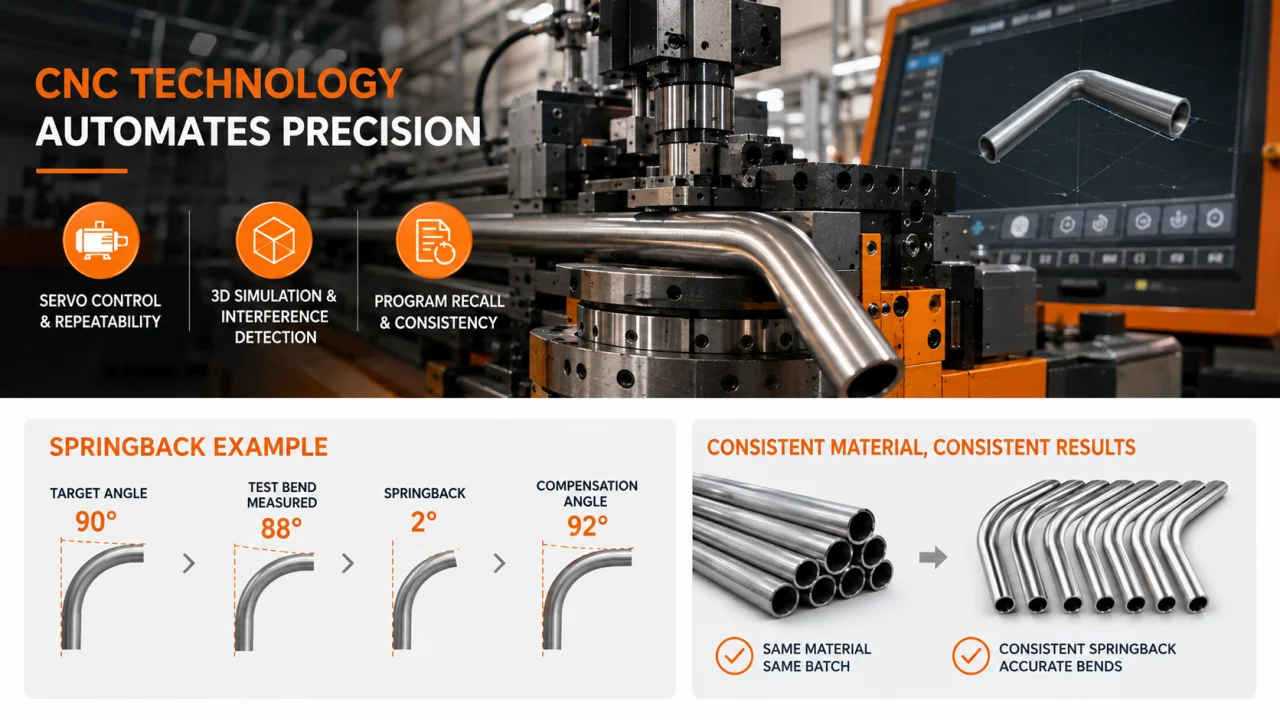
CNC technology turns manual skill into automated repeatability. Here is how modern machines hold precision without depending on operator experience. These features are the practical tools that make precision tube bending achievable on the shop floor. Each one removes a source of human error.
Servo Control and Repeatability
Servo motors drive the bending, feeding, and rotation axes with closed-loop control. The machine knows exactly where each axis is and corrects any deviation in real time. This is why CNC machines repeat the same bend thousands of times without drift. Repeatability is the foundation of precision production. Your first part and your thousandth part come out the same.
3D Simulation and Interference Detection
Before any tube is cut, the control system can simulate the full bending sequence in 3D. Operators see the result on screen, catch interference, and correct the program. Automatic interference detection alerts the operator if the tube, tooling, or machine would collide. Simulation eliminates trial bends and protects tooling. For complex parts, this saves both time and material.
Program Recall and Consistency
A CNC control stores hundreds of programs with up to 30 bends each. Repeat orders recall instantly, so the same part runs the same way every time. This removes the variation that comes from manual programming. For manufacturers running mixed products, program recall keeps each batch consistent with the last. You can switch between products in minutes without re-entering data.
Precision in Practice: The Springback Example
Springback compensation is best understood with a real example. Here is how it works on the shop floor. This is the same method used to set up production bends for customers.
How Springback Is Measured
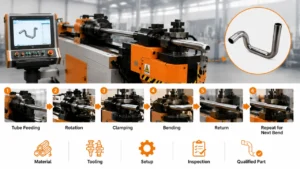
To set up a bend, the manufacturer uses tube from the same manufacturer and the same batch. This consistency is the precondition for accurate compensation. First, a test bend is made at the target angle, then measured. Suppose the target is 90 degrees. The actual measurement comes back at 88 degrees. The difference is 2 degrees, so the compensation angle is set to 2 degrees. The machine then programs 92 degrees to deliver a true 90-degree bend. This measurement loop is repeated whenever the material changes.
Why Material and Batch Consistency Matter
The same material from the same batch behaves the same way bend after bend. If the operator switches to a different batch or supplier, springback can change and the compensation becomes wrong. This is why disciplined manufacturers standardize their tube sourcing and re-verify compensation when material changes. Consistency in the input guarantees consistency in the output. When you plan your production, keep the material source stable for the whole run.
Choosing Equipment and Tooling for Precision Work
If you are buying a machine or outsourcing precision bending, focus on the factors that control accuracy. Ask the right questions before you invest.
What to Look for in a Precision Bending Machine
Check the three accuracy axes: bending, feeding, and rotation. Confirm the machine uses servo control and can hold your required tolerance. Look for 3D simulation and interference detection, which prevent errors before production. Program storage and recall matter for mixed-product shops. A machine with these features gives you the capability, and your process control delivers the results. Do not settle for a machine that cannot document its accuracy.
Tooling Considerations for Tight Tolerances
Ask how tooling is produced and whether it is matched to your product dimensions. Custom tooling built to your tube OD, wall thickness, and bend radius gives the best result. A complete tooling package, including mandrel, wiper die, and pressure die, keeps the whole system consistent. Suppliers who manufacture their own tooling can adjust it faster and keep the match tight. Tooling is where precision is won or lost. For a reference on achievable tolerances, read CRD Manufacturing’s tolerance guide.
Verify Before You Invest
Never commit on specifications alone. Ask for a sample bend with your own tube. Check the angles, radii, and cross-section against your drawing. Confirm the compensation process and the verification steps. A serious supplier confirms parameters, builds tooling, produces a sample, and only ships after acceptance. This verification protects your precision from day one. In precision tube bending, the sample is the evidence you need. Our sample service follows this exact process.
Frequently Asked Questions About Precision Tube Bending
What is precision tube bending?
Precision tube bending produces bends that meet specified dimensions within a defined tolerance. It controls bend angle, plane rotation, feeding position, and cross-section roundness. Modern CNC machines with servo control achieve repeatable precision across production batches.
What tolerance can precision tube bending achieve?
On a CNC machine, bending accuracy can reach ±0.1 degrees, with feeding and rotation at ±0.1 mm. Final part tolerance also depends on tooling, material, and process control. These numbers represent the machine capability that repeatable production builds on.
What factors affect tube bending accuracy?
Five factors control accuracy: machine accuracy, tooling match, springback compensation, material consistency, and verification. Each one plays a role. Machine accuracy sets the ceiling, and the other four determine what you actually achieve in production.
How do you compensate for springback in tube bending?
Springback compensation measures the actual bend and adjusts the programmed angle. For example, a 90-degree target that measures 88 degrees needs a 2-degree compensation angle. Material from the same batch behaves consistently, so compensation stays accurate across the run.
What is the best method for tight-tolerance tube bending?
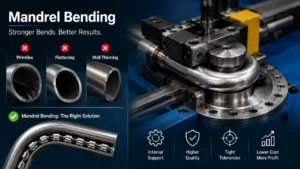
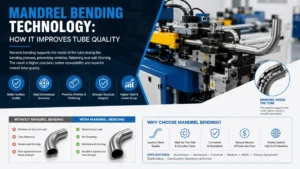
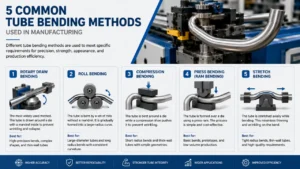
Rotary draw bending with a mandrel is the standard for tight tolerances. It supports the inner wall during the bend, preventing wrinkling and ovality. CNC control adds servo accuracy and repeatability. For thin-wall and small-radius parts, this combination delivers the best results.
How do you ensure consistency across tube bending batches?
Consistency comes from controlled inputs and verification. Use tube from the same manufacturer and batch. Keep process parameters stable. Verify with samples and first article inspection. CNC program recall ensures the same part runs the same way every time.
How do I choose a precision tube bending machine?
Check the three accuracy axes: bending, feeding, and rotation. Confirm servo control and your required tolerance. Look for 3D simulation, interference detection, and program storage. Verify the supplier’s tooling capability and ask for a sample with your own tube. You can also review our general FAQ for more guidance.
Conclusion
Precision tube bending is a system, not a single machine feature. You now know the five factors: machine accuracy, matched tooling, springback compensation, material consistency, and verification. You also know how springback is measured and compensated in practice. Apply these principles, and your parts will meet tolerance more consistently. Keep this guide beside your desk when you evaluate suppliers or plan a new precision job.
At Zhangjiagang Zhuoran Machinery, we build CNC pipe bending machines with servo-controlled bending, feeding, and rotation accuracy. Our machines hold bending accuracy around ±0.1 degrees. We manufacture tooling matched to your product dimensions, including mandrels, wiper dies, and pressure dies. Our machines feature 3D simulation, interference detection, and 500-program storage. We are built to ISO 9001 quality standards and CE compliance requirements, and our equipment is exported to more than 80 countries. Explore how our equipment serves different applications.
Ready to achieve precision on your parts? Send us your tube OD, wall thickness, bend radius, material, and tolerance requirements. Our engineers will recommend the right machine, tooling, and compensation setup for your application. Whatever your precision tube bending challenge, the solution starts with the right questions.