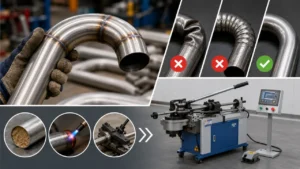
Aluminum tube bending is widely used in HVAC, refrigeration, heat exchanger, industrial equipment, vehicle components, and fabricated aluminum assemblies. Aluminum is relatively easy to form, but that does not mean every aluminum tube or profile can be bent with the same machine, tooling, or process settings.
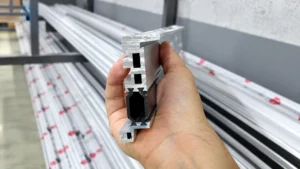
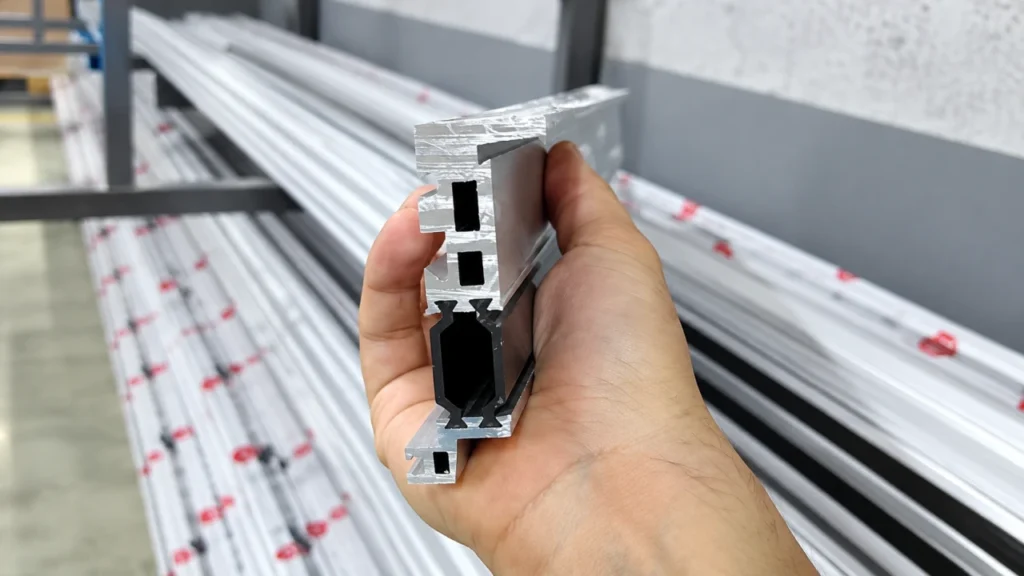
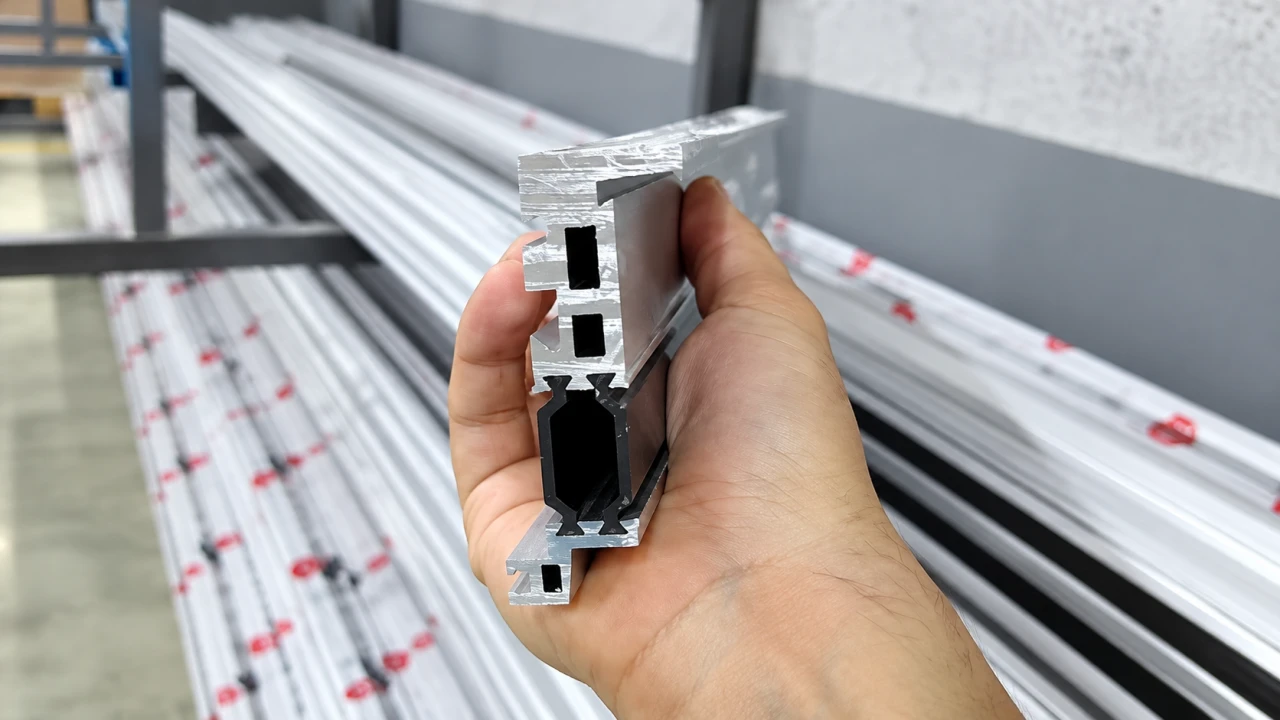
Round aluminum tubing and irregular aluminum profiles behave differently during forming. A profile may have a large height but a small width, multiple hollow sections, thin walls, or an asymmetrical cross-section. These characteristics affect machine clearance, tooling design, bending force, surface protection, and the risk of local deformation.
This guide explains the main challenges of aluminum tube bending, how to select a suitable CNC machine, how tooling affects the result, and why the complete profile geometry must be reviewed before confirming a machine model.
What Is Aluminum Tube Bending?
Aluminum tube bending is the controlled forming of aluminum tubing or aluminum profiles into a required angle, radius, or three-dimensional shape.
The process may involve:
- Tube feeding
- Profile clamping
- Rotation
- Bending
- Pressure support
- Tooling guidance
- Springback adjustment
- Final dimensional inspection
For round tubes, selection often begins with the outside diameter and wall thickness. For aluminum profiles, this approach is not enough. Many aluminum profiles have rectangular, square, oval, T-shaped, U-shaped, or other irregular cross-sections.
In these cases, the complete cross-section must be evaluated. The machine and tooling must provide enough space for the profile to rotate and pass through the bending area without interference.
Why Aluminum Profiles Require Special Machine Selection
The most important difference between aluminum tubes and aluminum profiles is their cross-sectional geometry.
A round aluminum tube has a relatively predictable shape. An irregular aluminum profile may have:
- Different heights and widths
- Multiple hollow chambers
- Thin walls
- Reinforcing ribs
- Open or partially open sections
- Uneven material distribution
- Asymmetrical forming behavior
A profile with a height of 80 mm does not necessarily require the same machine as a round tube with an 80 mm diameter. The actual width, wall thickness, hollow structure, bending radius, and number of bends may lead to a different machine recommendation.
For this reason, machine selection should consider the following information:
| Selection factor | Why it matters |
|---|---|
| Profile height | Determines vertical forming and clearance requirements |
| Profile width | Affects die contact and rotation space |
| Wall thickness | Influences deformation and cracking risk |
| Hollow structure | May require special support or tooling design |
| Bend radius | Affects forming force and surface quality |
| Number of bends | Multiple bends may require more machine movement and space |
| Profile orientation | Changes how the material reacts during bending |
| Tooling clearance | Prevents contact between the profile and machine components |
| Required tolerance | Determines the level of control and inspection required |
The machine should be selected from the complete part drawing rather than from one dimension alone.
Common Challenges in Aluminum Tube Bending
Cracking During Tight-Radius Bending
Aluminum may crack when the bending radius is too small for the material condition, wall thickness, and profile geometry.
The risk may increase when:
A practical solution is to review the profile drawing and required bend radius before selecting the machine. If necessary, the engineering team can evaluate the forming sequence and tooling arrangement.
Kinking and Local Collapse
Kinking occurs when the profile loses its intended shape during bending. The inside wall may fold, or one part of the cross-section may collapse near the bend.
This problem is more likely when:
The solution may involve a different bend die, clamp die, pressure die, or additional support. A mandrel is not automatically suitable for every aluminum profile. Many irregular aluminum profiles cannot use a conventional mandrel in the same way as round tubing.
Cross-Section Deformation
A bent aluminum profile may show:
The amount of deformation depends on the relationship between the cross-section, material, wall thickness, radius, tooling, and bending sequence.
For complex profiles, the machine must be evaluated together with the actual tooling. A machine that can bend a round tube of a certain size may not produce the same result on an irregular profile with a similar height.
Surface Scratches and Marks
Aluminum surfaces can be sensitive to tooling marks. Scratches may occur if:
Surface quality should be included in the project requirements. If the visible surface is important, the tooling design and contact surfaces should be reviewed before production.
Springback and Angle Variation
After the bending force is released, aluminum may recover part of its original shape. The final angle may therefore differ from the programmed angle.
Springback is affected by:
The machine control system can support angle adjustment and process control, but the actual compensation value must be confirmed through testing with the customer’s material and tooling condition.
How to Bend Aluminum Tubing Without Kinking
A stable aluminum tube bending process usually starts with a controlled review of the material and part drawing. The general tube bending process should be considered together with the actual aluminum profile.
Confirm the Complete Profile
For round tubes, record the outside diameter and wall thickness. For profiles, record:
Do not describe an irregular profile only as an “80 mm tube” if that measurement represents only its height.
Review the Bend Radius
The required bend radius affects forming force and deformation risk. A smaller radius usually creates a more demanding forming condition.
The engineering review should confirm:
Match the Tooling to the Section
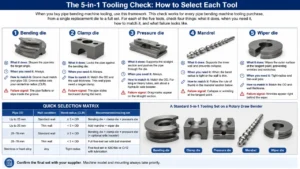
The bend die, clamp die, and pressure die must match the actual workpiece.
For aluminum tube and profile bending, the basic tooling configuration includes:
A support die may be required depending on the profile and forming condition. A wiper die may be used for specific applications and is normally associated with a mandrel configuration.
Control the Bending Speed
Bending speed can affect how the material moves through the tooling. The speed should be adjusted through the control system according to the profile, tooling, and required result.
A stable process is more important than simply selecting the highest possible speed.
Test the Actual Material
The same profile drawing may behave differently if the material condition, supplier, or production batch changes.
For a reliable evaluation, use the actual material intended for production whenever possible. Record the result after bending and check:
Aluminum Tube Bending Methods
Rotary Draw Bending
Rotary draw bending uses a bend die to guide the tube or profile around a defined radius. It is suitable for controlled bends and can be configured with clamp and pressure tooling.
This method is often considered when the part requires:
Roll Bending
Roll bending uses rollers to gradually form the workpiece. It can be useful for larger radii or continuous curved shapes.
Its suitability depends on:
Compression Bending
Compression bending forms the material around a fixed die through a pressing movement. It may be suitable for some simpler bend configurations, but the tooling must still match the actual profile.
For a broader overview of aluminum tube and profile forming methods, see the Hydro aluminum pipe and tube reference.
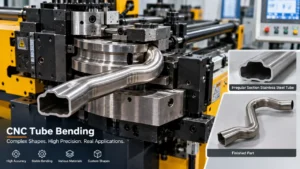
CNC Aluminum Tube and Profile Bending
CNC bending machines control feeding, rotation, bending movement, and program parameters through the control system.
For complex aluminum profiles, CNC control can help manage:
The machine model, tooling configuration, and control system must be considered together. For CNC operating principles, see how a CNC tube bender works.
How to Select an Aluminum Tube Bending Machine
Zhuoran Machinery commonly uses the 38CNC tube bending machine and 50CNC tube bending machine for aluminum tubes and aluminum profiles. The 75CNC tube bending machine can also be evaluated for larger or more complex workpieces.
| Tube bending machine model | Applicable materials | Selection reference |
|---|---|---|
| 38CNC tube bending machine | Aluminum tubes and profiles | Selected according to the complete cross-section and bending requirements |
| 50CNC tube bending machine | Aluminum tubes and profiles | Used when the workpiece requires more forming space or process capacity |
| 75CNC tube bending machine | Aluminum tubes and profiles | Suitable for evaluation of larger or more complex profiles |
| 130CNC tube bending machine | Aluminum tubes and profiles | Maximum processing size: 130 mm, subject to profile geometry and engineering confirmation |
38CNC for Aluminum Tubes and Profiles
The 38CNC tube bending machine can be used for aluminum tubes and profiles. It may be suitable for projects with relatively compact cross-sections and manageable forming requirements.
However, the final decision should consider:
The machine should not be selected only because the profile has a certain height or because it resembles a round tube.
50CNC for Larger or More Demanding Workpieces
The 50CNC tube bending machine can also be used for aluminum tubes and profiles. It may be considered when the workpiece requires more forming space or when the profile geometry is more demanding than a smaller machine can comfortably handle.
The machine selection still depends on the complete profile drawing and the required forming sequence.
75CNC for Complex Aluminum Profiles
The 75CNC tube bending machine is a formal tube bending machine model for evaluating larger or more complex aluminum tubes and profiles.
It may be considered when:
A large profile dimension does not automatically mean that 75CNC is required. The complete geometry must be reviewed.
130CNC for Larger Processing Dimensions
The 130CNC tube bending machine has a maximum processing size of 130 mm.
This model may be evaluated for larger aluminum tubes or profiles. The 130 mm figure should be understood as a machine processing reference, not as a guarantee that every 130 mm profile can be bent with the same tooling.
The final evaluation must consider:
Tooling Requirements for Aluminum Profile Bending
Tooling is one of the most important parts of aluminum tube bending. A tube bending machine cannot produce a stable result if the tooling does not match the workpiece. See pipe bending machine tooling for related tooling considerations.
| Tooling component | Main function |
|---|---|
| Bend die | Defines the bending path and radius |
| Clamp die | Holds the profile securely during forming |
| Pressure die | Controls the profile as it moves around the bend die |
| Support die | Provides additional support when required |
| Wiper die | Helps control material flow in specific bending conditions |
| Mandrel | Provides internal support for suitable tube geometries |
Bend dies, clamp dies, and pressure dies are standard tooling components for the bending process.
A support die depends on the actual profile and forming condition. It should not be added or removed without considering the cross-section, wall thickness, bend radius, and material flow.
Irregular aluminum profiles commonly use special tooling rather than a conventional round-tube mandrel arrangement. A wiper die is generally associated with a mandrel configuration. Therefore, the need for a mandrel and wiper die must be decided together with the tooling design.
A Practical Machine Selection Example for an Irregular Aluminum Profile
Consider a customer aluminum profile with a complex cross-section. Its height may be approximately 80 mm, while its width is relatively small.
This example shows why machine selection cannot be based on height alone.
If the profile requires only one bend and the overall width is limited, a 75CNC machine may be evaluated.
If the workpiece has an approximately 80 mm round or maximum section, or if the part requires multiple bends, a 75CNC or larger machine may be required.
The final machine model still depends on:
- Complete profile drawing
- Cross-section width and height
- Wall thickness
- Bending radius
- Number of bends
- Bending sequence
- Tooling clearance
- Required surface quality
- Sample test result
This is a practical selection example, not a universal rule for every aluminum profile.
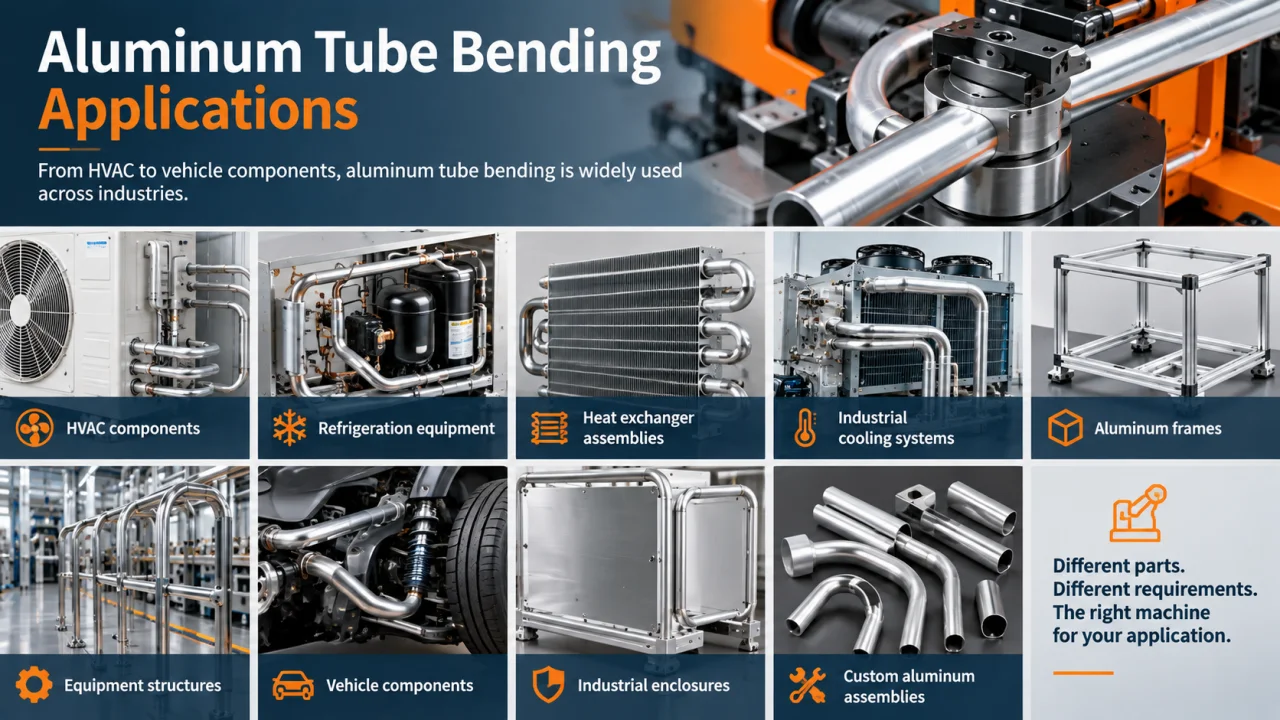
Aluminum Tube Bending Applications
Aluminum tube and profile bending may be used in:
- HVAC components
- Refrigeration equipment
- Heat exchanger assemblies
- Industrial cooling systems
- Aluminum frames
- Equipment structures
- Vehicle components
- Industrial enclosures
- Custom aluminum assemblies
Frequently Asked Questions
Can a CNC machine bend aluminum tubes and profiles?
Yes. Zhuoran’s 38CNC, 50CNC, and 75CNC machines can be used for aluminum tubes and aluminum profiles. The final model depends on the complete cross-section, wall thickness, radius, tooling, and number of bends.
Can 38CNC bend aluminum profiles?
38CNC can be used for aluminum profiles, but the actual suitability must be confirmed from the profile drawing and forming requirements.
When should I choose a 50CNC or 75CNC machine?
A 50CNC or 75CNC machine may be considered when the workpiece has a larger or more complex cross-section, requires more forming space, or involves multiple bends.
What is the maximum processing size of the 130CNC machine?
The maximum processing size of the 130CNC model is 130 mm. The final result still depends on the profile geometry and tooling configuration.
Do irregular aluminum profiles need a mandrel?
Not usually in the same way as round tubes. Many irregular aluminum profiles cannot use a conventional mandrel arrangement. The need for a mandrel depends on the actual cross-section and forming process.
Are bend dies, clamp dies, and pressure dies included?
Bend dies, clamp dies, and pressure dies are standard tooling components for the bending process. Their design must match the actual aluminum tube or profile.
When is a support die required?
A support die may be required when the profile needs additional forming support. The decision depends on the cross-section, wall thickness, bend radius, and material behavior.
Does a wiper die require a mandrel?
A wiper die is normally used together with a mandrel configuration. The final tooling arrangement should be confirmed by the engineering team according to the workpiece and forming process.
Can one machine bend every aluminum profile?
No. Different profiles may require different machine sizes, tooling arrangements, and process settings. The final selection should be based on the actual drawing and sample evaluation.
Conclusion
Successful aluminum tube bending depends on more than machine size. The complete cross-section, wall thickness, bend radius, profile structure, tooling, machine clearance, and bending sequence all affect the final result.
Zhuoran commonly uses 38CNC, 50CNC, and 75CNC machines for aluminum tubes and profiles. For larger processing dimensions, The 130CNC tube bending machine has a maximum processing size of 130 mm. However, these figures should be evaluated together with the actual profile geometry.
For irregular aluminum profiles, do not select a machine based only on one height or width measurement. Send the profile drawing, wall thickness, bend radius, number of bends, and required bending sequence to Zhuoran’s engineering team.
Need Help Selecting an Aluminum Tube Bending Machine?
Send your aluminum profile drawing, cross-section dimensions, wall thickness, bend radius, number of bends, and required bending sequence to the Zhuoran engineering team. We can review the tube bending machine model, tooling configuration, and sample testing requirements for your project.