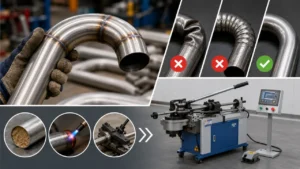
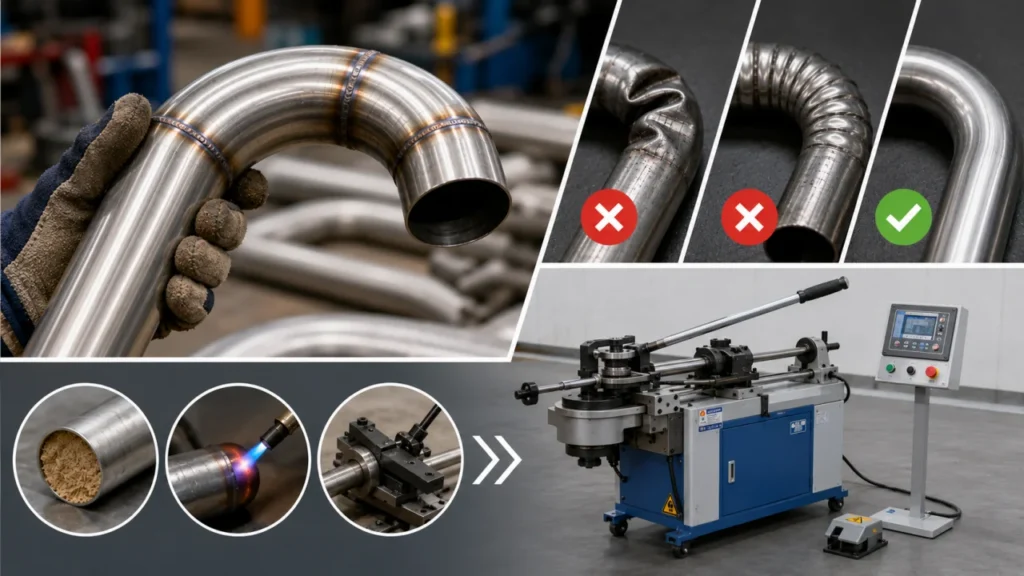
If you bend exhaust pipe the wrong way, You get a kinked, crushed, or cracked tube that you throw in the scrap bin. Many DIY guides make exhaust pipe bending look easy: pack the pipe with sand, heat it with a torch, and bend. It works for one pipe, maybe two. It does not work when you need clean bends every day.
This guide covers every solution for How to Bend an Exhaust Pipe, ranging from homemade methods to industrial production machines, so you can pick the option matching your budget and workload. You will learn how to bend exhaust pipe without a dedicated bender, why pipes wrinkle and how to prevent it, the key differences between crush bending and mandrel bending, and how to select a suitable exhaust pipe bending machine for your workshop.
By the end, you will know exactly which method matches your pipe size, wall thickness, and volume — and when it makes sense to stop bending by hand.
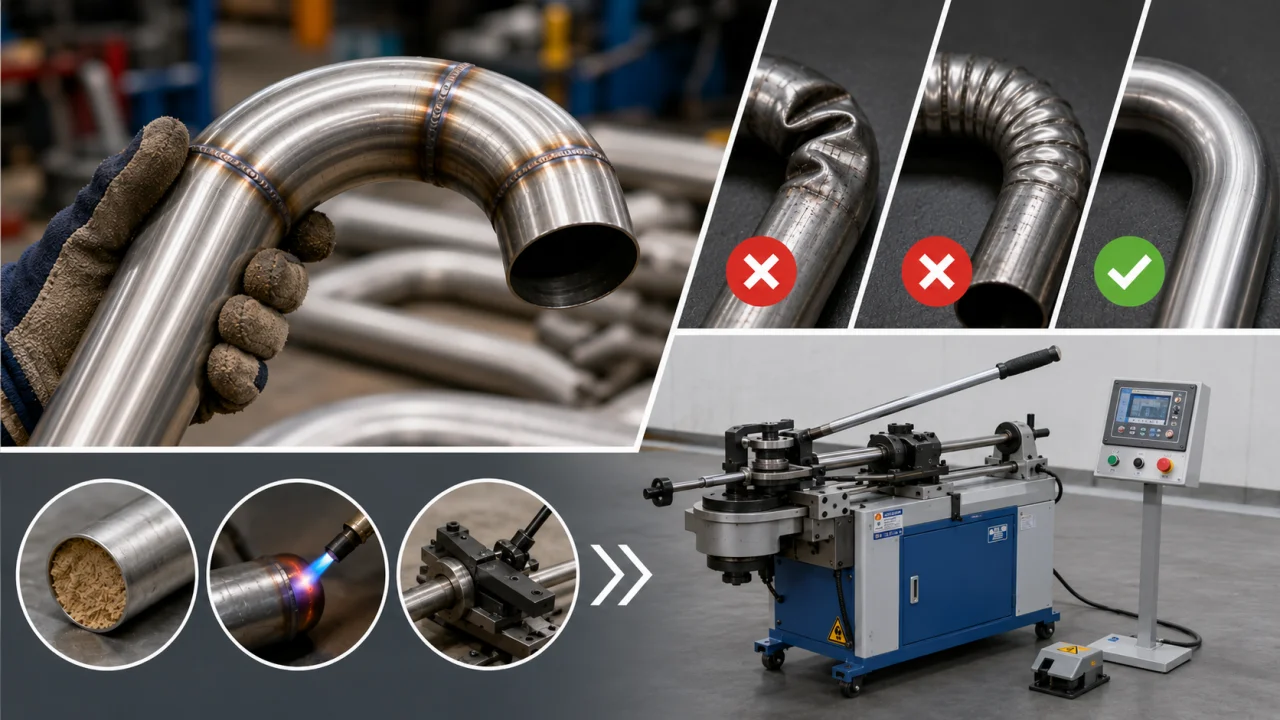
Why Bending Exhaust Pipe Is Harder Than It Looks
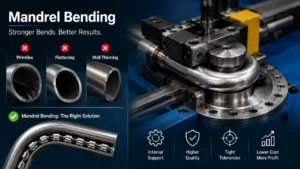
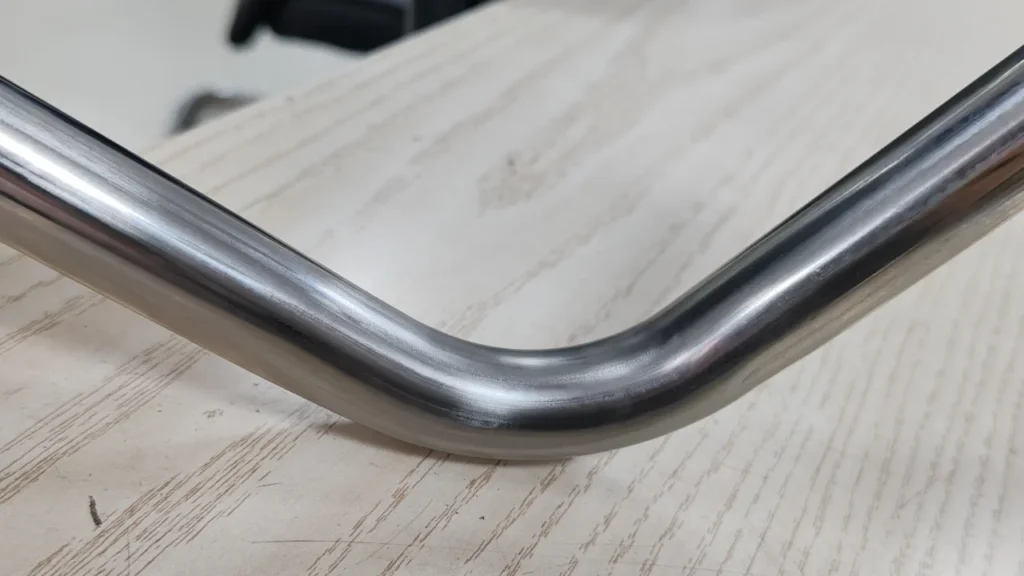
Bending exhaust pipe is not like bending solid rod. A hollow tube collapses when the inner radius has no support. The inner wall compresses, the outer wall stretches, and the middle either wrinkles or flattens. That is the kink you see on cheap bends. The fix is not strength. It is support, matching, and control — the same three essentials that every professional bender uses, which we break down below.
What DIY guides rarely tell you: manual methods produce inconsistent angles, take a long time per pipe, and need a lot of practice to look clean. For a one-off repair, that is fine. For a shop with a steady flow of exhaust jobs, manual bending becomes the bottleneck.
3 DIY Methods to Bend Exhaust Pipe at Home
These are the methods you will find in most online guides. Each one works. Each one has limits. If you only need the machine decision, skip to the 4-way comparison table.
1. Heat bending with a torch. Heat the pipe with an oxy-acetylene or MAPP torch until it glows, then bend it with leverage. Heat makes the metal pliable and reduces the chance of kinking. Move the flame constantly — heating one spot too long weakens the metal. Use this for mild steel and aluminized pipes, and let the pipe cool naturally after bending.
2. Sand packing. Fill the pipe with dry sand, cap both ends, and bend it cold. The packed sand supports the inner wall, just like a mandrel does. Tap the pipe while filling to remove air pockets. Works well with a hydraulic bender, but emptying the sand afterwards takes time, and leftover sand can contaminate welds.
3. Conduit and lever bending. A cheap conduit bender can handle small-diameter exhaust tube. The catch: conduit benders crush thin-wall tube easily. Go slowly and check the bend often. A long pipe used as a lever gives you more control than raw muscle.
| Method | Cost | Bend quality | Speed | Best for |
|---|---|---|---|---|
| Heat + leverage | Low | Medium | Slow | One-off repairs, mild steel |
| Sand packing | Low | Medium | Slow | Small batches, cold bending |
| Conduit / lever | Lowest | Low | Slow | Small diameters, low volume |
Every DIY method shares one ceiling: it is slow, manual, and hard to repeat. When your exhaust work grows past a pipe or two a week, you hit that ceiling fast.
The 3 Essentials of Kink-Free Exhaust Bending
Skip the trial-and-error. Before you bend exhaust pipe again, learn these three essentials — they explain every good bend and every kink you have ever seen.
1. Support. The inner wall of the pipe needs something behind it. A mandrel inside the tube is the professional solution. Sand or a spring works for DIY. No support, no clean bend on thin-wall tube. Rule of thumb: the tighter the radius or the thinner the wall, the more support you need. Mandrel selection guides state the practical thresholds (for example, R/D ≥ 3 with a wall ratio above 0.05 usually allows coreless bending, per this mandrel guide).
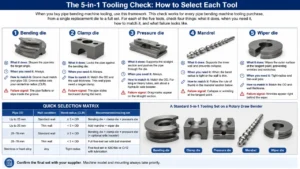
2. Match. The bending die radius and groove must match your pipe. A die sized for 2-inch pipe will crush 1.5-inch pipe. The die also sets your bend radius — for exhaust work, keep the centerline radius at least 1.5 times the pipe diameter to keep flow smooth (a figure you will see in most exhaust fabrication guides). Matching also covers die material; tooling suppliers document typical grades such as 42CrMo and Cr12 (supplier example). Matching die to pipe is a complete topic on its own; our guide to pipe bending machine tooling covers dies, mandrels, and wipers in detail.
3. Feed. Speed and pressure control decide the result. Bending too fast gives wrinkles; too slow on a hot pipe weakens the material. Machines handle this automatically; manual bending depends on your hands. See the four methods compared to see where manual bending stands.
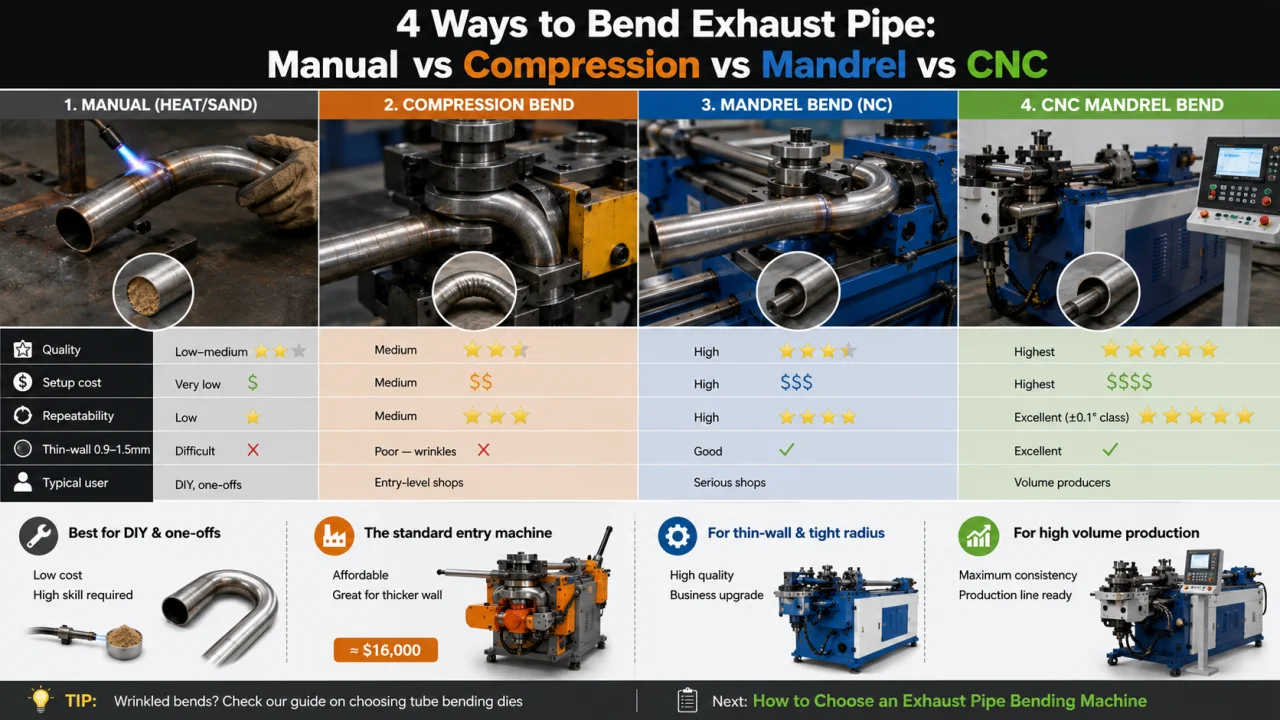
4 Ways to Bend Exhaust Pipe: Manual vs Compression vs Mandrel vs CNC
Here is the decision table every exhaust shop needs. It compares the four routes, from cheapest to most capable.
| Method | Quality | Setup cost | Repeatability | Thin-wall 0.9–1.5mm | Typical user |
|---|---|---|---|---|---|
| Manual (heat/sand) | Low–medium | Very low | Low | Difficult | DIY, one-offs |
| Compression bend | Medium | Medium | Medium | Poor — wrinkles | Entry-level shops |
| Mandrel bend (NC) | High | High | High | Good | Serious shops |
| CNC mandrel bend | Highest | Highest | Excellent (±0.1° class) | Excellent | Volume producers |
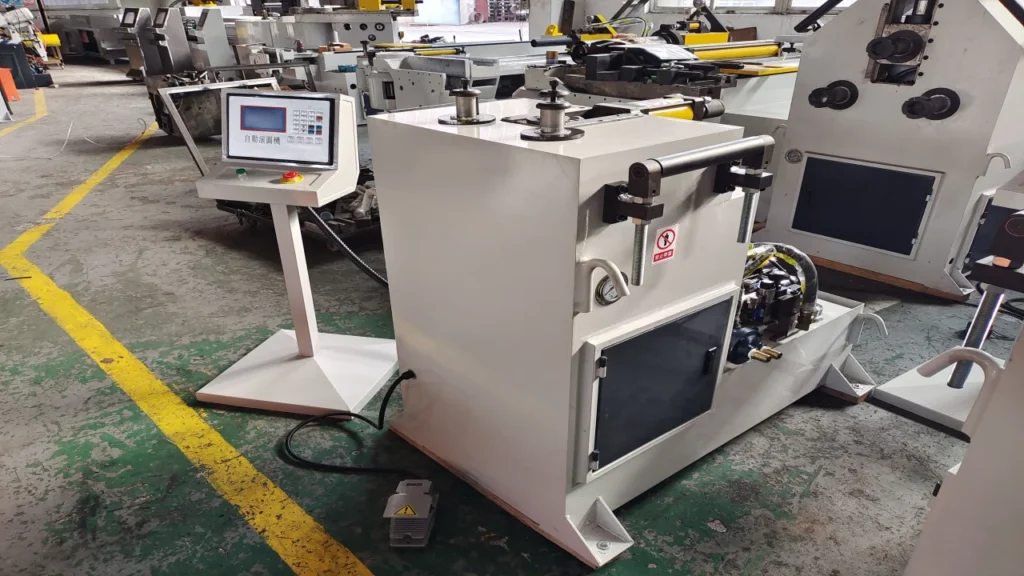
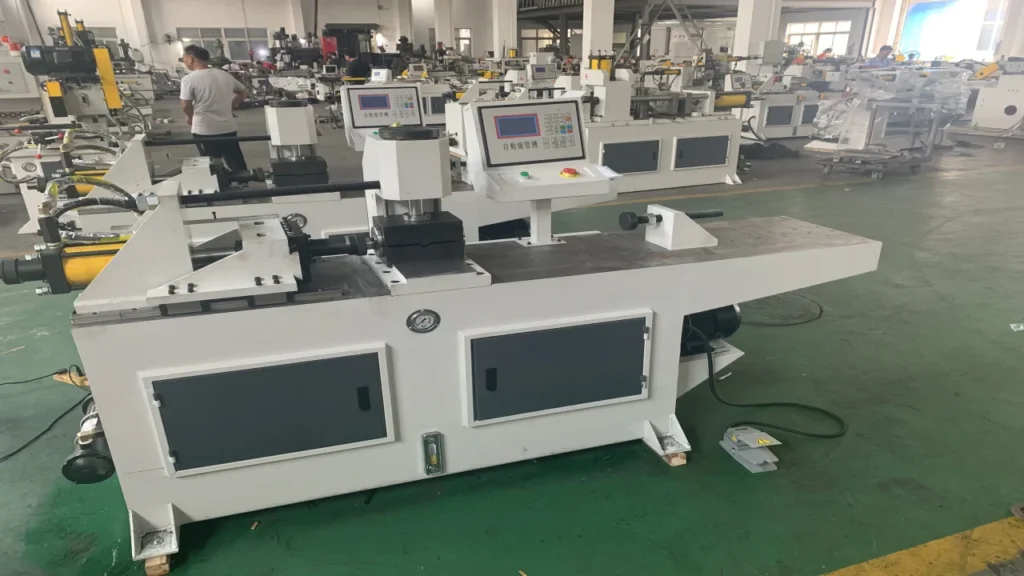
Compression bending presses the pipe against a fixed die. Machines of this type are often marketed as muffler pipe benders or exhaust pipe benders. If you bend exhaust pipe at shop volume, this is the standard entry machine — and it is affordable: an industrial model with tooling retails around $16,000 in the US market as a reference. Its limit is the same as its name: the pipe gets squeezed, so thin-wall stainless tends to wrinkle.
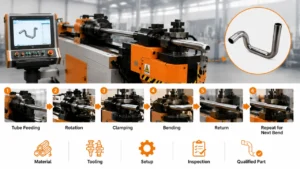
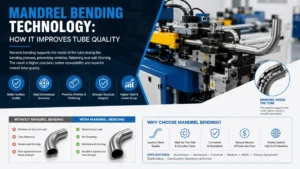
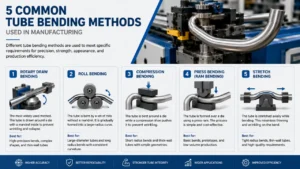
Mandrel bending (rotary draw) inserts a mandrel inside the tube and bends the pipe around a rotating die. This is the answer for thin-wall stainless and tight-radius exhaust routes. It is more expensive, but it is the reason exhaust manufacturers use it for production.
CNC mandrel bending adds automated control of feed, rotation, and springback. The machine repeats the same program hundreds of times with the same result — that is what consistency means in a production line.
If your bends come out wrinkled today, check our guide on choosing tube bending dies for the tooling rules behind each method. For the full sizing checklist, jump to How to Choose an Exhaust Pipe Bending Machine.
How to Choose an Exhaust Pipe Bending Machine
Choosing the right way to bend exhaust pipe comes down to three numbers: pipe diameter, wall thickness, and how many bends you run per day. Here is how we size it.
Capacity: match the pipe OD. Exhaust work lives mostly in the 1.5–3 inch range (38–76 mm). Make sure the machine covers your full range, not just your most common size. Our pipe bending machine range covers 38–76 mm completely, so you can bend exhaust pipe for every car, truck, and motorcycle job that comes in.
Thin-wall capability. Stainless exhaust tube is often 0.9–1.5 mm wall. Compression benders wrinkle it. With a mandrel set, our machines bend thin-wall stainless cleanly — this is the capability that separates an exhaust machine from a general pipe bender.
Three tiers of machines. Match the exhaust pipe bending machine tier to your volume:
- Entry — hydraulic or semi-automatic bender. Ideal for a new exhaust shop or a garage adding exhaust service. Affordable, simple to operate, handles standard wall tube.
- Advanced — NC mandrel bender. Programmed bends, mandrel support, thin-wall capability. The right choice when you start charging for quality.
- Production — CNC mandrel bender. For exhaust manufacturers and high-volume shops. Repeatability in the ±0.1° class, multi-bend programs, minimal operator skill per part. See our CNC pipe bending machines and NC pipe bending machines.
Power, floor space, and tooling. Entry machines run on single-phase 220–240V — check your shop wiring before buying. Every new machine from us includes one standard die set for the pipe size you specify; additional dies are quoted per size. Custom tooling lead time is 7–15 days, so plan your first production run accordingly. We also provide installation and operator training with every machine.
Exhaust Pipe Materials and Bend Radius
Different pipes bend differently — and when you bend exhaust pipe daily, the differences add up. Know your material before you choose a method.
- Stainless 304 — corrosion-resistant, work-hardens, needs mandrel support for tight bends.
- Stainless 409 — the standard for OEM exhaust systems, less expensive, easier to bend exhaust pipe in than 304.
- Aluminized steel — affordable and common for aftermarket systems; bends like mild steel but the coating burns off where you heat it.
Bend radius matters as much as material. As a rule, keep the centerline radius at least 1.5 times the pipe diameter (a common guideline in exhaust fabrication references such as this bending guide). Tighter than that, and you need mandrel support and a slower feed. Thinner walls also raise the risk of wrinkles when you bend exhaust pipe at the same radius.
FAQ
Q1: Can I bend exhaust pipe without a bender? Yes, for small jobs. Heat the pipe with a torch and bend it with leverage, or pack it with dry sand and bend it cold. These methods work for one-off repairs, but quality and speed drop quickly, and thin-wall stainless is very hard to do by hand.
Q2: What is the best way to bend exhaust pipe? For clean, repeatable results, a mandrel bender is the best way to bend exhaust pipe. It supports the inner wall so thin-wall stainless does not wrinkle. For occasional mild-steel jobs, heat bending is acceptable. The right method depends on your volume and material.
Q3: Why does my exhaust pipe kink when I bend it? When you bend exhaust pipe and it kinks, the inner radius had no support. Add support (mandrel, sand, or spring), match the die radius to the pipe, and slow down the feed. Thin-wall tube and tight radii kink fastest.
Q4: What is a mandrel bender? A mandrel bender inserts a steel mandrel inside the tube before bending. The mandrel supports the inner wall and prevents collapse, so you get smooth bends on thin-wall and tight-radius pipe. It is the standard tool for professional exhaust fabrication.
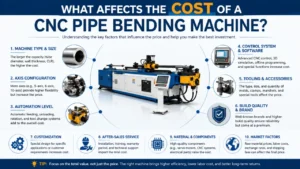
Q5: How much does an exhaust pipe bending machine cost? Entry hydraulic compression benders, often marketed as muffler pipe benders, start around $16,000 with tooling (US market reference). NC mandrel benders cost more, and CNC production machines more still. Request a quote with your pipe size and volume for an exact price.
Q6: Can a pipe bender handle thin-wall stainless exhaust? Yes, if it is a mandrel bender. Compression benders tend to wrinkle 0.9–1.5 mm stainless. Our machines bend thin-wall stainless cleanly with a mandrel set — send your pipe size and wall thickness for a recommendation.
Q7: What size exhaust pipe bending machine do I need? Match the machine to your pipe OD range and wall thickness. Most exhaust shops need 38–76 mm (1.5–3 inch) coverage. If you bend stainless daily, choose a mandrel or CNC machine; occasional mild steel allows an entry hydraulic model.
When DIY Stops Being Enough
Bending exhaust pipe by hand teaches you the trade. It also caps your output. Once you are turning away jobs or re-bending pipes by hand, the math changes: a machine pays for itself in consistent bends, less scrap, and faster turnarounds. Start with the manual methods if you are learning how to bend exhaust pipe at home.
Move to a machine when your volume and quality demands outgrow your hands. If you are not sure which tier fits you, send us your pipe size, wall thickness, and weekly volume, and we will recommend the machine and tooling set. You can also browse our full pipe bending machine lineup or check our guide to CNC pipe bending machine costs in 2026 before you budget. We can show you the machines over a video call, so you see the bends before you buy.