EV battery cooling runs on tube. Whether the pack uses a stamped plate with a copper pipe pressed into a groove, a microchannel tube bent to follow the cell arc, or a brazed plate with formed channels, the coolant path is a bent tube or a formed channel that behaves like one. Aluminum accounts for roughly 64 percent of cooling plate installations worldwide, according to market data cited by one supplier, and that single material choice drives most of the bending difficulty.
This guide works through what EV battery cooling demands from a bending process: which construction creates which bending problem, how thin-wall aluminum behaves at a radius, where the leak risk actually sits, and what to send before anyone quotes a serpentine.
Why EV Battery Cooling Comes Down to the Tube
Bending decides three functions that meet inside a cooling plate.
Thermal performance depends on geometry
Coolant has to reach every cell in the pack with roughly equal flow. That means a serpentine with consistent pitch, consistent bore and no collapsed sections. A bend that flattens the tube changes the local flow resistance, and the cells downstream of that bend run hotter than the model predicted.
Structural integrity depends on wall
The tube wall at the outer radius thins as it stretches. On a pressure-retaining coolant circuit, thinning is a fatigue and leak issue rather than a cosmetic one. EV battery cooling circuits also see thermal cycling for a decade, which is a different duty from a one-off industrial part.
Assembly depends on dimensional repeatability
A serpentine that must drop into a machined groove, or fit between cell rows, is only as good as its pitch accuracy. Aluminum springs back more than steel, so pitch accuracy is a bending-compensation problem before it is a machining problem.
Three Constructions, Three Bending Problems
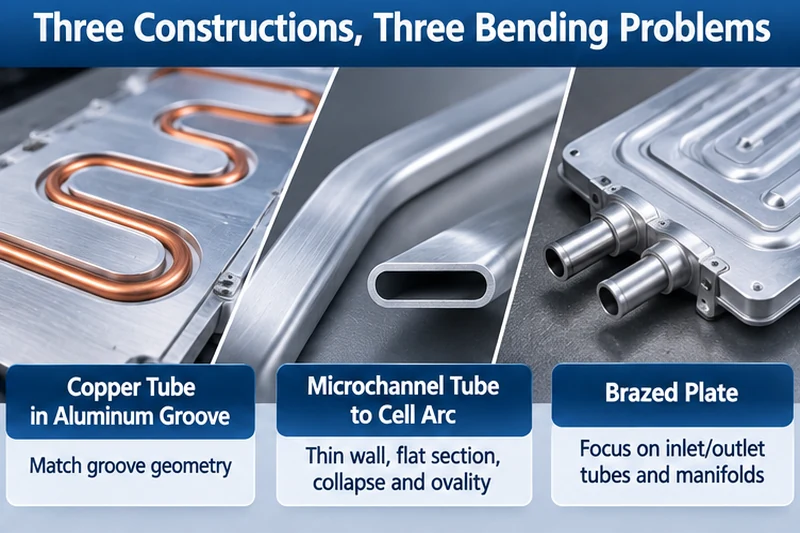
The market uses three constructions, and each one loads the bending process differently.
| Construction | How the coolant path is made | Bending problem it creates |
|---|---|---|
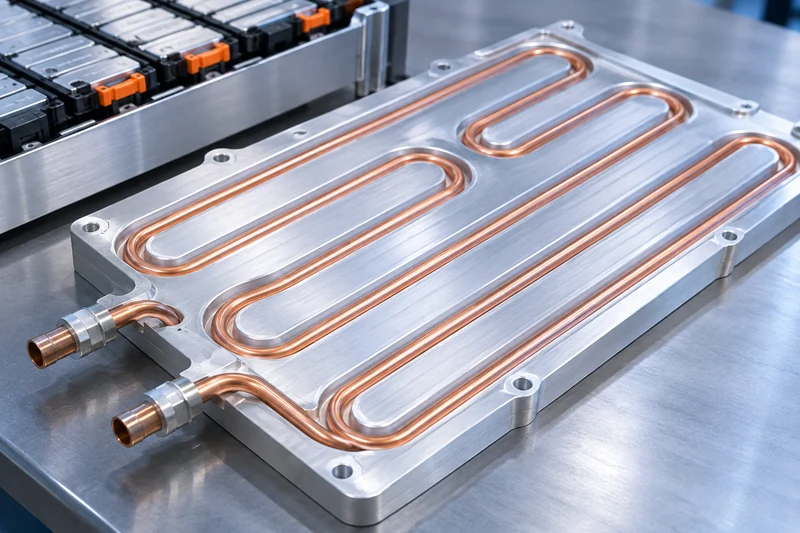
| Copper tube in an aluminum groove | Aluminum plate around 10 mm thick, CNC-cut with S-shaped grooves, copper tube pressed into them | The bent copper tube must match the groove geometry, so radius consistency matters more than strength |
| Microchannel tube bent to the cell arc | Thin flat aluminum tube routed between cell rows, following the pack curvature | Thin wall plus flat section is the hardest bend in the family, with collapse and ovality dominating |
| Brazed plate | Channels formed by brazing two stamped halves, with inlet and outlet tubes | Bending shifts to the manifolds and connections rather than the plate itself |
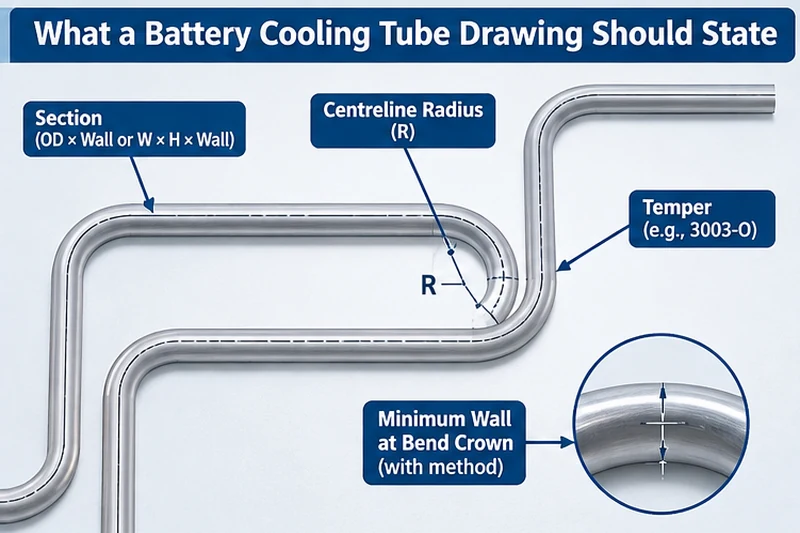
What a battery cooling plate tube drawing should state
A drawing that leaves these four items out will be quoted four times and built wrong once.
- Section: outside diameter and wall for round, or width, height and wall for flat
- Temper, because annealed and harder stock are different jobs at the same dimensions
- Centreline radius and which face a flat section bends against
- Minimum wall at the bend crown, with the measurement method named
Those four make a quotation technical. Without them the reply is a price for a shape.
The copper-in-groove approach
A 10 mm aluminum plate with S-shaped grooves cut into it, and copper tube pressed in, is a straightforward construction that outsources the bending to a well-understood material. Copper bends predictably and anneals readily, so the process risk sits in matching the groove rather than in forming the tube.
Tolerance conversations shift as a result. The tube has to fit a groove that was machined to a nominal path, so pitch and radius must match the groove within the assembly clearance. A tube that is dimensionally acceptable as a tube can still be unassemblable as a groove insert.
The microchannel route
Routing a microchannel tube between cell rows, following the arc of the cells, is the construction that puts the most demand on bending. The section is flat, the wall is thin, and the radius is set by cell geometry rather than by process convenience.
Flat tube adds a variable round tube does not have: orientation. Bending a flat section the hard way loads the narrow sides, and bending it the easy way loads the wide faces. Which one applies changes the minimum radius, the tooling and the failure mode.
The brazed plate
Brazing two stamped halves produces the channel and removes most tube bending from the plate itself. What remains is the inlet and outlet tube, plus any manifold that has to route around the pack.
Brazed construction is described in trade sources as the dominant choice in high-end vehicles and the highest-investment route in the industry, which is why EV battery cooling programmes usually choose it last rather than first. For a bending supplier, that means the work that remains is connections and manifolds — smaller parts, tighter tolerances, higher consequence per failure.
Aluminum 3003 and the Temper Question
Aluminum 3003 is widely described as the preferred alloy for cooling plates, on formability, corrosion resistance and thermal conductivity. Those three properties are exactly what a coolant circuit needs, and they are also why the alloy is specified rather than chosen by the fabricator.
The temper decides the bend, not the alloy
The same 3003 arrives in conditions from fully annealed to work-hardened, and the condition changes what a radius will do. Annealed stock tolerates tight radii and marks easily. Harder tempers hold shape and crack.
For EV battery cooling work, this makes the material certificate a process document rather than a purchasing formality. A bend proven on annealed stock is not proven on H14, and the difference only appears at the outer radius.
Where the aluminum penalty shows up
Aluminum has a lower elastic modulus than steel, around a third of it, and a yield strength in the same order as annealed stainless. The ratio of yield to modulus drives springback, which means an aluminum bend springs back substantially more than a steel bend of the same size.
For a serpentine the consequence is direct: the pitch between bends is set by where the material ends up, not by where the die puts it. Compensation has to be measured per batch, and the same reasoning that applies to springback in tube bending applies here with a larger magnitude.
Bending Serpentine Tube: Radius and Pitch
A serpentine is a sequence of bends with a pitch that has to stay consistent, and pitch error accumulates the same way angle error does.
A strain table for a 10 mm tube
Working the same formula across radius multiples makes the choice concrete for a typical section.
| Radius multiple | Centreline radius | Outer-fibre strain |
|---|---|---|
| 1.5D | 15 mm | about 33% |
| 2D | 20 mm | 25% |
| 2.5D | 25 mm | 20% |
| 3D | 30 mm | about 17% |
| 4D | 40 mm | 12.5% |
Thin-wall aluminum at 2.5D to 3D is the practical zone for a supported bend; 1.5D is a tooling project rather than a parameter change.
A strain table for a 10 mm tube
The geometric estimate applies: outer-fibre strain is roughly half the outside diameter divided by the centreline radius.
strain ≈ (outside diameter ÷ 2) ÷ centreline radius
A 10 mm tube on a 15 mm centreline radius works out to about 33 percent. A 10 mm tube on a 25 mm radius works out to 20 percent. Both are achievable in thin-wall aluminum with the right support, and neither is achievable unsupported.
For a flat section, substitute the dimension in the plane of bending for the diameter, and check which face your die is loading. That is the whole reason flat tube orientation changes the answer.
How pitch error accumulates
Twelve bends sound forgiving until the errors are added.
- Twelve bends with 0.5° of error each can accumulate to roughly 6° of direction change at the end of the serpentine
- At 200 mm from the last bend, that is roughly 21 mm of position error
- The same twelve bends with 0.1° each accumulate to about 1.2°, or roughly 4 mm
That arithmetic explains why a serpentine is inspected for pitch and why compensation has to be measured rather than assumed.
Why pitch error matters more than angle error
A single bend with half a degree of error still assembles. Twelve bends with half a degree each accumulate into a serpentine that no longer fits between cell rows, and the error appears at the last bend rather than the first.
- Set compensation per batch from a measured first part
- Check pitch at both ends of the serpentine, not only the middle
- Record the compensation value with the program, so a repeat order starts from a known point
- Allow a straight relief between bends where the design permits, since it absorbs accumulated error
Flat and Microchannel Tube: The Hard Case
Flat sections are where EV battery cooling bending gets genuinely difficult, because the failure mode changes from cracking to collapse.
Orientation decides everything on flat tube
A flat section has two hard directions to bend and one forgiving one, and the drawing usually does not say which applies.
- Bending across the wide faces loads the thin sides and collapses them first
- Bending across the narrow faces loads the wide faces, which are stiffer in that direction
- The dimension in the plane of bending is what substitutes for diameter in the strain formula
- Tooling, mandrel profile and minimum radius all follow from that orientation
Most flat-tube disputes trace to an orientation the drawing never fixed.
Thin wall plus flat section
A flat tube has two short sides and two long faces. Bending across the long faces loads the section in a way that wants to buckle the short sides inward, and there is very little wall to resist it.
Tooling matters more here than anywhere else in this article. A mandrel matched to the flat bore, a wiper die supporting the inner radius, and a pressure die that follows the outer face all contribute; remove any one and the section flattens.
What collapse costs downstream
A collapsed section does not simply look wrong. It reduces the local flow area, raises pressure drop across that bend, and can change flow distribution across the pack. In a system designed around a predicted pressure drop, one flattened bend moves the operating point.
Specifications for EV battery cooling therefore usually control ovality or section flatness, not only bend angle.
Ovality and Flow: What the Number Actually Does
Ovality is often treated as a flow problem. The arithmetic says it is mostly a fit and fatigue problem, which changes what to inspect.
| Section | Area (mm²) | Perimeter (mm) | Hydraulic diameter (mm) |
|---|---|---|---|
| 10 mm round | 78.5 | 31.4 | 10.0 |
| 11 mm by 9 mm ellipse | 77.8 | 31.6 | 9.84 |
A 10 percent ovality on a 10 mm bore costs well under one percent of flow area and about 1.6 percent of hydraulic diameter. Flow is affected, but only mildly. What ovality really threatens is the fit into a machined groove and the fatigue life at the flattened wall, where stress concentrates.
So the inspection priority for EV battery cooling reads differently from a general tube job: section dimension matters for assembly, wall matters for leaks, and flow matters only where ovality is severe.
Troubleshooting: Where Bends and Leaks Actually Begin
As a result, a coolant circuit that leaks in service becomes a warranty event, and the evidence usually traces back to one of four places at a bend.
- Outer-radius thinning, where the wall stretched
- Surface marks or scoring from tooling, which become crack initiation sites under thermal cycling
- Seam or weld defects in the tube itself, opened by bending strain
- Joints, where the bend meets a fitting, a brazed connection or a manifold
The control that matters most
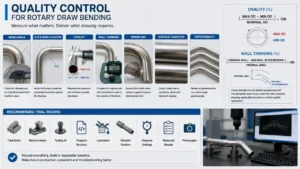
Thinning is the measurable one, and it should be specified as a minimum wall at the bend rather than as a percentage reduction.
A worked example makes the specification difference clear. A 1.0 mm wall specified as “10 percent maximum thinning” allows 0.9 mm at the crown; the same intent written as “minimum wall 0.9 mm at the crown” produces one number to measure and one gauge to use. Two ways of writing it, two very different inspection conversations.
For EV battery cooling, the absolute figure is the better specification because the thermal and pressure models behind it were built on a wall figure rather than on a percentage of one. A percentage invites a discussion about which nominal was intended; an absolute minimum can be checked with an ultrasonic gauge on the finished part.
Thinning mechanism is covered in wall thinning during bending, and the surface side in tube bending defects.
Three questions that decide feasibility
Before a radius is quoted, three questions settle most of it.
- What is the calculated strain at the tightest bend
- What wall remains at the crown after that bend
- Which temper arrives, and does the certificate state it
If the calculated wall falls below the drawing minimum, the part is a design conversation. If the temper is unstated, the answer is a trial bend rather than a number.
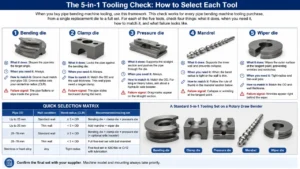
Tooling for Thin-Wall Aluminum
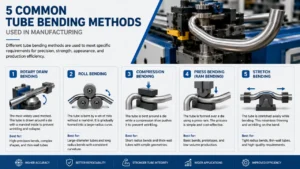
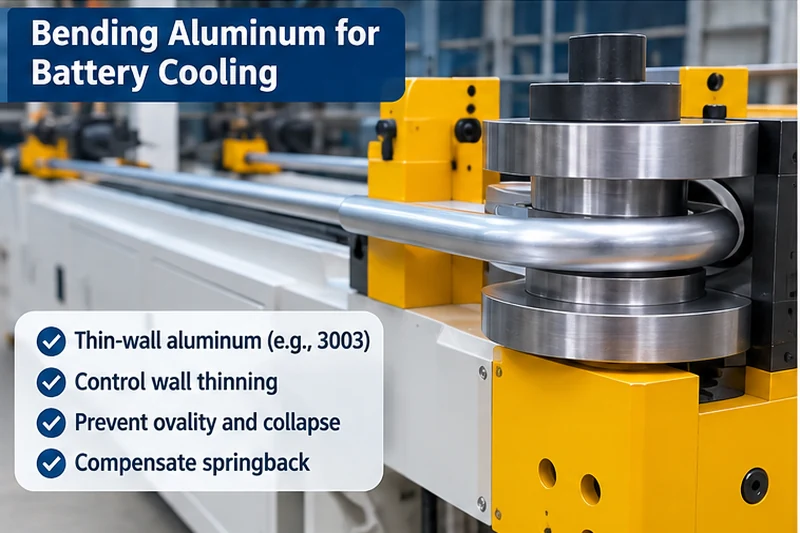
Tooling for EV battery cooling tube bending follows the same family as any rotary-draw set, with the tolerances tightened.
- A bend die sized to the actual section, not the nominal size
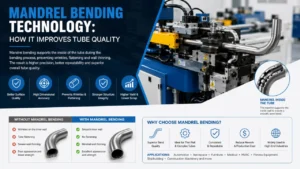
- A mandrel matched to the bore, and for flat tube, matched to the flat profile
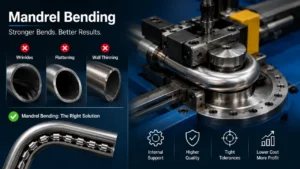
- A wiper die supporting the inner radius, since thin wall wrinkles first there
- Polished working surfaces, because aluminum marks easily and marks become leak sites
- Lubrication specified for aluminum rather than carried over from a steel job
Aluminum also galls differently from steel: it transfers to tooling more readily under pressure, and a picked-up die surface then marks every part that follows. Die inspection belongs in the setup, not only in maintenance. Tooling life and wear measurement are covered in bend die wear and tooling life.
Decision Matrix: Which Construction Fits Your Pack
| Requirement | Construction to evaluate | Bending implication |
|---|---|---|
| High volume, simple pack geometry | Stamped plate | Little tube bending; focus shifts to stamping and brazing |
| Cylindrical cells needing a wrap-around path | Serpentine or snake tube | Round tube is easier to bend than flat; pitch consistency is the challenge |
| Flat cells with tight gaps | Microchannel tube bent to the cell arc | Hardest bend; section control dominates |
| Higher pressure or multi-layer channels | Brazed plate | Bending focuses on manifold and connections |
| Prototype volume | Copper tube in a machined groove | Copper is forgiving, and the groove can be re-cut |
In practice, an honest note on ordering this list: the constructions above are described in supplier and trade material, and the bend difficulty ranking reflects geometry rather than any single supplier’s capability. Which route suits a specific pack is an engineering decision that belongs with the thermal and structural designers.
What a trial bend proves
A trial bend on EV battery cooling work answers four questions that no calculation can.
- Whether the delivered temper forms at the required radius
- What the wall actually measures at the crown afterwards
- Whether the section stays close enough to fit its groove or gap
- Whether springback makes the pitch achievable with compensation
Four answers from one part is a good return, which is why the trial belongs in the quotation rather than in the first production run.
Cleanliness and contamination control
Coolant circuits are sensitive to particles, and bending is a particle-generating operation.
- Cut and deburr before bending rather than after, so chips never enter the bore
- Cap or plug the ends during handling and storage
- Clean the mandrel and dies between material changes
- Blow through and inspect before any leak test, since debris can mask or mimic a leak
A part that passes a leak test with debris in the bore can still block a microchannel downstream.
Cleanliness discipline costs almost nothing and is the difference between a part that passes bench testing and a part that survives a vehicle. Clean the tooling, cap the ends, and treat the bore as a controlled surface rather than as an open pipe.
For EV battery cooling work, that habit is also a commercial one. A supplier who can describe a cleanliness routine is describing a process they control, which is a better signal than a certificate.
Inspection and Leak Test
EV battery cooling parts are inspected on dimensions first and leak-tightness second, and the two use different methods; check dimensions before you pressurise anything.
| Method | What it proves | Where it fits |
|---|---|---|
| Pressure decay | No gross leak or pressure boundary defect | Production screening of every part |
| Helium mass spectrometry | Very small leaks | OEM-grade validation, as described in trade sources |
| Ultrasonic wall measurement | Wall at the bend crown | First article and sampling |
| Section or optical check | Ovality and flatness at the bend | First article, and sampling on flat tube |
| Visual against a standard | Surface marks and tooling pickup | Every part |
The combination matters more than the sensitivity of any one test. Helium testing a part with a collapsed section still tells you nothing about flow; a section check on a part with a pinhole still passes.
A note on battery cooling plate tube supply
Buyers often approach this from the plate side and treat the tube as a purchased detail.
- Tube supply and tube bending are separate capabilities, and few suppliers do both well
- Plate dimensions are set by the thermal design; tube dimensions are set by the same design and by what can be bent
- Changing tube wall to improve cooling changes the bend feasibility at the same time
- Ordering tube and bending from one source shortens the loop when a section will not form
For EV battery cooling programmes, that last point matters more than price, because a section that cannot be bent stops the whole plate.
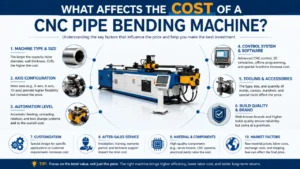
Cost and Lead Time
EV battery cooling work changes the cost structure in three places, and all three are driven by section rather than by size.
- Tooling is specific, because a bend die serves one section and one radius
- Scrap is expensive, because thin aluminum at a tight radius has a narrow process window
- Validation is longer, because leak testing and first-article records are part of the deliverable, not an extra
Two planning notes follow for any EV battery cooling programme. Ask for the material condition on the certificate before quoting, since annealed and harder tempers are different jobs at the same drawing. And budget a trial bend for every new heat or temper change, because the process window is set by the material you actually receive.
What EV battery cooling buyers get wrong
Four assumptions cost programmes time on the tube side, and each one is avoidable.
- Assuming the plate supplier can also bend the tube, when the two capabilities rarely sit together
- Assuming a wall change for thermal reasons leaves bending unchanged
- Assuming a drawing without temper is a complete drawing
- Assuming a trial bend is an extra step rather than part of the quotation
You can test all four with one question: what section, what temper, what radius, and what wall is allowed at the crown. A supplier who answers those before pricing is doing EV battery cooling work properly.
Wall to diameter, and why it decides the route
For a 10 mm section, D/t tells you which bending world you are in before any tooling is discussed.
- A 1.0 mm wall gives D/t 10, which supports a tighter radius with a mandrel
- A 0.5 mm wall gives D/t 20, where collapse dominates and tooling quality decides the result
- Halving the wall doubles D/t, which is why a thermal change of a few tenths of a millimetre can turn a routine bend into a development project
That ratio, not the alloy name, is what a bending supplier should ask for first, and it is the question that separates a serious EV battery cooling quote from a brochure. Ask it early, and the rest of the conversation gets shorter.
One closing point on scope. A supplier who bends tube does not design the cooling plate, and a plate designer does not usually bend tube. The interface between those two parties is the drawing specification, which is why this article spends so long on what a drawing should state. Get that interface right and EV battery cooling projects move at the speed of the thermal design. Get it wrong and they move at the speed of the slowest rework.
What to Send Before an EV Tube Bending Quote
Six items decide whether a serpentine is feasible.
- Section: round with outside diameter and wall, or flat with width, height and wall
- Material and temper, with the certificate where available
- Centreline radius per bend, and which face the bend loads on a flat section
- Number of bends, the pitch between them, and the total developed length
- Pressure and leak-test requirement, since that sets the acceptance method
- Whether the part is a prototype or a production drawing, because the route differs
A request missing the temper or the flat-section orientation produces a quote that cannot be honoured, and the failure surfaces at the first sample rather than at the quotation. Send the four items above and the reply becomes a process route you can check.
Frequently Asked Questions
What makes EV battery cooling tube harder to bend than a general tube?
Thin wall and flat sections, in that order. A round 10 mm tube with a reasonable wall is a routine job; the same tube flattened to a microchannel profile at a tight radius is not.
Which aluminum alloy is used for cooling plates?
Aluminum 3003 is widely specified for cooling plates, on formability, corrosion resistance and thermal conductivity. The temper matters as much as the alloy, because it sets what radius will form.
How tight a radius can a cooling tube take?
There is no universal figure. Calculate the strain from the diameter and radius, compare it with what the delivered temper will tolerate, and confirm with a trial bend. A flat section needs the dimension in the plane of bending rather than a single diameter.
Does ovality reduce cooling performance?
Less than most people assume. A 10 percent ovality costs well under one percent of flow area; its real effects are on assembly fit and on fatigue at the flattened wall.
Where do cooling tubes normally leak?
At the outer radius where the wall thinned, at tooling marks that became cracks, at tube seam defects opened by bending, and at joints. That order is also the order worth inspecting.
Can the same tooling bend round and flat tube?
No. A die is made for one section, and a flat section needs a mandrel matched to its profile in addition to the die. Expect separate tooling for each section family.
Do I need helium leak testing?
That depends on the customer specification. Pressure decay screens production parts; helium mass spectrometry detects much smaller leaks and is described in trade sources as the OEM-grade method.
A closing note on scope
A supplier who bends tube does not design the cooling plate, and a plate designer rarely bends tube.
The interface between those two parties is the drawing specification, which is why this article spends so long on what a drawing should state. Fix that interface and EV battery cooling projects move at the speed of the thermal design. Leave it vague and they move at the speed of the slowest rework, which is usually a die nobody ordered because the drawing never mentioned the temper.
Reference Sources
- Trumony Aluminum, Aluminum Cooling Plate Guide for EV and BESS Thermal Management — source for the roughly 64 percent aluminum share of cooling plate installations (citing Market Growth Reports, 2024), Aluminum 3003 as the preferred alloy on formability, corrosion resistance and thermal conductivity, and the serpentine and snake cooling tube product forms. trumony.com
- Changheng, How to produce battery cooling plate — source for the copper-pipe-in-groove construction with a 10 mm aluminum plate and CNC-cut S-shaped grooves, the microchannel tube bent to the cell arc, the brazed plate as the dominant high-end construction, and the pressure decay and helium mass spectrometry leak test methods. china-changheng.com
- Senior Flexonics, Electric Vehicle Thermal Management Solutions — cooling plate materials including stainless steel and aluminum, and combined aluminum and copper constructions. seniorflexonics.com
- ASTM B221, Standard Specification for Aluminum and Aluminum-Alloy Extruded Bars, Rods, Wire, Profiles, and Tubes — the product standard behind extruded aluminum tube supply, including temper designation. Cited by name because the standard body’s page was unavailable at the time of writing.
Related reading on EV battery cooling tube bending: pipe bending machine tooling, wall thinning during bending, bend die wear and tooling life, aluminum tube bending guide, bent tube inspection, tube bending machine RFQ checklist.