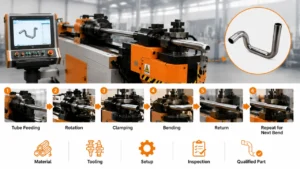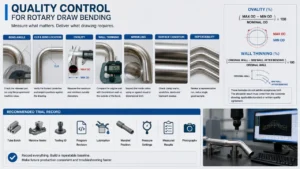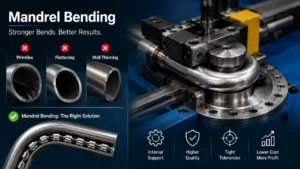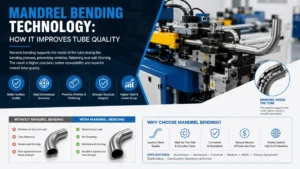
Buying pipe bending machine tooling is where most bending jobs go right or wrong. Pick the wrong bending die, and you deal with wrinkles, flattened sections, or cracked tubes.
Choose the right set, and the same machine runs clean, repeatable bends all day. The problem is that pipe bending machine tooling is not a single product. It is a set of five tools that work together: the bending die, the clamp die, the pressure die, the mandrel, and the wiper die.
Each tool has one specific job, and each one must match your pipe diameter, wall thickness, bend radius, and pipe material. Most buyers we talk to are not sure which pipe bending machine tooling they need, which die material to choose, or how to order a custom set without mistakes. This guide covers all of that.
You will learn what each tool does, how to select pipe bending machine tooling for your pipe specs, how to fix common bending defects, and what to send your supplier when you order. By the end, you can spec a tooling set with confidence and order right the first time.
What Is Pipe Bending Machine Tooling?
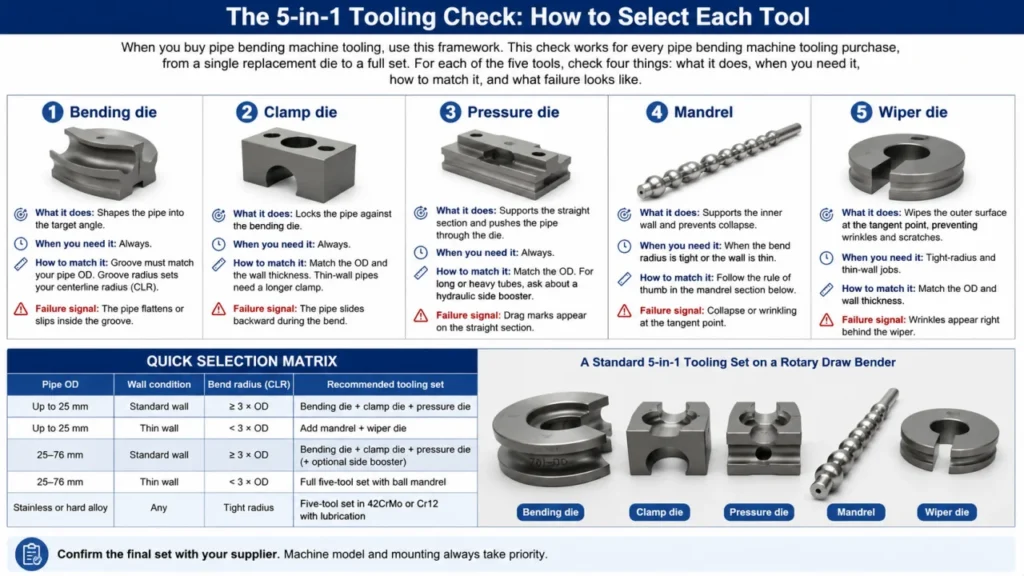
Pipe bending machine tooling is the collective name for the replaceable parts that shape the pipe during bending. Unlike the machine frame, pipe bending machine tooling wears out and gets swapped between jobs. A standard pipe bending machine tooling set on a rotary draw bender includes five tools:
- Bending die. The tool that shapes the pipe into the target angle. It rotates and forces the pipe around its groove.
- Clamp die. Locks the pipe against the bending die so the bend starts at the exact point you set.
- Pressure die. Supports the straight section and pushes the pipe through the die. On long, heavy tubes, a hydraulic side booster adds extra push.
- Mandrel. Sits inside the pipe and supports the inner wall. It prevents collapse on thin-wall and tight-radius bends.
- Wiper die. Sits at the tangent point and wipes the outer surface, preventing wrinkles and scratches.
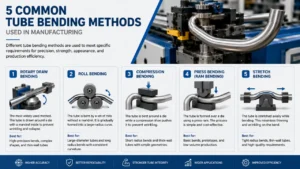
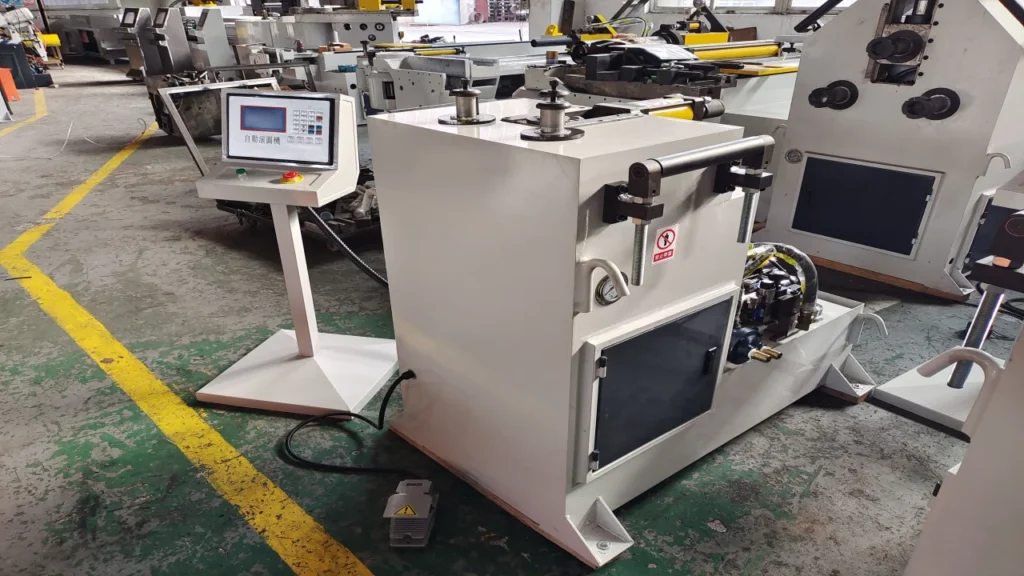
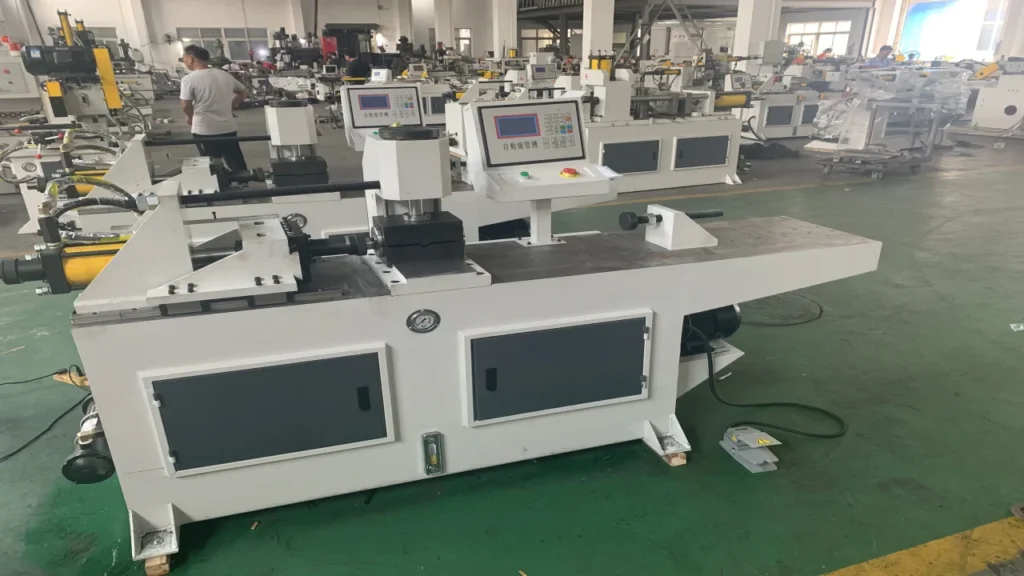
These five tools work as one system. However, when one is missing or mismatched, the other four cannot fully compensate. For example, bending thin-wall stainless steel without a mandrel usually ends in collapse. That is why tooling is normally quoted and sold as a matched set rather than as single items. In practice, a new pipe bending machine ships with one standard die set, sized to the pipe diameter you specify. Different radii, other materials, and square or rectangular tubes are custom tooling. You can see the full pipe bending machines these dies are designed for on our product page. Already know the basics? Jump to the 5-in-1 selection check.
The 5-in-1 Tooling Check: How to Select Each Tool
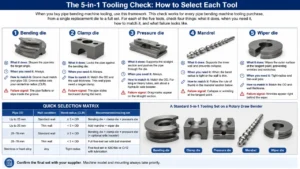
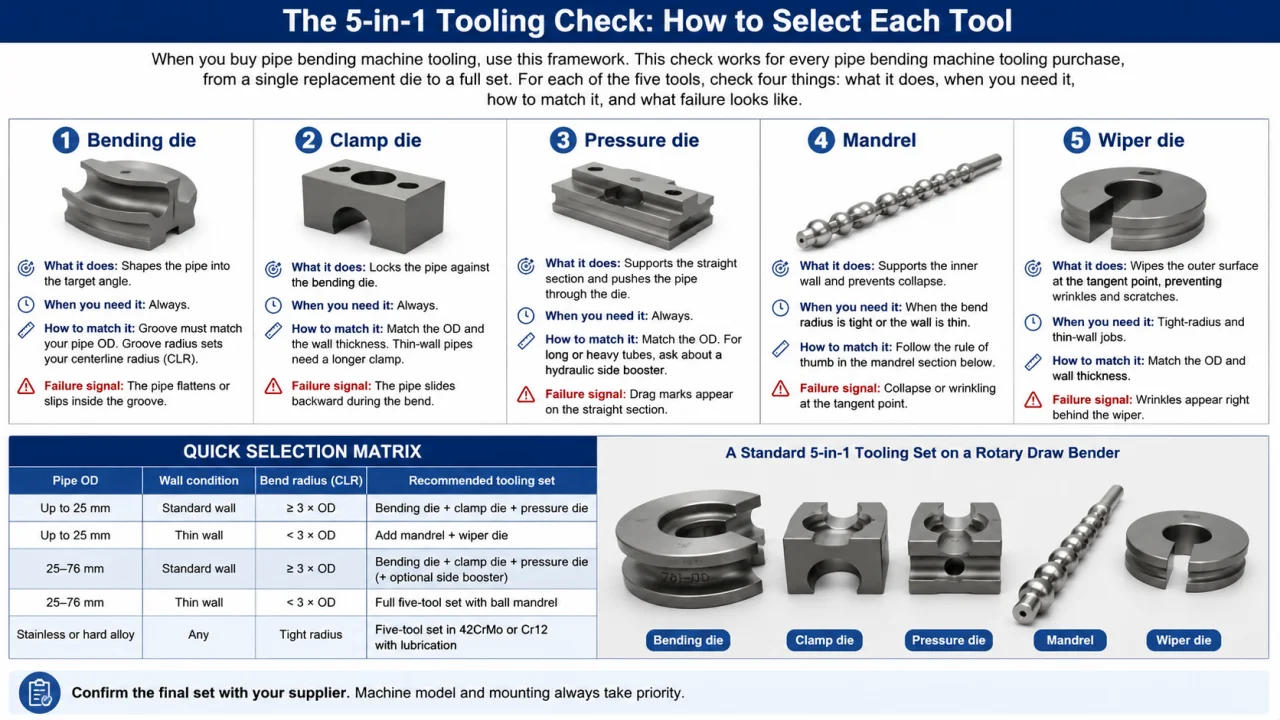
When you buy pipe bending machine tooling, use this framework. This check works for every pipe bending machine tooling purchase, from a single replacement die to a full set. For each of the five tools, check four things: what it does, when you need it, how to match it, and what failure looks like.
1. Bending die. The groove must match your pipe outer diameter (OD). The groove radius sets your centerline radius (CLR). If you need a tighter CLR than the die allows, order a new die — do not force the bend. Failure signal: the pipe flattens or slips inside the groove.
2. Clamp die. Match the OD and the wall thickness. Thin-wall pipes need a longer clamp to spread the clamping force. Failure signal: the pipe slides backward during the bend.
3. Pressure die. Match the OD. For long or heavy tubes, ask about a hydraulic side booster. Failure signal: drag marks appear on the straight section.
4. Mandrel. You need one when the bend radius is tight or the wall is thin. The rule of thumb is in the mandrel section below. Failure signal: collapse or wrinkling at the tangent point.
5. Wiper die. Use it on tight-radius and thin-wall jobs to keep the outer curve smooth. Failure signal: wrinkles appear right behind the wiper.
Quick selection matrix. This pipe bending machine tooling matrix is a starting point, not an absolute standard. Find your pipe OD and wall thickness, then read off the recommended set.
| Pipe OD | Wall condition | Bend radius (CLR) | Recommended tooling set |
|---|---|---|---|
| Up to 25 mm | Standard wall | ≥ 3 × OD | Bending die + clamp die + pressure die |
| Up to 25 mm | Thin wall | < 3 × OD | Add mandrel + wiper die |
| 25–76 mm | Standard wall | ≥ 3 × OD | Bending die + clamp die + pressure die (+ optional side booster) |
| 25–76 mm | Thin wall | < 3 × OD | Full five-tool set with ball mandrel |
| Stainless or hard alloy | Any | Tight radius | Five-tool set in 42CrMo or Cr12 with lubrication |
Confirm the final set with your supplier. Machine model and mounting always take priority.
Choose the Right Tool Material
The die material decides how long your pipe bending machine tooling lasts and how clean the bends stay. Here is the practical breakdown:
- Carbon steel pipes: 45# steel tooling. This is the standard, cost-effective choice for mild and carbon steel. It covers most everyday bending jobs.
- Stainless steel and hard alloys: 42CrMo or Cr12. These grades resist wear when the pipe is hard or abrasive. Most tooling suppliers quote 42CrMo at HRC 45–52 after quench and temper, and Cr12MoV at HRC 58–62 (supplier spec example, material guide).
- Aluminum pipes: nylon tooling. Softer tooling avoids scratching soft aluminum surfaces. Some shops also use nylon for coated tubes.
- Heat treatment matters. Vacuum quenching and nitriding can lift the surface hardness of alloy dies. Nitrided surfaces reach HV 800–1200, which extends die life on high-volume runs (heat treatment guide).
Match the material to the pipe, not to the cheapest quote. As a result, a die that is too soft for stainless wears out fast. A die that is too hard for aluminum can scratch the tube.
Fix Common Bending Defects with the Right Tooling
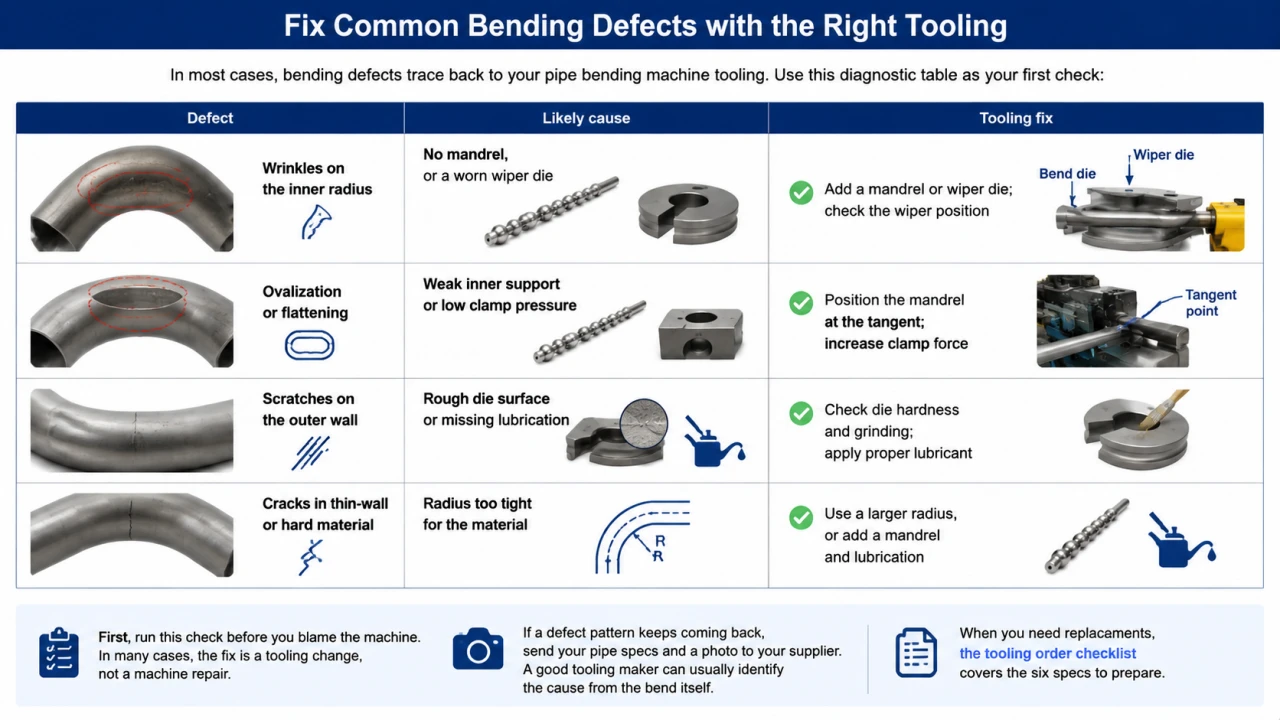
In most cases, bending defects trace back to your pipe bending machine tooling. Use this diagnostic table as your first check:
| Defect | Likely cause | Tooling fix |
|---|---|---|
| Wrinkles on the inner radius | No mandrel, or a worn wiper die | Add a mandrel or wiper die; check the wiper position |
| Ovalization or flattening | Weak inner support or low clamp pressure | Position the mandrel at the tangent; increase clamp force |
| Scratches on the outer wall | Rough die surface or missing lubrication | Check die hardness and grinding; apply proper lubricant |
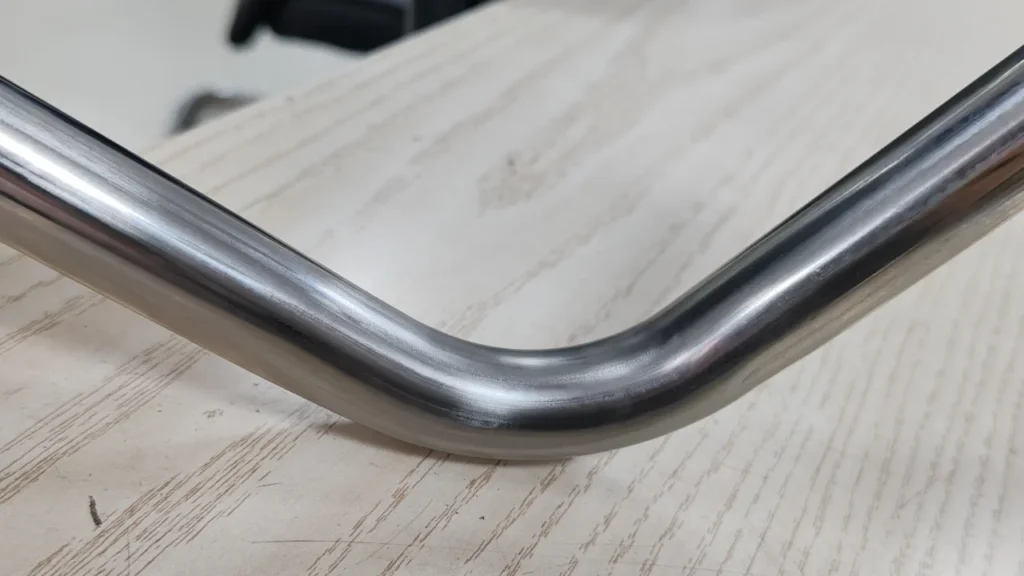
| Cracks in thin-wall or hard material | Radius too tight for the material | Use a larger radius, or add a mandrel and lubrication |
First, run this check before you blame the machine. In many cases, the fix is a tooling change, not a machine repair. If a defect pattern keeps coming back, send your pipe specs and a photo to your supplier. A good tooling maker can usually identify the cause from the bend itself. When you need replacements, the tooling order checklist covers the six specs to prepare.
Mandrel or No Mandrel? Know When You Can Skip It
The most common pipe bending machine tooling question we hear is “do I really need a mandrel?” Here is the short version.
A common industry rule: when the bend radius is at least 3 times the pipe OD and the wall is not thin, you can usually bend without a mandrel. One mandrel selection guide states the rule as R/D ≥ 3 and S/D ≥ 0.05 for coreless bending (mandrel selection guide). Another bender manufacturer puts it in similar terms: standard tooling covers pipes where R/D > 3 and wall ratio t/D > 0.04; below that, add a wiper die and a multi-segment mandrel (tube bending dies guide).
As a result, below those thresholds, the inner wall has no support, and the pipe collapses at the tangent. That is when you need a mandrel. Which type?
| Mandrel type | Best for | Limits |
|---|---|---|
| Plug mandrel | Thick-wall tubes, large radii | Limited support on tight bends |
| Ball mandrel | Thin-wall and tight-radius bends | Not for extreme precision work |
| Formed mandrel | High-precision, small-diameter tubes | Higher cost per piece |
In pipe bending machine tooling, the mandrel and the wiper die solve different problems. The mandrel supports the inside of the tube; the wiper die controls the outside. On a tight-radius thin-wall job you usually need both. For very large radii, a pipe rolling machine may be a better fit than bending tooling altogether.
How Long Does Pipe Bending Tooling Last?
Pipe bending machine tooling life depends on usage, material, and maintenance. There is no fixed calendar — the wear pattern tells you.
- Check monthly. Look for surface roughness, nicks, or a worn groove.
- Watch bend quality. If the same setup starts producing wrinkles or flats, inspect the tooling first.
- Keep lubricated. Lubrication reduces friction and slows wear on the contact surfaces.
Replace a die when its geometry no longer holds the bend quality you need. In short, running a worn die saves a little money today and costs scrap later. Store tooling dry and protected, and never drop dies on hard floors — a small nick in the groove will mark every pipe you bend afterwards.
How to Order Tooling for Your Pipe Bending Machine
Ordering custom pipe bending machine tooling is easy once you know the six parameters your supplier needs. We call it the 6-Point Tooling Order Check:
- Pipe outer diameter (OD) — include the tolerance if it matters.
- Wall thickness — thin wall changes the tooling set.
- Bend radius (CLR) — the centerline radius you need.
- Bend angle — for example 90°, 180°, or multi-bend parts.
- Pipe material — steel, stainless, aluminum, or copper.
- Machine model — so the die mount matches your machine.
With these six numbers, any pipe bending machine tooling maker can quote a set. On your CNC pipe bending machine or NC pipe bending machine, the die mount must match the machine specifications — never assume it will.
Standard versus custom pipe bending machine tooling: a new machine includes one standard die set for the pipe size you specify. Other diameters, radii, or materials are custom tooling. Typical lead time for custom dies is 7–15 days, depending on the spec and the production schedule. Ask these questions before you order: What material and hardness will the dies be? Will you provide drawings for confirmation? What is the replacement policy for a defective die?
FAQ
Q1: What tools are needed for a pipe bending machine? A standard pipe bending machine tooling set uses five tools: a bending die, a clamp die, a pressure die, and, for tight-radius or thin-wall bends, a mandrel and a wiper die. Most new machines include one standard die set. Extra radii and different materials need custom tooling.
Q2: Do I need a mandrel for pipe bending? Only when the bend is tight or the wall is thin. As a rule of thumb, if the bend radius is at least 3 times the pipe OD and the wall is not thin, you can usually bend without a mandrel. Tight radius or thin wall means the inner wall needs support, and a ball or formed mandrel is the right choice.
Q3: Why does my pipe wrinkle during bending? Wrinkles usually mean the inner wall has no support, or the wiper die is worn or misplaced. Check the wiper die position first. If the bend radius is tight or the wall is thin, add a mandrel. Wrinkles rarely come from the machine itself.
Q4: How often should I replace bending dies? There is no fixed interval. Inspect monthly for roughness, nicks, and groove wear. Replace a die when it no longer holds bend quality. Running a worn die costs more in scrap than the die costs.
Q5: Can one tooling set work for different pipe sizes? No. The bending die groove must match the pipe OD, and the radius must match your target CLR. A set built for 32 mm pipes will not bend 50 mm pipes correctly. Different sizes need matching dies.
Q6: What material are pipe bending dies made of? Pipe bending machine tooling is usually made of 45# steel for carbon steel pipes, and 42CrMo or Cr12 for stainless and hard alloys. Nylon tooling is sometimes used for aluminum. The right grade depends on the pipe material and production volume.
Q7: How long does custom tooling take to make? Typical lead time is 7–15 days, depending on the spec and the production schedule. To get started, send your OD, wall thickness, bend radius, angle, pipe material, and machine model, and you will get a delivery time with the quote.
Get the Right Tooling for Your Bending Job
Tooling is a small part of a bending line, but it decides whether your parts come out right. Match your pipe bending machine tooling to your pipe specs, choose the material that fits your tubes, and use the diagnostic table when defects appear. When you are ready to order, the six-point check makes sure nothing gets lost in translation.
We build pipe bending machines and the pipe bending machine tooling that runs on them, and we quote custom dies directly from your specs. Send us your pipe size, wall thickness, radius, and material, and we will recommend the tooling set and give you a lead time. You can also see the full product line or ask about our pipe bending machines.
If you are still comparing options, our article on CNC pipe bending machine costs in 2026 and this guide on bending exhaust pipes cover the next steps. We are happy to show you the tooling shop over a video call.